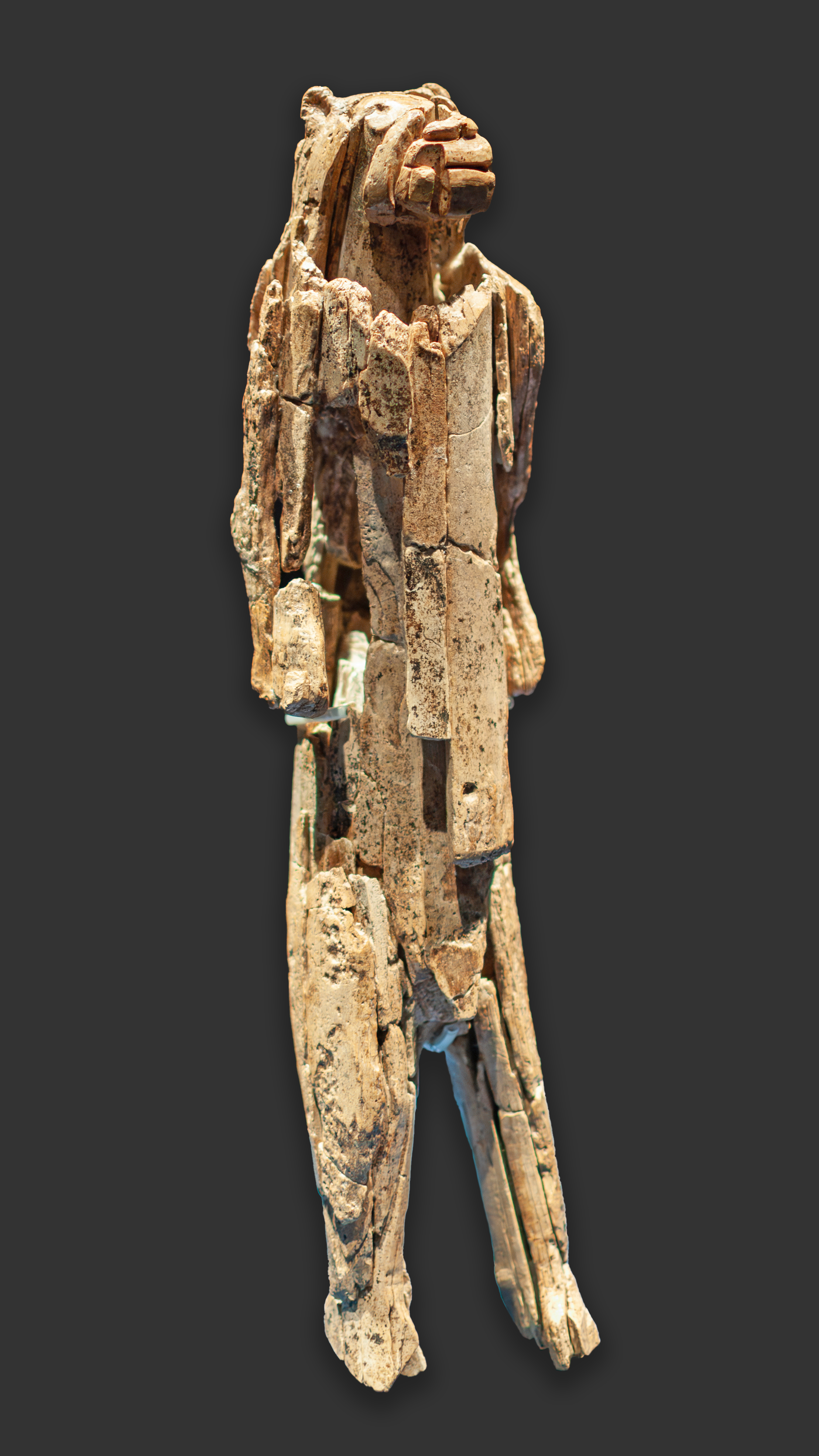
Whoever carved it combined human and animal traits. We do not know what it represented for their community.
Museum documentation · free public access, no account required.
Image 1 of 2 · Main image
CONTRIBUTED RECREATION · VISUAL INTERPRETATION
Reconstruction · Declared visual hypothesis
Recreation contributed to the project. Not an archaeological photograph nor a metric facsimile. Materials, finish, proportions, and visible details may differ from the original. The image serves as visual support; the record and its sources distinguish the documented from the interpreted.
Explore in 3D
Load the model only when you want to explore it. Drag or use the arrow keys to turn it; + and − zoom. Closing it releases its memory.
User-contributed digital reconstruction; file metadata declares Tripo. It is not an archaeological scan nor a metric replica. The display scale is indicative, not a measurement of the original; the contributed geometry is preserved intact. Interpretation of the Hohlenstein-Stadel Lion-man; does not certify the exact position of fragments, ivory detail, or material reconstruction of the original.
History and context
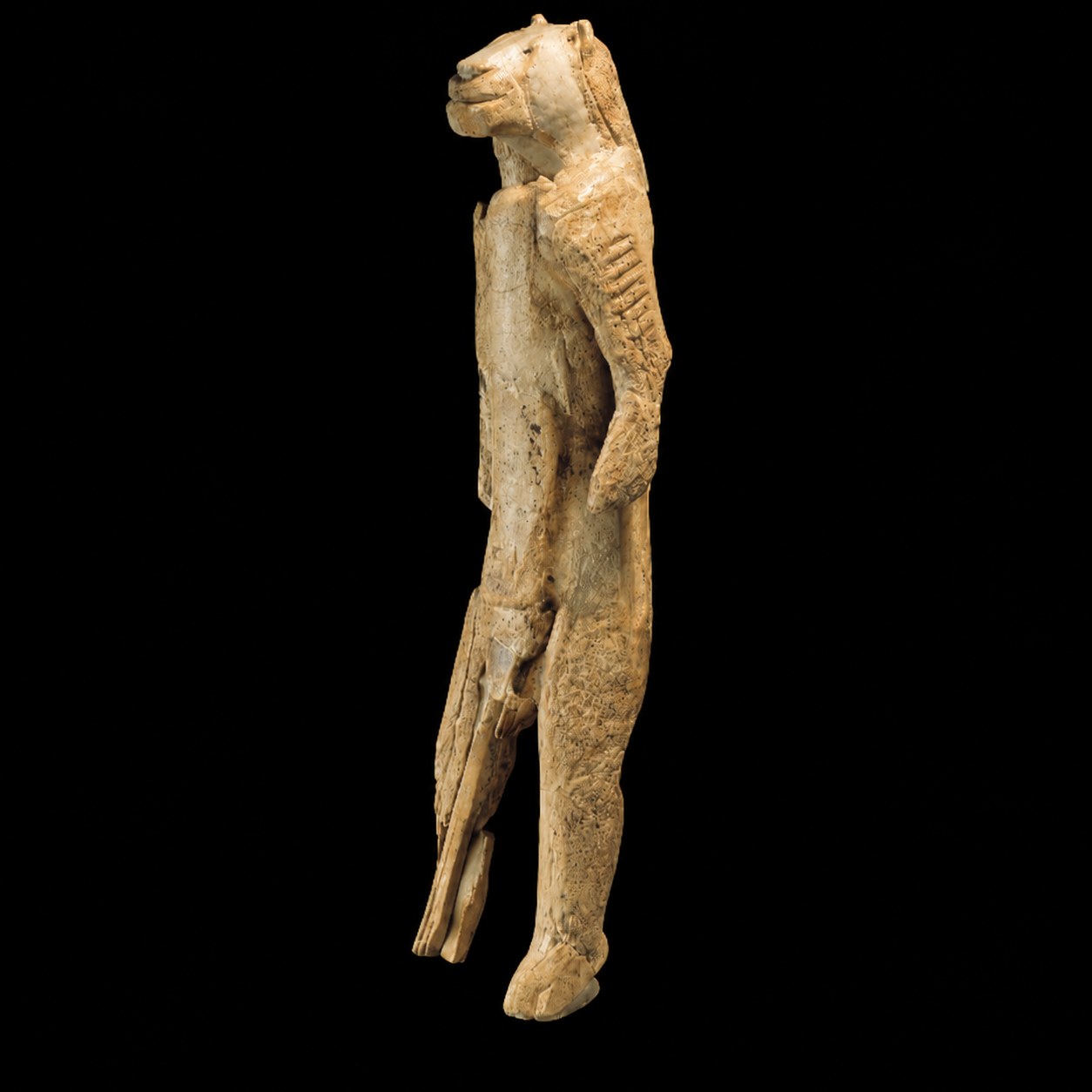
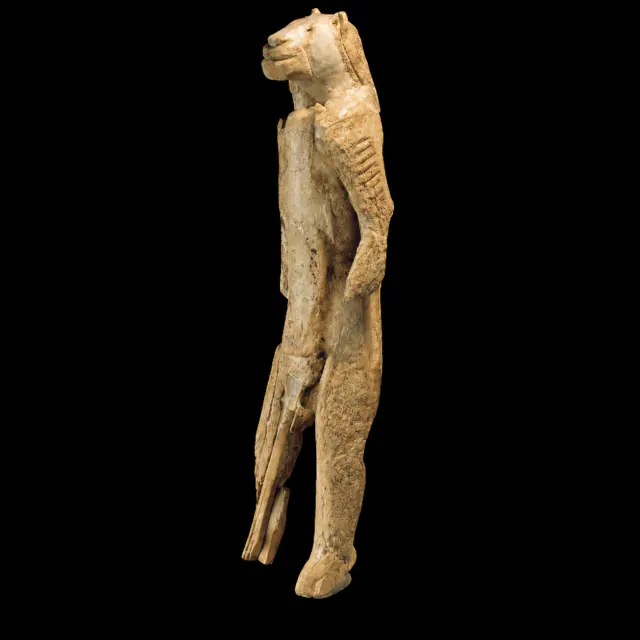
Fragments excavated at Hohlenstein-Stadel in 1939 were pieced together over decades to form a figure about 31 centimetres tall. Carving tusk ivory required working around its curve, planning the three-dimensional form and keeping in mind an image that did not simply reproduce an observed animal.
"Lion-man" or Löwenmensch describes the visible combination. Whether it was a deity, spirit, narrator, mask, or female/male figure remains open; the extraordinary effort alone does not translate its meaning.
Evidence and interpretation
The anthropomorphic form, lion features, material, context and date are documented. Identity, sex and mythology remain hypotheses. The modern reassembly is part of the object's history.
Catalogue facts
Date
≈40,000 years · Aurignacian
Location
Hohlenstein-Stadel · Swabian Jura, Germany
Material and height
Mammoth ivory · ≈31 cm
Find context
Fragments excavated in 1939
A SHARED TOPIC, DIFFERENT MOMENTS
Objects connected through time
Follow a topic across the collections. A shared tag is a way to compare objects, not proof that one culture influenced another.
The order uses the midpoint of each approximate date range; ranges can overlap. Spacing does not represent elapsed time. Swipe, scroll or use the arrows. With the sequence focused, use ← / →, Home or End.
About 4 min to read · 7 sections. Further reading and sources · free access. Editorial review recorded: .
The time invested is also part of the piece
An experimental reproduction cited by curator Jill Cook required over four hundred hours with tools similar to Palaeolithic ones. It is not a stopwatch for the original, but a way to appreciate the resistance of ivory and the labour hidden in its surface. The figure appeared in a dark inner chamber with few traces of activity compared to other inhabited sites in the region. That contrast allows a special use of the space to be proposed; it does not by itself reveal a religion or the plot of a myth.
The ivory was not a block of just any shape. The tusk had a natural cavity at one end, and the carver used it to separate the legs. By removing part of its walls they could obtain the hollow between them. The length and thickness of the tusk also conditioned the posture and the arms pressed against the body. Looking at the piece this way allows one to appreciate a concrete solution: the design adapted to the available material, rather than ignoring its form.
It is worth pausing at areas less striking than the head. The left arm bears horizontal incisions with small reliefs between them. There are also fine marks on the left ear and the sole of the foot on that side. These are details documented by the museum, not additions from an imaginary reconstruction. Their meaning remains unknown, but they show that the carver's attention was not limited to the general silhouette. A frontal photograph can hide them; lateral views and details of the original help to find them.
During the new restoration, differences between the two sides of the figure were observed. The right ear and arm are less elaborated than the left ones. The body also tapers in stages from the shoulders downwards. These irregularities are part of the object and deserve to be preserved in a faithful reproduction. They do not allow the author to be identified nor to know why the work stopped at a certain point. They do remind us that an ancient sculpture does not need to be perfectly symmetrical to show very careful work.
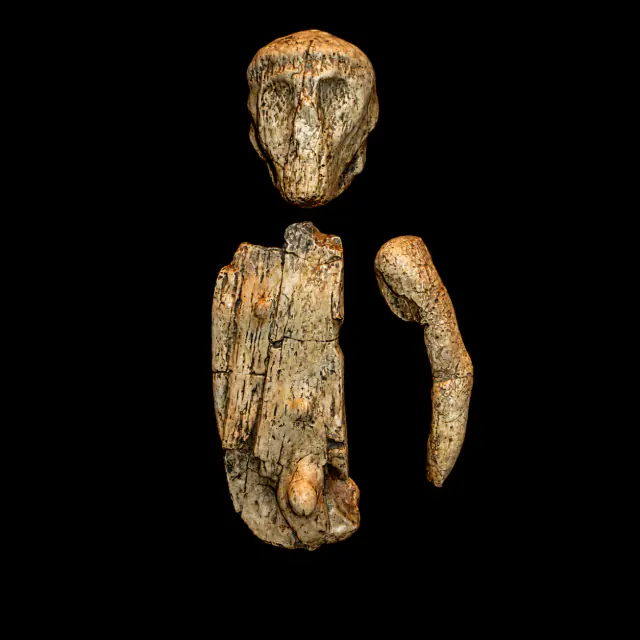
In 2009 archaeologists relocated the spot where the original fragments had appeared and recovered more pieces. The 2012 and 2013 restoration was able to incorporate them into a set of over three hundred fragments. It was not simply a matter of filling gaps so the figure looked complete: the new joins allowed details that were previously missing to be observed. That is why photographs of different mounts do not always show exactly the same appearance. The date and documentation of an image matter as much as its sharpness.
The caves of the Swabian Jura preserve much more than this sculpture. In the Ach and Lone valleys, carved animals, ornaments and flutes have been found. UNESCO protects a complex of six caves together with their surroundings, because the relationship between objects, archaeological layers and landscape also forms part of their value. Comparing the Lion-man with those pieces allows different choices to be appreciated: representing a recognisable animal, transforming the human body, or making an instrument. It does not oblige one to attribute the same function or ceremony to them.
The communities of the region lived among animals they knew through hunting and the risks of the environment. Hearth remains, tools and ornaments situate the figures in that daily life. Some sculptures represent large prey; others, birds, fish or predators. That variety prevents reducing all images to hunting instructions. The lion in this figure refers to a real animal, although its combination with human traits does not exist in nature. Recognising both aspects is more useful than inventing a name or biography for it.
Item or group in the record · Documented collection
The collection belongs to Museum Ulm. Its premises are undergoing renovation: the museum announces the temporary display of the Lion-man at kunsthalle weishaupt until 4 October 2026 and its return in January 2027. Information checked on 18 September 2026; confirm location before travelling.
The holding institution is documented; public display may change. Check its official record before visiting.

 English
 Español
 Français
 Italiano
 Deutsch
 Русский
 Português
 Polski
 Română
 Svenska
 Norsk bokmål
 Suomi
 Türkçe
 العربية
 简体中文
 한국어
 हिन्दी
 Ελληνικά
 You are viewing
 View full-size photograph ⛶
