
 English
 Español
 Français
 Italiano
 Deutsch
 Русский
 Português
 Polski
 Română
 Svenska
 Norsk bokmål
 Suomi
 Türkçe
 العربية
 简体中文
 한국어
 हिन्दी
 Ελληνικά
ORETANA NECROPOLIS · BURIAL 4
453 astragali from Alarcos
Game, chance, protection and death in the same tomb
A tomb at Alarcos contained 453 sheep or goat ankle bones, whose use is still being studied.
Museum documentation · free public access, no account required.
Generated reconstruction · Declared visual hypothesis
Declared visual reconstruction; not a photograph of the original nor documentary evidence.
History and context
The cremation tomb of a man approximately 20 to 30 years old gathered a decorated falcata, spears, shield, fibula, buckle, pottery and 453 ovicaprine astragali. The assemblage turns an everyday bone into an exceptional funerary accumulation.
The astragali could have served for playing, casting lots, practising divination, acting as amulets, becoming tokens or forming an offering. Some perforated or worked specimens show distinct biographies; quantity does not automatically equate to a single function.
Calculating minimum animals helps measure the scale of the deposit, but does not prove that all were sacrificed in a single funeral. The museum preserves this uncertainty as a central part of the story.
Evidence and interpretation
Documented fact: number of astragali, species, grave goods, cremation and published anthropological data. Interpretation and caution: «Prince of Alarcos», unique collective sacrifice and exclusive meaning of the astragali are not demonstrated.
Catalogue facts
- Narrative date
- 4th–3rd centuries BCE · necropolis chronology
- Location
- Oppidum of Alarcos, Poblete/Ciudad Real
- Material
- Bone, iron, bronze and pottery
- Context
- Aristocratic cremation tomb with warrior grave goods
- Classification
- Iberian collection or explicit interpretive resource
- Visual reference
- Tomb plan and astragalus assemblage · UCLM publication
A SHARED TOPIC, DIFFERENT MOMENTS
Objects connected through time
Follow a topic across the collections. A shared tag is a way to compare objects, not proof that one culture influenced another.
The order uses the midpoint of each approximate date range; ranges can overlap. Spacing does not represent elapsed time. Swipe, scroll or use the arrows. With the sequence focused, use ← / →, Home or End.
Bone6 dated objects
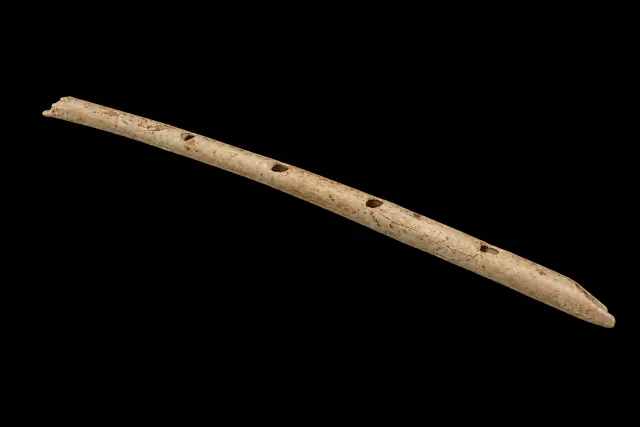
≈35,000–40,000 years
Hohle Fels flute
Prehistory
Approximate catalogue age; editorial reference 2026 for ordering only, not calibrated dating.
Read the record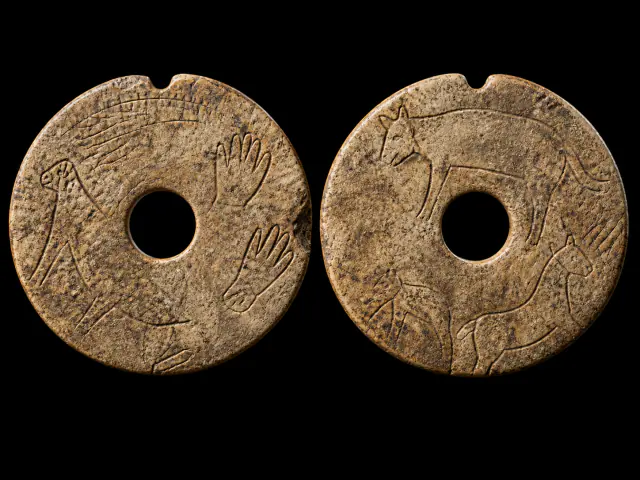
≈18,000–16,000 years
Rondelle de Mas-d'Azil
Prehistory
Approximate catalogue age; editorial reference 2026 for ordering only, not calibrated dating.
Read the record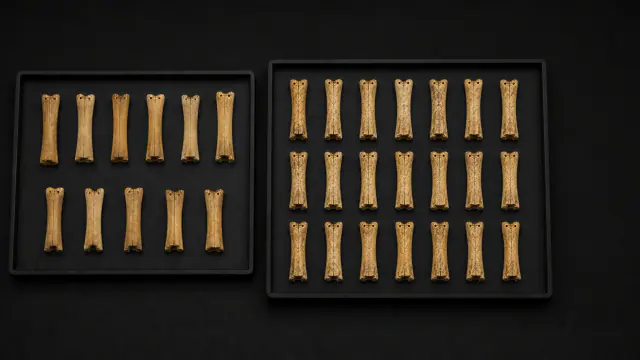
≈4000–3800 cal BCE
El Miradero spatula-idols
Prehistory
Date of the funerary assemblage.
Read the record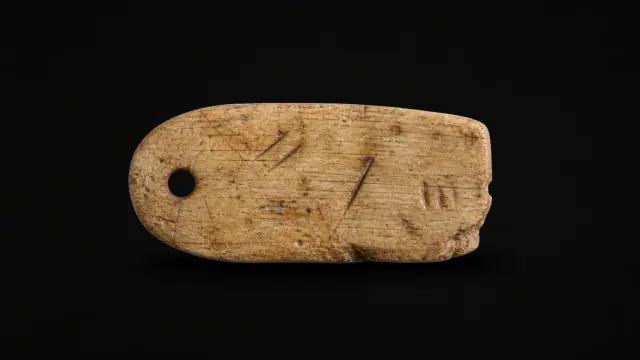
ca. 3300–3100 BCE
Naqada labels
Ancient Egypt
Date range for the assemblage of labels and inscribed materials, not a single object.
Read the record
c. 3100–2900 BCE
Ivory tablets
Ancient Egypt
Date range for the assemblage of tablets and labels.
Read the record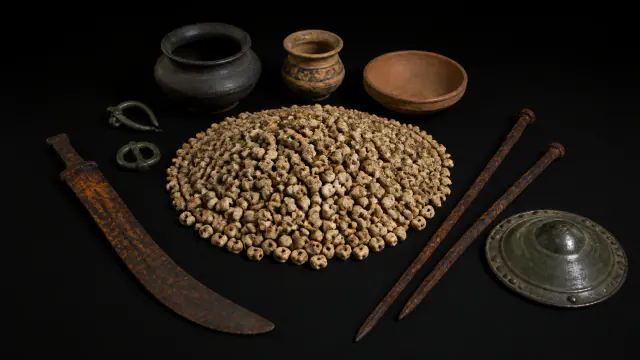 You are viewing
4th–3rd centuries BCE · necropolis chronology
453 astragali from Alarcos
Iberians
Funerary context chronology, not direct dating of each astragalus.
Current record
Also connected, without a comparable date (3)
These objects are not placed after the others: an unknown date does not mean a more recent object.
- Bone needlePrehistory · No individual dating published on this record
- Ishango, without genealogical shortcutBatwa / Twa histories · More than 20,000 years; context ca. 25,000–20,000 BP
- Oracle bonesAncient China · from ca. 1200 BCE
A closer look
About 1 min to read · 1 section. Further reading and sources · free access. Editorial review recorded: .
Two burials that must not be confused
The large assemblage of 453 astragali comes from Necropolis II of Alarcos, where these bones appear in approximately a quarter of the burials, associated with rich grave goods. A different context helps refine the comparison: tomb 36 of Necropolis III contained seven astragali with fire signs, a bone die and two smooth river stones interpreted as possible tokens. This association offers more concrete indications of play than the isolated astragali. However, it does not allow automatically transferring that function to the 453 pieces from the other burial.
Sources and references
Did you enjoy this exhibit?
Your opinion helps us improve the museum. You can change it whenever you like.
Loading your rating…