
 English
 Español
 Français
 Italiano
 Deutsch
 Русский
 Português
 Polski
 Română
 Svenska
 Norsk bokmål
 Suomi
 Türkçe
 العربية
 简体中文
 한국어
 हिन्दी
 Ελληνικά
SOUND · AURIGNACIAN
Hohle Fels flute
An instrument for making music
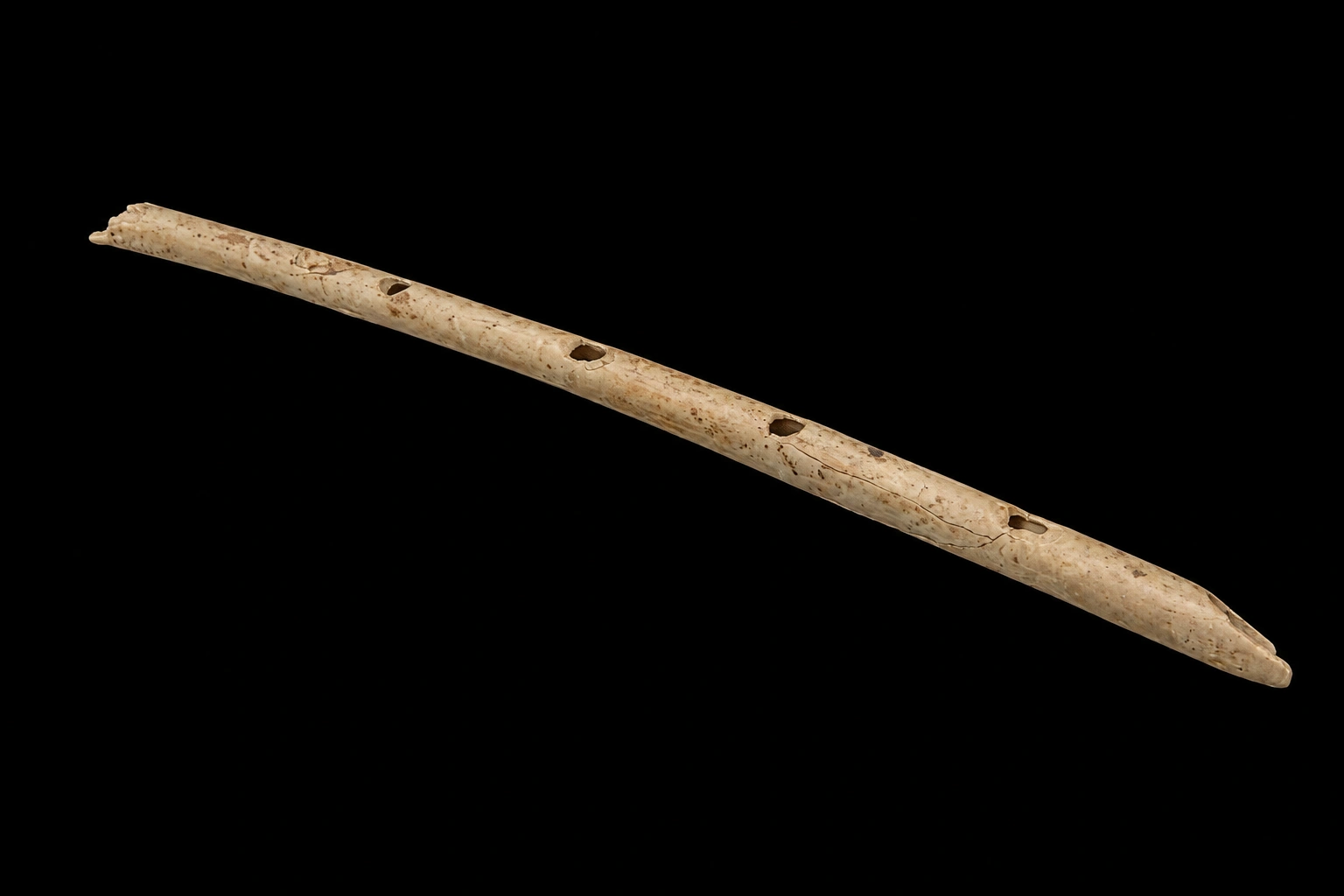
Four holes survive; a fifth is reconstructed at the broken end.
Museum documentation · free public access, no account required.
Reconstruction · Declared visual hypothesis
Tomatenpflanze / Wikimedia Commons, contrast by Sémhur, CC BY-SA 4.0. Interpretive AI edition. Found in 2008 in twelve fragments; four holes preserved, probable fifth lost at the end. The new lighting accentuates the holes; it must not be used to measure their shape or diameter. The alternative photo by Hannes Wiedmann was inspected but not sent to ImageGen: far end out of focus. It is not an archaeological photograph nor a certified restitution. Microdetails, finish and colour are interpretive approximations.
Tracekeepers / OpenAI ImageGen; source photograph: Tomatenpflanze; contrast by Sémhur · Urgeschichtliches Museum Blaubeuren (URMU) · Inventory: 1977-0119-0089-9000 · CC BY-SA 4.0
Explore in 3D
Load the model only when you want to explore it. Drag or use the arrow keys to turn it; + and − zoom. Closing it releases its memory.
User-supplied digital reconstruction; file metadata declares Tripo. It is not an archaeological scan nor a metric replica. The display scale is indicative, not a measurement of the original; the supplied geometry is preserved intact. Associated with the Hohle Fels flute by user delivery. The model’s shape, perforations and surface do not certify the measurements or conserved state of the archaeological piece.
History and context
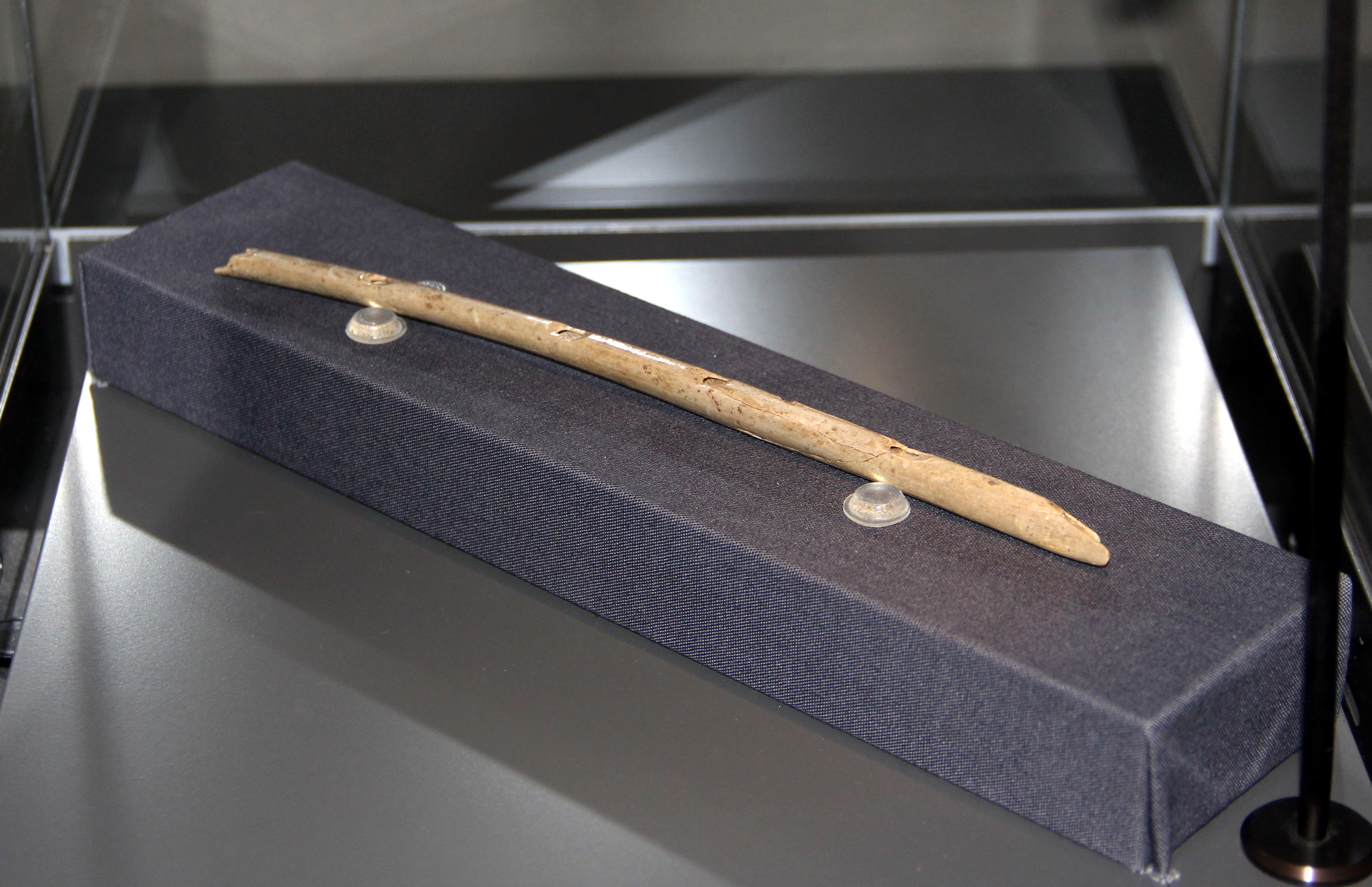
Around 40,000 years ago, someone chose the hollow radius of a griffon vulture and transformed it into a flute. Its twelve fragments appeared in 2008 just seventy centimetres from the female figurine of Hohle Fels.
The reconstructed piece measures 21.7 centimetres and preserves four holes; the broken end makes a fifth probable. Figurative art and music shared the same horizon, but neither the exact scale nor the repertoire have survived.
Evidence and interpretation
The mouthpiece, the holes and the manufacturing traces allow it to be identified as an instrument. We do not know what melodies it played or in what contexts.
Catalogue facts
- Date
- ≈35,000–40,000 years
- Location
- Hohle Fels, Germany
- Material
- Griffon vulture radius
- Measurement
- 21.7 cm · four preserved holes · probable fifth
A SHARED TOPIC, DIFFERENT MOMENTS
Objects connected through time
Follow a topic across the collections. A shared tag is a way to compare objects, not proof that one culture influenced another.
The order uses the midpoint of each approximate date range; ranges can overlap. Spacing does not represent elapsed time. Swipe, scroll or use the arrows. With the sequence focused, use ← / →, Home or End.
Bone6 dated objects
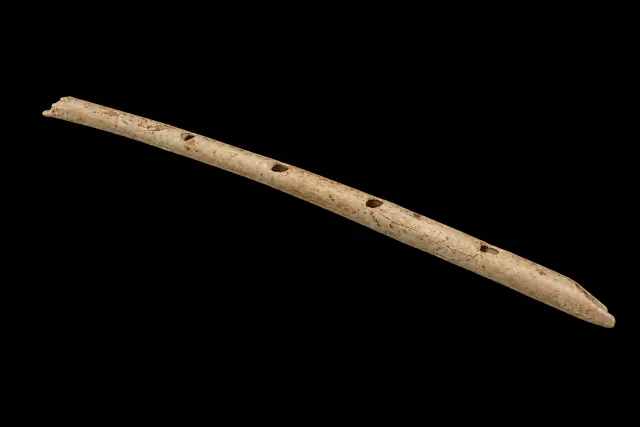 You are viewing
≈35,000–40,000 years
Hohle Fels flute
Prehistory
Approximate catalogue age; editorial reference 2026 for ordering only, not calibrated dating.
Current record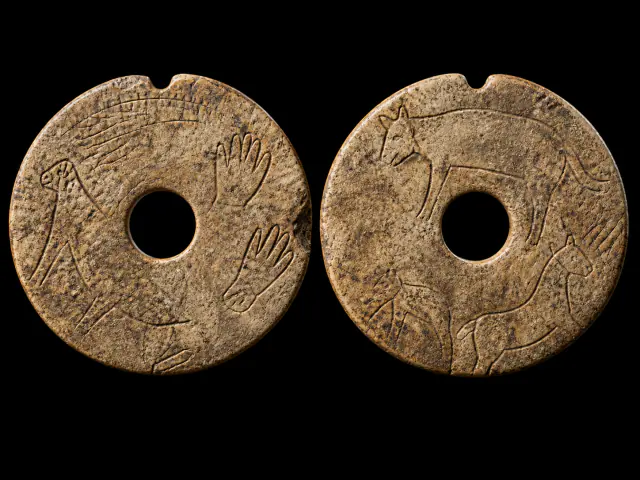
≈18,000–16,000 years
Rondelle de Mas-d'Azil
Prehistory
Approximate catalogue age; editorial reference 2026 for ordering only, not calibrated dating.
Read the record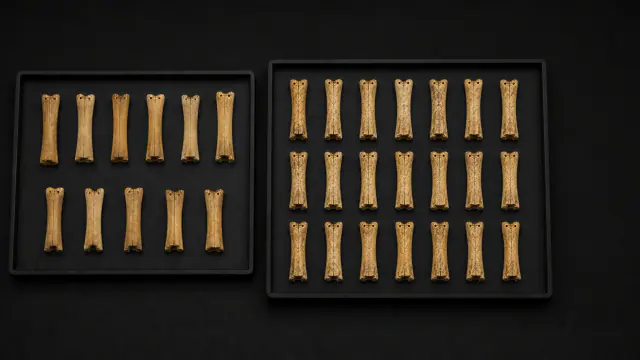
≈4000–3800 cal BCE
El Miradero spatula-idols
Prehistory
Date of the funerary assemblage.
Read the record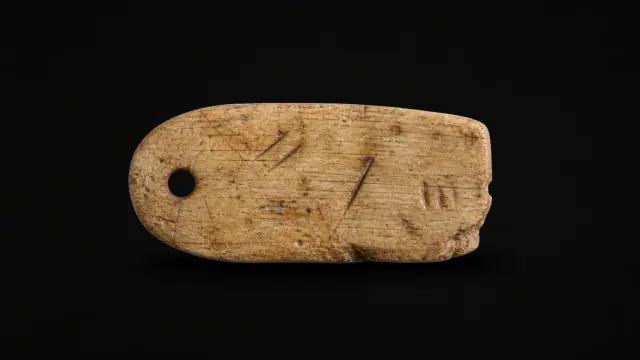
ca. 3300–3100 BCE
Naqada labels
Ancient Egypt
Date range for the assemblage of labels and inscribed materials, not a single object.
Read the record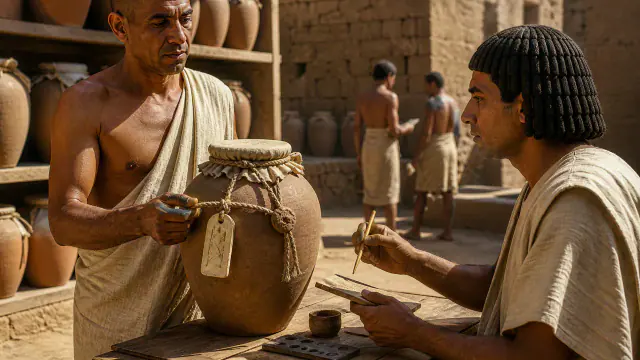
c. 3100–2900 BCE
Ivory tablets
Ancient Egypt
Date range for the assemblage of tablets and labels.
Read the record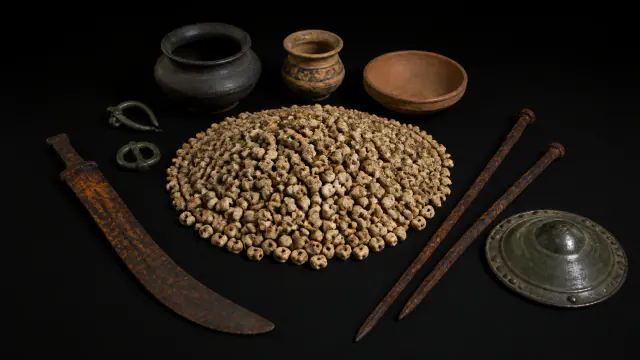
4th–3rd centuries BCE · necropolis chronology
453 astragali from Alarcos
Iberians
Funerary context chronology, not direct dating of each astragalus.
Read the record
Also connected, without a comparable date (3)
These objects are not placed after the others: an unknown date does not mean a more recent object.
- Bone needlePrehistory · No individual dating published on this record
- Ishango, without genealogical shortcutBatwa / Twa histories · More than 20,000 years; context ca. 25,000–20,000 BP
- Oracle bonesAncient China · from ca. 1200 BCE
A closer look
About 4 min to read · 7 sections. Further reading and sources · free access. Editorial review recorded: .
The edge where air becomes sound
The end of the flute preserves an oblique rebate that produces a notch: it is not merely a perforated tube. This detail guides the reconstruction of how it was blown, although the Blaubeuren museum warns that the same mechanism cannot be extended to all flutes in the region. Even the length of the bone offers a useful limit: the complete instrument cannot have been much longer. A sonic reconstruction depends on these small material constraints, not on attributing a modern melody to it.
- Museum · URMU · Gänsegeierflöte, inventory 1977-0119-0089-9000Access recorded: .
The flute was not an isolated find
Hohle Fels, Geißenklösterle and Vogelherd have yielded flutes or fragments of instruments made from bird bones and mammoth ivory. The assemblage allows us to speak of a regional musical tradition, not merely of an exceptional object that someone made once. Nor does it prove that their owners played together: they come from places and contexts that must be studied separately. Comparing them serves to recognise repeated solutions and distinct material choices. The flute in this entry stands out for its preservation within a wider history of finds.
- Museum · URMU · Musical instruments: flutes of the Swabian JuraAccess recorded: .
Making a tube when the material is solid
An ivory flute from Geißenklösterle shows a different technical problem. The ivory was solid: it did not offer the natural bore of a bird bone. To make that other instrument, two elongated halves were prepared, hollowed out inside and joined. Maintaining a regular interior and a joint that did not leak air required precision. The comparison does not attribute that procedure to the Hohle Fels flute; it helps to understand that makers could arrive at a similar form through different work depending on the material chosen.
- Museum · URMU · Elfenbeinflöte, inventory 1986-0156-9000-9000Access recorded: .
Recognising music among the fragments
The remains of the ivory flute from Geißenklösterle were not immediately identified as an instrument. A fragment was first published as decorated ivory; in 2003 Maria Malina recognised the holes and assembled thirty-one pieces. It is a useful comparison for assessing the small fragments of Hohle Fels: a broken part can appear uninformative until it fits with others. Archaeological discovery continues in the laboratory and in the store. Preserving and reviewing materials allows questions to be answered that the excavation did not resolve at first.
- Museum · URMU · Elfenbeinflöte, inventory 1986-0156-9000-9000Access recorded: .
Music shared space with other work
The Aurignacian layers of Hohle Fels contain stone tools and implements made of bone, antler and ivory, as well as ornaments and figurines. Among the animal remains appear species that were exploited as food. This combination situates the flute in communities that mastered many different tasks. We do not know the occupation of its maker nor who could play it. The context does allow us to leave behind an overly simple scene, in which surviving and creating were incompatible activities or necessarily belonged to separate groups of people.
Evidence of music, not the date it began
The study that presented the flutes in 2009 stressed that the archaeological record of music is incomplete. Finding an instrument allows us to affirm that objects for producing musical sounds were already being made; it does not allow us to date the first time someone sang, marked a rhythm or accompanied another person. That is why it is advisable to distinguish ‘preserved instrument’ from ‘beginning of music’. Even a very ancient piece constitutes minimal evidence of what existed, not a complete inventory of all forms of making music then.
Size also changes how it is played
Another useful comparison is the swan bone flute from Geißenklösterle. The museum explains that its narrow bore makes it more difficult to sound than one of larger diameter, and that its small length favours a high register. Not all bones therefore provided equivalent instruments. Their shape influenced the maker’s work and the player’s effort. Natural differences between bones and the missing parts also limit sonic reconstruction: a replica can explore possibilities, but does not guarantee recovering exactly the sounds of the original.
- Museum · URMU · Schwanenflöte, inventory LMW Gk 24-197Access recorded: .
Reference images and provenance
 View full-size photograph ⛶
Found in 2008 in twelve fragments; four holes preserved, probable fifth lost at the end.
Documentary original · Exact correspondence
Tomatenpflanze; contrast by Sémhur · Urgeschichtliches Museum Blaubeuren (URMU) · Inventory: 1977-0119-0089-9000

Location and territory
LOCATED SITE
Hohle Fels Cave · GermanyArchaeological site marker.Where it is held
Museum für Urgeschichte und Eiszeitkunst (URMU)
Item or group in the record · Documented collection
Inventory 1977-0119-0089-9000; advisable to check current display before visiting.
Museum für Urgeschichte und Eiszeitkunst · URMU
Item or group in the record · Documented collection
Exact entry for the original; the general instrument page does not unequivocally identify which are currently on display.
The holding institution is documented; public display may change. Check its official record before visiting.
Sources and references
- URMU · Gänsegeierflöte, inventory 1977-0119-0089-9000
- URMU · Musical instruments: flutes of the Swabian Jura
- URMU · Elfenbeinflöte, inventory 1986-0156-9000-9000
- University of Tübingen · Hohle Fels: Aurignacian excavations and materials
- Conard, Malina and Münzel · New flutes document the earliest musical tradition in southwestern Germany, Nature (2009), abstract on PubMed
- URMU · Schwanenflöte, inventory LMW Gk 24-197
Did you enjoy this exhibit?
Your opinion helps us improve the museum. You can change it whenever you like.
Loading your rating…