
 English
 Español
 Français
 Italiano
 Deutsch
 Русский
 Português
 Polski
 Română
 Svenska
 Norsk bokmål
 Suomi
 Türkçe
 العربية
 简体中文
 한국어
 हिन्दी
 Ελληνικά
MIDDLE MAGDALENIAN · ≈18,000–16,000 YEARS
Rondelle de Mas-d'Azil
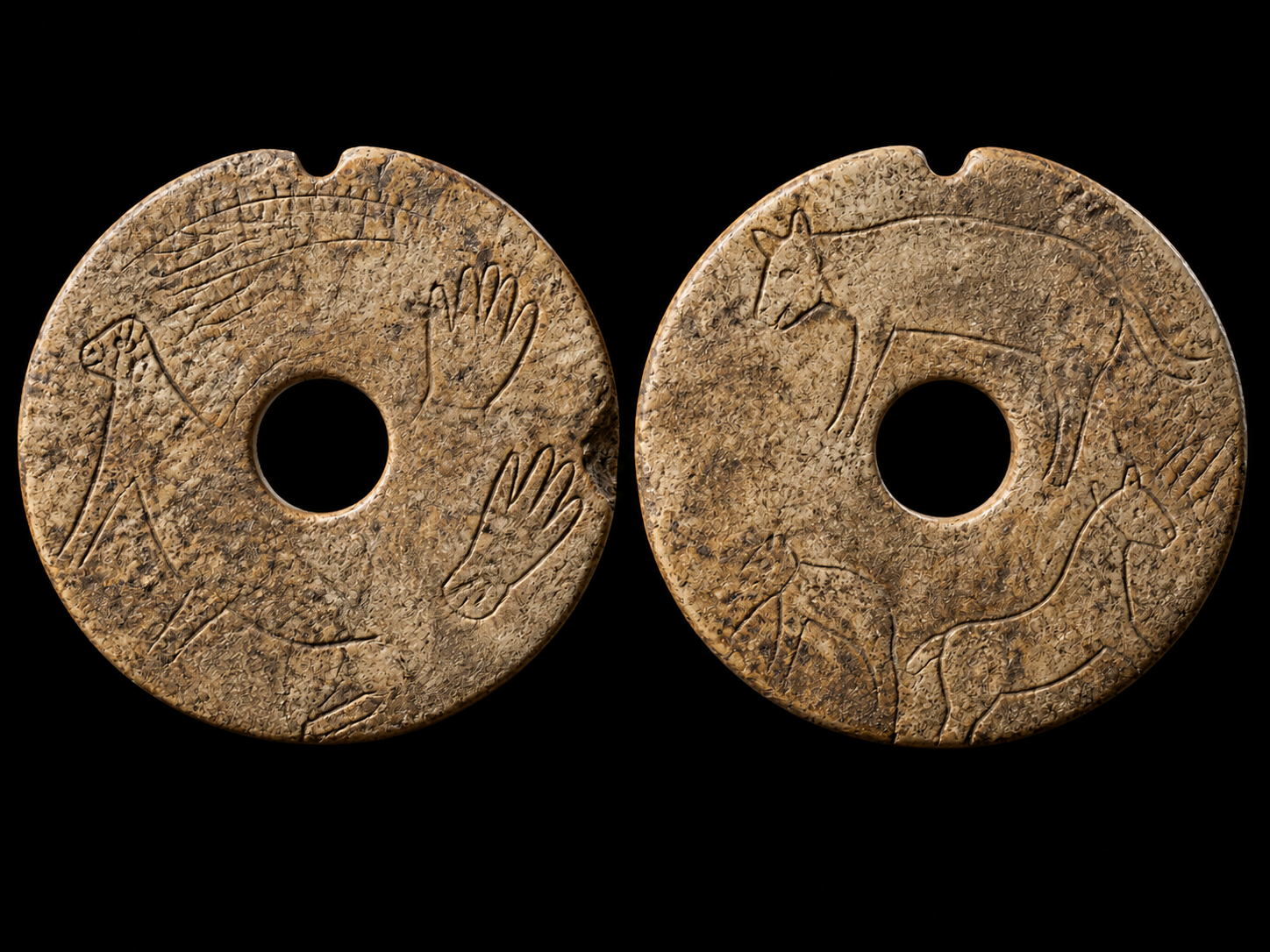
Two humans, two bear paws and a horse in seven centimetres
A small engraved disc shows people and animals, but we do not know what it was used for.
Museum documentation · free public access, no account required.
Reconstruction · Declared visual hypothesis
Recreation supplied to the project. Not an archaeological photograph nor a metric facsimile. Materials, finish, proportions and visible details may differ from the original. Enlarged faces belong to this same recreation. They do not certify the hole size nor the exact tracing of the original motifs.
Explore in 3D
Load the model only when you want to explore it. Drag or use the arrow keys to turn it; + and − zoom. Closing it releases its memory.
Digital reconstruction supplied by the user; file metadata declares Tripo. Not an archaeological scan nor a metric replica. Display scale indicative, not a measurement of the original; supplied geometry preserved intact. Interpretation of the Mas-d'Azil rondelle. Its two sides, thickness and motifs are not presented as metric record nor as proof of a concrete function.
History and context
Piece MAN 48120 was cut from a scapula and today measures 7.8 centimetres. The inventory describes two humans, two bear paws and a horse: a fragmentary composition that forces one to examine both sides and the edge losses.
Amulet, token, spinning element, musical toy or spindle whorl are mutually incompatible proposals. None should obscure the main datum: image, support and breakage survived; the associated action did not.
Evidence and interpretation
Iconography, material, measurements, Piette's excavations and chronology are documented. Function and narrative are unknown.
Catalogue facts
- Date
- ≈18,000–16,000 years
- Location
- Mas-d'Azil · Ariège, France
- Inventory
- MAN 48120
- Material and measurement
- Bone/scapula · 7.8 × 3.7 × 0.2 cm
A SHARED TOPIC, DIFFERENT MOMENTS
Objects connected through time
Follow a topic across the collections. A shared tag is a way to compare objects, not proof that one culture influenced another.
The order uses the midpoint of each approximate date range; ranges can overlap. Spacing does not represent elapsed time. Swipe, scroll or use the arrows. With the sequence focused, use ← / →, Home or End.
Bone6 dated objects
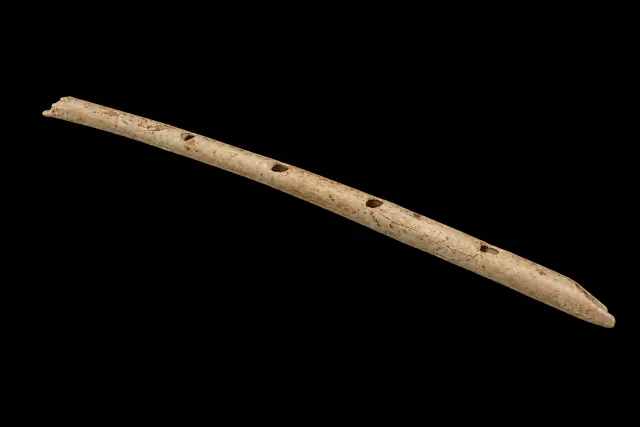
≈35,000–40,000 years
Hohle Fels flute
Prehistory
Approximate catalogue age; editorial reference 2026 for ordering only, not calibrated dating.
Read the record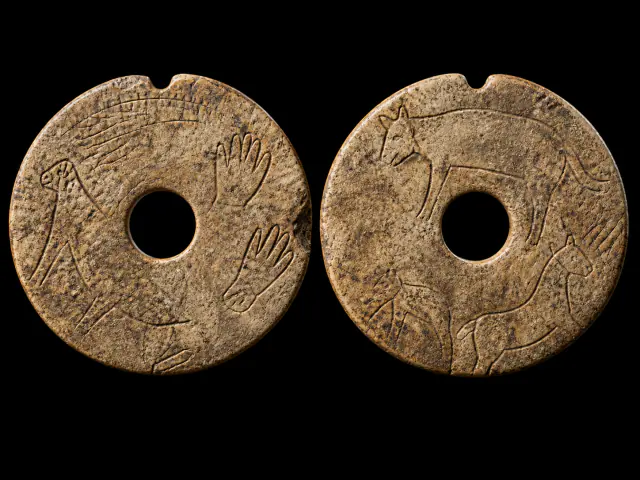 You are viewing
≈18,000–16,000 years
Rondelle de Mas-d'Azil
Prehistory
Approximate catalogue age; editorial reference 2026 for ordering only, not calibrated dating.
Current record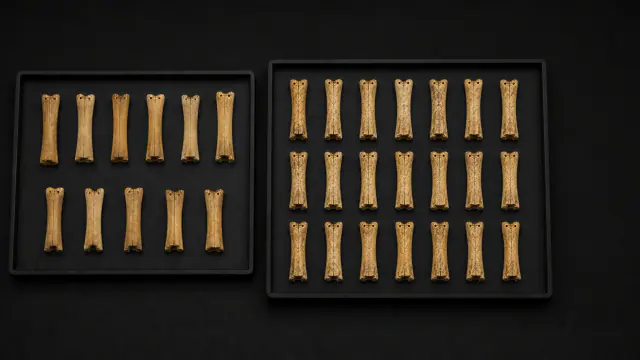
≈4000–3800 cal BCE
El Miradero spatula-idols
Prehistory
Date of the funerary assemblage.
Read the record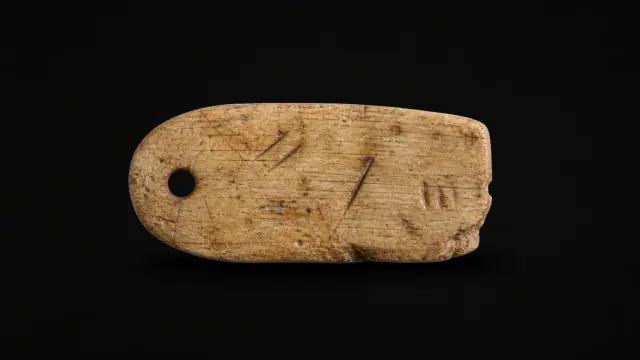
ca. 3300–3100 BCE
Naqada labels
Ancient Egypt
Date range for the assemblage of labels and inscribed materials, not a single object.
Read the record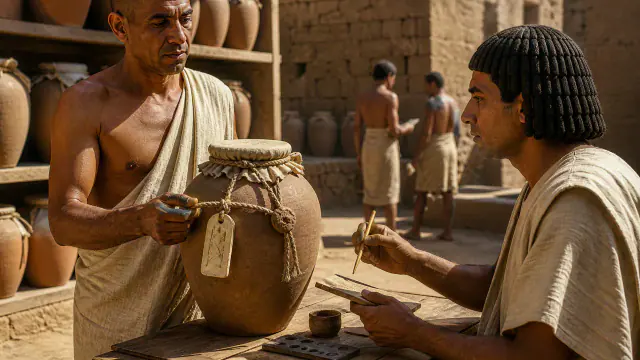
c. 3100–2900 BCE
Ivory tablets
Ancient Egypt
Date range for the assemblage of tablets and labels.
Read the record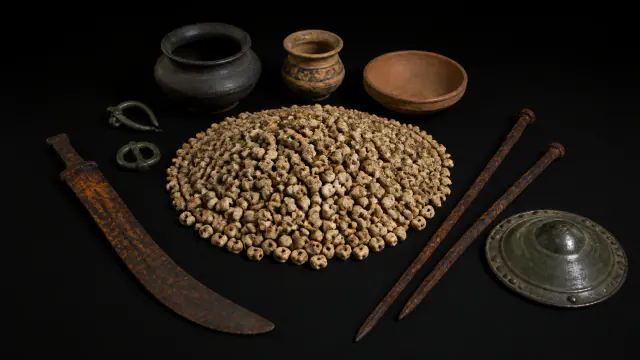
4th–3rd centuries BCE · necropolis chronology
453 astragali from Alarcos
Iberians
Funerary context chronology, not direct dating of each astragalus.
Read the record
Also connected, without a comparable date (3)
These objects are not placed after the others: an unknown date does not mean a more recent object.
- Bone needlePrehistory · No individual dating published on this record
- Ishango, without genealogical shortcutBatwa / Twa histories · More than 20,000 years; context ca. 25,000–20,000 BP
- Oracle bonesAncient China · from ca. 1200 BCE
A closer look
About 3 min to read · 7 sections. Further reading and sources · free access. Editorial review recorded: .
A paw could represent an entire presence
The Musée d'Archéologie nationale catalogue compares this fragment with other bear representations: a plaque from La Madeleine brings together paws and a salmon, while a perforated baton from Massat shows a head. Not all animals had to appear complete. That selection of parts broadens the way of looking at the rondelle: what was engraved matters, but also what may have been lost with the edge. The catalogue interprets some compositions as attacks; they are readings of fragmentary images, not preserved narratives from their authors.
An image needs its inventory number
Several pieces from Mas-d'Azil circulate on the internet with the same name. The one in this record is fragment MAN 48120, not the complete disc known as the cow and calf rondelle. That second object was found in the Péquart excavations, decades after Piette's. Moreover, the museum distinguishes on its faces an adult aurochs and a bison calf: the traditional name does not replace the study of the animals represented either.
Thickness also matters
It is worth looking at this piece from the edge, not just approaching the engravings. The original is a very thin sheet of shoulder blade: barely two millimetres thick. That changes our impression of an object which, enlarged on screen, may look like a thick, heavy medal. The lines on both faces were made on that delicate support. In this record, the documentary photograph allows one to check what part survives; a recreation must not silently complete the missing strokes.
It could be made without a pair of compasses
How do you obtain a disc from a flat bone? An experimental study published in EXARC compared different ways of cutting rondelles. Marks produced by freehand work resembled certain archaeological remains more closely than those obtained with a compass. The conclusion is not that all were made the same way, but that a fairly regular shape does not require supposing an instrument that has not been found. Discarded cut-offs help reconstruct the work as much as the finished piece.
Spinning it does not resolve its use
The same study tested different functions, including image spinning and use as a spindle whorl. That a replica works in one way demonstrates a possibility, not what its prehistoric owner did. To advance, the wear from tests must be compared with traces on the original. That is why an animation of alternating images is useful as a visual experiment, but does not justify presenting this rondelle as the first cartoon.
The fragments that tell how they were made
At Las Caldas, Asturias, roughed-out discs preserved in different manufacturing phases have been studied. Some show the bone cutting; others, the perforation or a still incomplete decoration. Seen together they allow us to follow decisions that a finished piece no longer reveals so clearly. Comparison with specimens from the Pyrenean area helps study shared techniques and changes throughout the Magdalenian. It does not imply that this specific fragment travelled between those caves.
Why the Piette collection matters
Édouard Piette gathered numerous objects from Pyrenean caves and donated his collection to the museum in 1904. He requested that its organisation and a dedicated gallery be preserved. The historic display is therefore part of the history of these pieces: it shows how prehistoric art was classified at that time. Today we can appreciate that collection and review its interpretations at the same time. Preserving an old display case does not oblige us to keep all the explanations that accompanied it intact.
- Museum · Musée d’Archéologie nationale — The Édouard Piette collectionAccess recorded: .
Location and territory
LOCATED SITE
Grotte du Mas-d'Azil · FranceMarker of the cave and its site museum.Where it is held
The holding institution is documented; public display may change. Check its official record before visiting.
Sources and references
- Musée d'Archéologie nationale · Piette archive
- Musée d’Archéologie nationale — L’ours dans l’art préhistorique, catalogue entry MAN 48120
- Musée d’Archéologie nationale — La rondelle à la vache et au veau
- Needham et al. — Spinning in Circles: production and function of rondelles (EXARC, 2019)
- Corchón Rodríguez and Rivero Vilá — Rodetes de Las Caldas, Zephyrvs 61
- Musée d’Archéologie nationale — The Édouard Piette collection
Did you enjoy this exhibit?
Your opinion helps us improve the museum. You can change it whenever you like.
Loading your rating…