
 English
 Español
 Français
 Italiano
 Deutsch
 Русский
 Português
 Polski
 Română
 Svenska
 Norsk bokmål
 Suomi
 Türkçe
 العربية
 简体中文
 한국어
 हिन्दी
 Ελληνικά
TREASURES · SEWING · TYPOLOGICAL RECONSTRUCTION
Bone needle
A needle for sewing and repairing
Its point pierces the material and the eye allows the thread to pass through. Needles are better preserved than many garments.
Museum documentation · free public access, no account required.
Generated reconstruction · Declared visual hypothesis
Rendered view of the GLB model provided for Tracekeepers. Reconstruction generated with Tripo; not a photograph of an original nor an archaeological scan. See the entry's cautions.
Model contributed to the Tracekeepers project
Explore in 3D
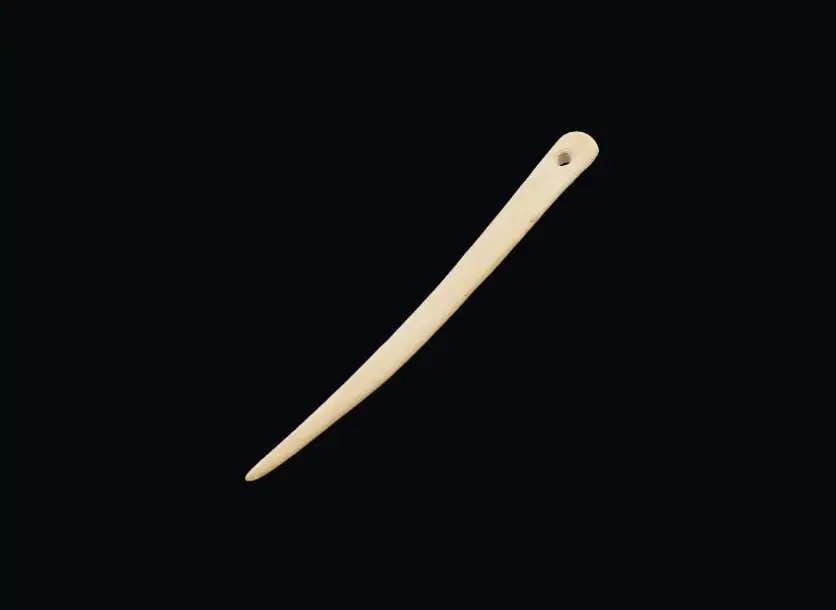
Load the model only when you want to explore it. Drag or use the arrow keys to turn it; + and − zoom. Closing it releases its memory.
Digital reconstruction provided by the project and generated with Tripo. It is not an archaeological scan or a metric replica; the scale in the gallery is adapted to the exhibition. Example of a needle with an eye: without a reference inventory or measurements, it is not attributed to an individual archaeological piece.
History and context
Bone needles preserved from the Upper Palaeolithic show that sewing has a history far older than metal. A complete Magdalenian needle was found in the Courbet Cave, France, which is now held by the British Museum.
The model received illustrates this type of tool. We do not present it as an exact copy of the Courbet needle nor as a confirmed find at Çakmaktepe: attributing an object requires provenance, measurements and a specific reference.
Evidence and interpretation
Reference object 1864,1226.813 is published by the British Museum. The utility of needles and awls in garment making is documented; the garment, the thread and the person who used each specimen can rarely be known.
The general design has archaeological parallels; no specific bone material, author, site or exact date is identified for the GLB.
Catalogue facts
- Type
- Bone needle with eye · didactic reconstruction
- Archaeological comparison
- Courbet · Magdalenian, Upper Palaeolithic
- Reference inventory
- British Museum · 1864,1226.813
- Measurement of the reference original
- 54.8 mm in length; no certified scale of the GLB
- Provenance of the GLB
- File provided to the project, without associated archaeological inventory
A SHARED TOPIC, DIFFERENT MOMENTS
Objects connected through time
Follow a topic across the collections. A shared tag is a way to compare objects, not proof that one culture influenced another.
The order uses the midpoint of each approximate date range; ranges can overlap. Spacing does not represent elapsed time. Swipe, scroll or use the arrows. With the sequence focused, use ← / →, Home or End.
THE CURRENT OBJECT
Its date is not sufficiently established to place it on the timeline. We keep it here, separate from the dated objects.
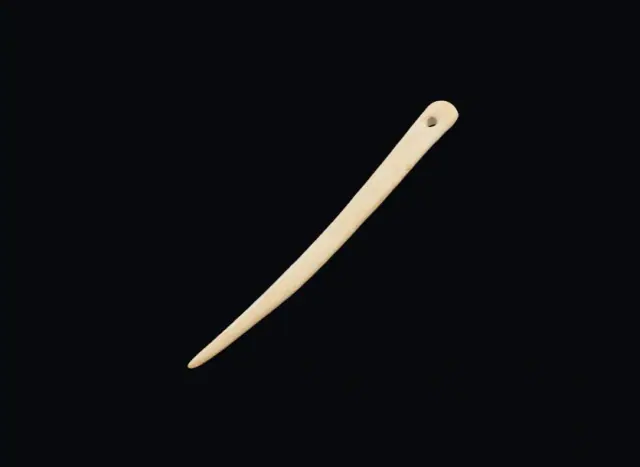 You are viewing
No individual dating published on this record
Bone needle
Prehistory
Magdalenian comparison, no numerical date for the depicted piece.
Current recordBone6 dated objects
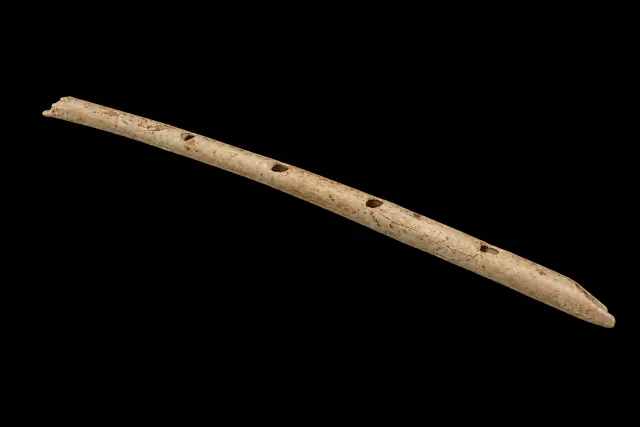
≈35,000–40,000 years
Hohle Fels flute
Prehistory
Approximate catalogue age; editorial reference 2026 for ordering only, not calibrated dating.
Read the record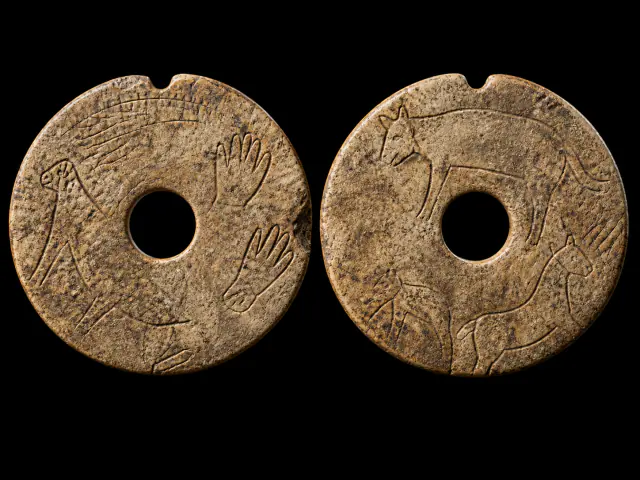
≈18,000–16,000 years
Rondelle de Mas-d'Azil
Prehistory
Approximate catalogue age; editorial reference 2026 for ordering only, not calibrated dating.
Read the record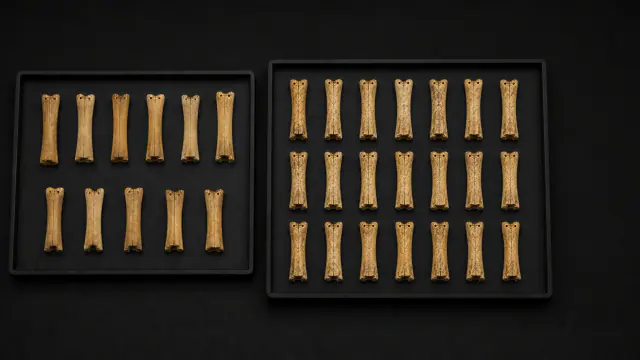
≈4000–3800 cal BCE
El Miradero spatula-idols
Prehistory
Date of the funerary assemblage.
Read the record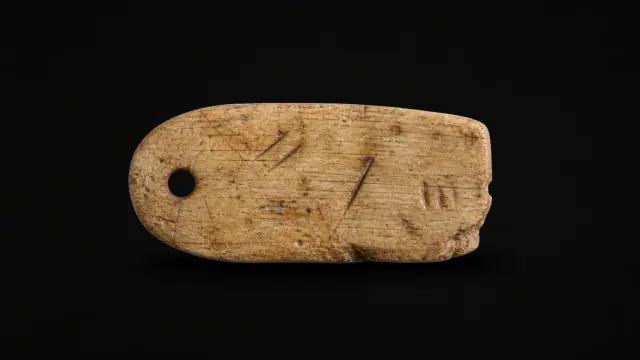
ca. 3300–3100 BCE
Naqada labels
Ancient Egypt
Date range for the assemblage of labels and inscribed materials, not a single object.
Read the record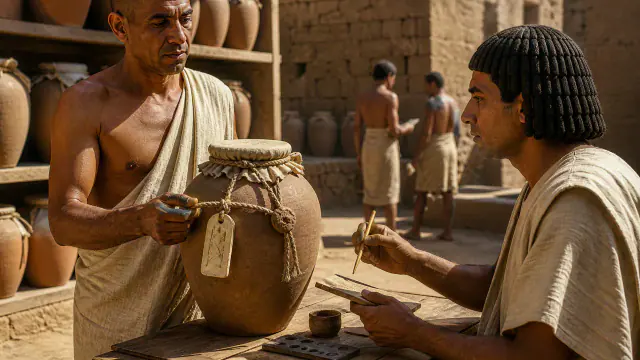
c. 3100–2900 BCE
Ivory tablets
Ancient Egypt
Date range for the assemblage of tablets and labels.
Read the record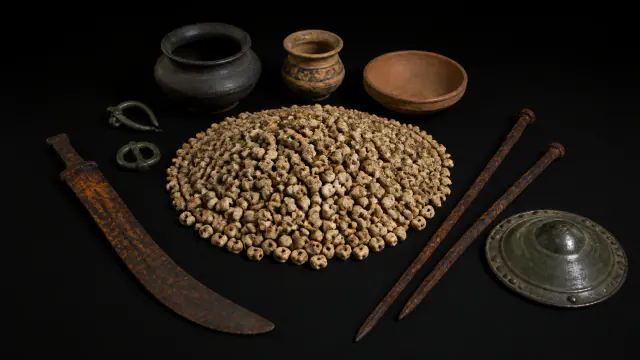
4th–3rd centuries BCE · necropolis chronology
453 astragali from Alarcos
Iberians
Funerary context chronology, not direct dating of each astragalus.
Read the record
Also connected, without a comparable date (2)
These objects are not placed after the others: an unknown date does not mean a more recent object.
- Ishango, without genealogical shortcutBatwa / Twa histories · More than 20,000 years; context ca. 25,000–20,000 BP
- Oracle bonesAncient China · from ca. 1200 BCE
A closer look
About 4 min to read · 9 sections. Further reading and sources · free access. Editorial review recorded: .
What the reference specimen preserves
The British Museum catalogue describes the Courbet needle as complete, with a cylindrical eye and polished surfaces that erased the marks of manufacture. It is a small object, 54.8 millimetres long. The institution allows its record to be consulted even though it indicates that it is not on display; digital access does not imply presence in a physical display case.
- Museum · British Museum — Courbet Needle, 1864,1226.813Access recorded: .
The needle and the awl do not do the same thing
An awl opens a hole; a needle with an eye can guide the thread. The Smithsonian presents both tools within the history of garment making. This difference helps to understand why the finish mattered: a rough tool could make it difficult to pass through the material.
- Museum · Smithsonian Human Origins · garment makingAccess recorded: .
Clothes disappear before the tools do
Archaeological preservation is uneven. A needle may survive when the garment, the seam and its contents have already been lost. Therefore, we speak of possibilities of making and repairing, but we do not assume a complete outfit, a gender-based division of labour, or the identity of the person who sewed.
A surprisingly light tool
The British Museum catalogue records a weight of 0.30 grams and a maximum width of 2.7 millimetres for the Courbet needle. These are measurements that an enlarged image makes easy to forget. The skill required to handle something like this cannot be judged by its size on the screen. Nor should the digital recreation in this record be measured as if it were a metric reproduction of the original: here it serves to explain a type of tool, not to replace its documentation.
- Museum · British Museum — Courbet Needle, 1864,1226.813Access recorded: .
Clothes did not start with the eye of the needle
The appearance of perforated needles does not mark the birth of clothing. It was possible to join materials by preparing holes with other tools and then passing a ligature through them. The review by Gilligan and colleagues places eyed needles within a longer history: they facilitated fine work and more varied forms of sewing. What was new was not necessarily covering the body for the first time, but having another way of making, adjusting and adorning what was already worn.
Not all needles served equally
A study by d’Errico and colleagues gathered data from hundreds of contexts in Eurasia and North America. Differences in length, thickness and shape suggest diverse tasks, not a single universal model. A thick seam and the attachment of a small ornament pose different demands. This approach allows us to ask what work each specimen solved without automatically attributing it to a specific garment. The preserved needle is a clue to the activity, not a complete pattern of the garment it helped to make.
Unfinished pieces reveal the process
The same research pays attention to manufacturing remains. In Shuidonggou, China, unfinished needles and discarded fragments allowed different work sequences to be distinguished. This is valuable because a highly polished specimen may have lost much of the evidence of its making. Failed or abandoned pieces are not second-class finds: they help to reconstruct the artisan's decisions. This result corresponds to the Chinese assemblage; it is not transferred to the French Courbet needle without evidence.
Sewing could also serve to display something
The review published in Science Advances proposes that fine sewing facilitated transferring part of personal adornment to clothing. Beads or other elements could be attached to a garment, instead of being worn only on the skin. This is an explanation that relates technique and social life, not proof that this needle sewed a ceremonial outfit. It invites us to think of clothing as protection and also as something that people could care for, decorate and present to others.
Small items may be missing from an excavation
A National Park Service text on Katmai needles reminds us that these objects, especially when broken, can go unnoticed during excavation. The recovery of tiny pieces depends partly on how sediment is processed and the time spent reviewing it. Therefore, finding few needles does not automatically equate to little sewing. It is a methodological caution drawn from another place and time, useful for interpreting the record without turning its absences into certainties.
Where it is held
British Museum
Reference material evidence · Documented collection
Holds the Courbet specimen used for comparison, not the provided model. The museum record indicates that the original is not on display.
The British Museum
Item or group in the record · Documented collection
The holding institution is documented; public display may change. Check its official record before visiting.
Sources and references
- British Museum — Courbet Needle, 1864,1226.813
- Smithsonian Human Origins · garment making
- Kathryn Myers, National Park Service — What Does a Bone Needle Say? (2014)
- Gilligan et al. — Paleolithic eyed needles and the evolution of dress (Science Advances, 2024)
- d’Errico et al. — The origin and evolution of sewing technologies in Eurasia and North America (Journal of Human Evolution, 2018)
Did you enjoy this exhibit?
Your opinion helps us improve the museum. You can change it whenever you like.
Loading your rating…