GOLDEN SILVER · TRACO-GETA GOLDWORK
Poroina Mare Rhyton The Poroina Mare rhyton
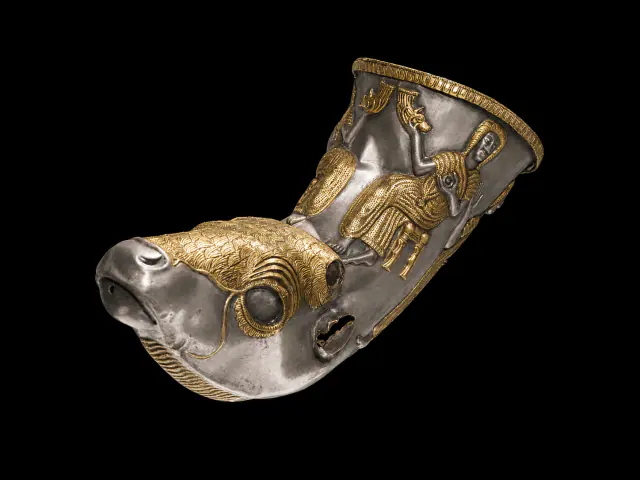
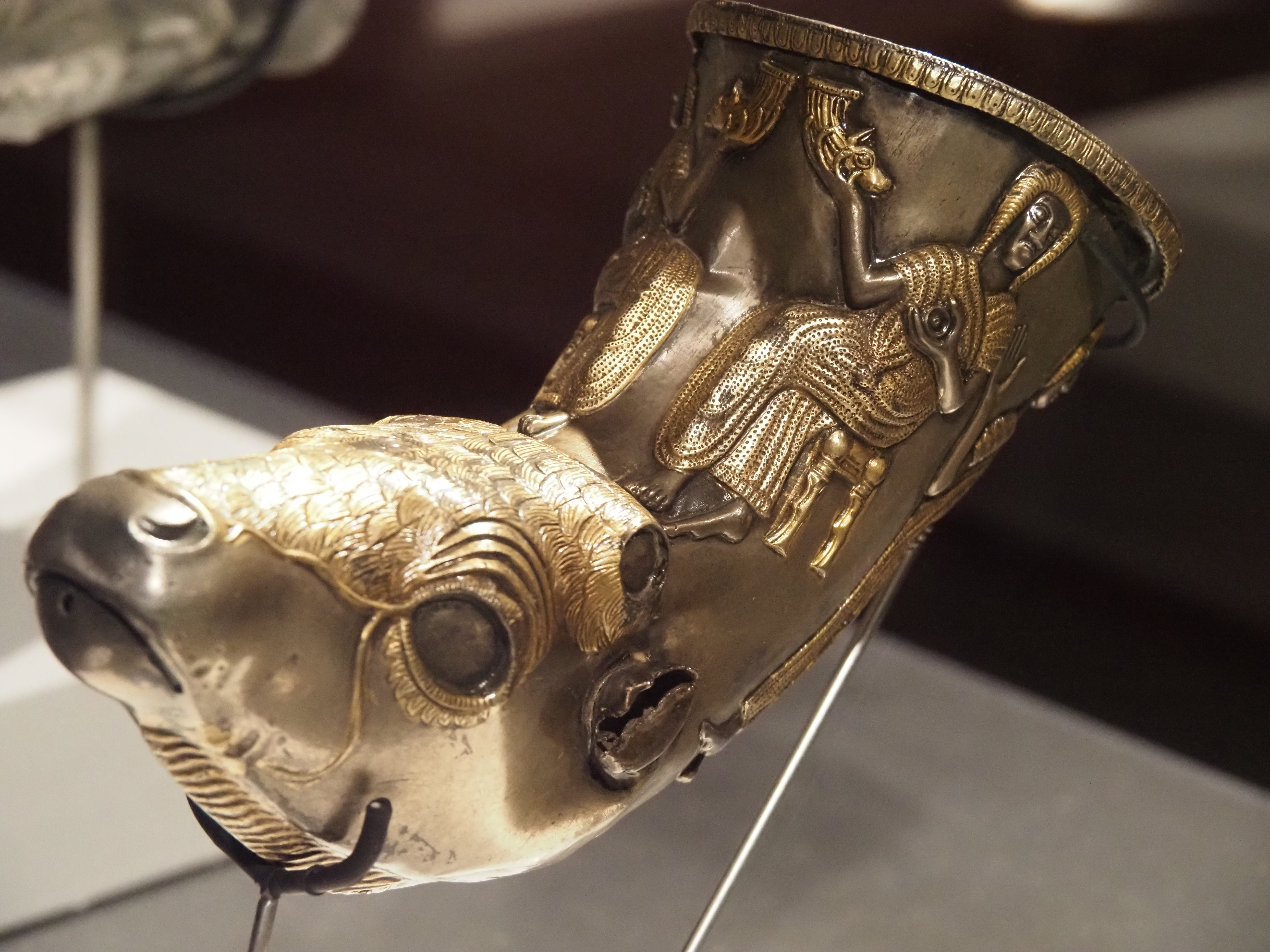
This partially gilded silver container ends in an animal head and carries four female figures.
ON THIS PAGE
History and context Evidence and facts Objects connected through time Further reading Reference images Location and territory Where it is held Sources and references Comments Museum documentation · free public access, no account required.
⛶ Enlarge image← Previous Image 1 of 2 · Main image Next →
Main image 2 RECONSTRUCTION FROM THE ORIGINAL · IA · CC0 1.0 Universal Reconstruction · Declared visual hypothesis
Newly finished interpretive visual reconstruction, derived from photography of the MNIR original, with documented boundaries and losses. It is not an archaeological photograph nor a certified restitution. Micro details, finish and color are interpretive approximations.
Tracekeepers/OpenAI ImageGen; photo source: Laci3 · Muzeul Național de Istorie a României, Bucharest · Inventory: 11335 · CC0 1.0 Universal
View full image: RECONSTRUCTION FROM THE ORIGINAL · IA · CC0 1.0 Universal RECONSTRUCTION FROM THE ORIGINAL · IA · CC0 1.0 Universal Reconstruction · Declared visual hypothesis
Newly finished interpretive visual reconstruction, derived from photography of the MNIR original, with documented boundaries and losses. It is not an archaeological photograph nor a certified restitution. Micro details, finish and color are interpretive approximations.
Tracekeepers/OpenAI ImageGen; photo source: Laci3 · Muzeul Național de Istorie a României, Bucharest · Inventory: 11335 · CC0 1.0 Universal
View full image: ORIGINAL PHOTOGRAPH · Laci3 · CC0 1.0 Universal ORIGINAL PHOTOGRAPH · Laci3 · CC0 1.0 Universal Documentary original · Exact correspondence
Documentary photograph without semantic retouching. Preserves the condition and visible details of the reference piece.
Laci3 · Muzeul Național de Istorie a României, Bucharest · Inventory: 11335 · CC0 1.0 Universal
History and context The container ends in an animal head, possibly that of a young bull, whose horns and ears are no longer preserved. Four female figures appear on the body, interpreted as priestesses and assistants. The partially gilded silver turns the pouring gesture into a visible scene.
The rhyton was discovered before 1883, without a well-recorded archaeological context. It could have belonged to a treasure or a grave goods, but we cannot reconstruct that set. Its particularities have been linked to a local workshop north of the Danube: a manufacturing hypothesis, not the signature of a known craftsman.
Evidence and interpretation Documented object, material and decoration. The identification of the figures and the funerary origin are interpretations. The recent record specifies the second half of the IV BCE; the presentation of 2015 used IV–III BCE.
Catalogue facts
Date Second half of the 4th century BCE
Location Poroina Mare · Mehedinți, Romania
Material Partially gilded silver
Inventory MNIR 11335
Function Libation glass; unknown concrete ritual Silver19 Gold32 Vessels70 Animal imagery49 Worship and offerings29
The order uses the midpoint of each approximate date range; ranges can overlap. Spacing does not represent elapsed time. Swipe, scroll or use the arrows. With the sequence focused, use ← / →, Home or End.
Earlier Later
9 / 19 In the centre: Poroina Mare Rhyton
You can scroll the first group without JavaScript. The other topics are also available below.
Gold The Gold of Varna · Towards 4600–4200 BCE · ThraciansPuabi headdress · ca. 2600–2450 BCE · SumerThe goat from PG 1237 · ca. 2600–2400 BCE · SumerBefore Phoenicia · 20th–18th centuries BCE · PhoeniciansTutankhamun's grave goods · death towards 1323 BCE · Ancient EgyptStag Vessel · 14th–13th centuries BCE · HittitesValchitran · second half of the 14th century–beginning of the 13th century BCE, according to NAIM; other publications use wider intervals from the Late Bronze. · ThraciansBefore the Iberias · Final Bronze, c. 1000 BCE · IberiansTomb 1 at Kuntur Wasi · c. 800 BCE · Pre-Inca culturesKushite king · c. 721–664 BCE · Nubia, Kerma and KushGold at Kuntur Wasi · c. 800–550 BCE · Pre-Inca culturesRegolini-Galassi tomb · ca. 675–650 BCE · Etruscans and RomeCondomina Earring · 6th century BCE · IberiansUni was also Astarte · Towards 510 BCE · Etruscans and RomeEzerovo Ring · 5th century BCE · chronology discussed in the bibliography · ThraciansCoțofenești helmet · Second half of the 5th century – beginning of the 4th century BCE · ThraciansA battle on a comb · Early 4th century BCE · Scythians and SakaThe Kul-Oba vase · 4th century BCE · Greek worldsThe Solokha gold comb · 4th century BCE · Greek worldsThe archer in gold · Type introduced from the late 6th century; specimen from the 4th century BCE. · Achaemenid PersiaTreasure of Jávea · 4th century BCE · IberiansSusa grave goods · c. 350 BCE · Achaemenid PersiaThoth in the form of a baboon · 664–30 BCE · Ancient EgyptFaces of the Steppe · Second half of the 4th century BCE · Scythians and SakaPoroina Mare Rhyton · Second half of the 4th century BCE · Thracians — You are viewingTreasure of Cheste · Jewellery from the 4th–3rd centuries BCE; concealment at the end of the 3rd century BCE. · IberiansMarina Alta Hoard · Jewellery: 5th–2nd centuries BCE; concealment probably around 80–73 BCE. · IberiansPanagyurishte · late 4th century – early 3rd century BCE, towards 300 BCE · ThraciansMairena Hoard · 3rd century BCE · IberiansPatera from Perotito · Second half of the 2nd–beginnings of the 1st century BCE · IberiansMoulds for gold · 9th–11th centuries CE · Mande WorldsGold rhinoceros · ca. 1220–1290; found in 1933 · Bantu-speaking worldsVessels Before Sumer · mid-6th–5th millennium BCE · SumerTwin-chambered vessel from Cova de l’Or · Early Neolithic · VI–V millennia BCE · PrehistoryBefore Egypt · ca. 4400–3800 BCE · Ancient EgyptBefore Nubia · V–IV millennium BCE · Nubia, Kerma and KushBefore Gojoseon · Middle Neolithic, c. 4000 BCE · Gojoseon and early KoreaBevel-rimmed bowl · ca. 3500–3000 BCE · SumerUruk Vase · ca. 3300–3000 BCE · SumerBefore Yayoi · Middle Jōmon, ca. 3000 BCE · Yayoi JapanVasiliki · ca. 2500–2200 BCE · Greek worldsBefore the Greeks · c. 2400–2200 BCE · Greek worldsBefore Ancient China · c. 2500–2000 BCE · Ancient ChinaLongshan · c. 2500–2000 BCE · Ancient ChinaKerma vessel · c. 1802–1640 BCE · Nubia, Kerma and KushGrave Circle A and Chrysolakkos · 18th–16th centuries BCE · Greek worldsBefore Vedic India · c. 1900–1300 BCE · Vedic and later Indian worldsJue · c. sixteenth century BCE · Ancient ChinaPithos · c. 1450–1375 BCE · Greek worldsTutankhamun's grave goods · death towards 1323 BCE · Ancient EgyptStag Vessel · 14th–13th centuries BCE · HittitesValchitran · second half of the 14th century–beginning of the 13th century BCE, according to NAIM; other publications use wider intervals from the Late Bronze. · ThraciansLiding · 12th–11th centuries BCE · Ancient ChinaBefore the Iberias · Final Bronze, c. 1000 BCE · IberiansGrey bowl from Hastinapura · c. 1100–800 BCE in the classical sequence of Hastinapura · Vedic and later Indian worldsBefore Etruscans and Rome · ca. 850–800 BCE · Etruscans and RomeThe urn under the helmet · 9th–8th centuries BCE · Etruscans and RomeTomb 1 at Kuntur Wasi · c. 800 BCE · Pre-Inca culturesRegolini-Galassi tomb · ca. 675–650 BCE · Etruscans and RomeThe great Greek krater of Vix · ≈530–500 BCE · Greek worldsScorțaru cauldron · 6th–5th centuries BCE · ThraciansVix Tomb · c. 500 BCE · Celtic worldsOrpheus among the Thracians · circa 440 BCE; attributed to the London Painter E 497. · ThraciansTwenty-six voiceless signs · 5th–4th centuries BCE · Scythians and SakaRogozen · mainly 5th–4th centuries BCE; The set has a history of accumulation, not a single manufacturing date. · ThraciansGrave goods of Baza and Toya · First half of the 4th century BCE · IberiansThe Attic krater that took on a new life in Cástulo · 4th century BCE · Greek worldsThe silver amphora of Chertomlyk · 4th century BCE · Greek worldsThe Kul-Oba vase · 4th century BCE · Greek worldsFaces of the Steppe · Second half of the 4th century BCE · Scythians and SakaPoroina Mare Rhyton · Second half of the 4th century BCE · Thracians — You are viewingBorovo · 4th century BC C.; 350–300 BCE in the ISAW catalog. · ThraciansLeipzig Fish Plate · Last third 4th–early 3rd century BCE · Greek worldsGolyamata Kosmatka · End of the 4th century – beginning of the 3rd century BCE; ritual burial at the beginning of the III according to Iskra. · ThraciansPanagyurishte · late 4th century – early 3rd century BCE, towards 300 BCE · ThraciansDove of the Amarejo · 3rd century BCE · IberiansMairena Hoard · 3rd century BCE · IberiansVase from Chão de Lamas · Piece: III–II centuries BCE · concealment ≈110–76 BCE · IberiansVas dels Guerrers · 3rd–early 2nd century BCE · IberiansWarriors' Vase · 3rd–2nd centuries BCE · IberiansThe dismantled cauldron · 2nd–1st centuries BCE · Celtic worldsKalathos of Alcorisa · 2nd–1st centuries BCE · IberiansPatera from Perotito · Second half of the 2nd–beginnings of the 1st century BCE · IberiansUrewe vessel · regional range c. 800 BCE–650 CE · Bantu-speaking worldsTwo rows of coffins · Mainly Middle Yayoi, 2nd century BCE–1st century CE · Yayoi JapanCeramics that continued · Last third of the 2nd century BCE–1st century CE · IberiansRoman glass oinochoe · Late 1st century BCE–early 1st century CE · Etruscans and RomeGladiators Cup of Chavagnes · 25–75 CE · Etruscans and RomeEgyptian oil lamp with a fish, held in Laon · 3rd–4th centuries CE · Ancient EgyptLaon lamp with fish · 3rd–4th centuries CE · Etruscans and RomeWater in a shell · 1816–1826 · San historiesWithout a comparable date (not part of the chronological order):
Animal imagery Lion-man · ≈40,000 years · Aurignacian · PrehistoryBefore the San · ≈25.500–23.500 BCE · San historiesBefore the name San · ≈25.500–23.500 BCE · San historiesAltamira · Assemblage ≈36,000–13,000 BP · bison ≈18,400–15,300 cal BP · PrehistoryLascaux · ≈23,500–21,000 cal BP · debated contextual estimate · PrehistoryZaraysk Bison · ≈23,000–21,000 years · PrehistoryRondelle de Mas-d'Azil · ≈18,000–16,000 years · PrehistoryLamp from La Mouthe · ≈20,500–13,000 years · Magdalenian framework · PrehistoryEngraved stone from Çakmaktepe · PPNA · site proposal: ≈9600–8800 BCE, provisional · PrehistoryCueva de las Manos · Sequence ≈9300–1300 BP · PrehistoryCylinder seal · c. 3500–3100 BCE · SumerQueen's Lyre · ca. 2600–2500 BCE · SumerThe goat from PG 1237 · ca. 2600–2400 BCE · SumerIndus seals · ca. 2600–1900 BCE · Indus civilisationQueen of the Night · 19th–18th centuries BCE · SumerBull-leaping · c. 1600–1450 BCE · Greek worldsStag Vessel · 14th–13th centuries BCE · HittitesBefore the Scythians and Sakas · Final Bronze–Initial Iron, ca. 1200–600 BCE · Scythians and SakaIvory in Nimrud · 9th–8th centuries BCE · PhoeniciansLamassu of Khorsabad · Reign of Sargon II · 721–705 BCE · SumerThe Tello Obelisk · c. 800–500 BCE · Pre-Inca culturesAshurbanipal Hunt · 645–635 BCE · SumerBanquet under leopards · Around 480–470 BCE · Etruscans and RomeThe oldest knotted carpet · 5th–4th centuries BCE · Scythians and SakaThe silver amphora of Chertomlyk · 4th century BCE · Greek worldsThoth in the form of a baboon · 664–30 BCE · Ancient EgyptPoroina Mare Rhyton · Second half of the 4th century BCE · Thracians — You are viewingBorovo · 4th century BC C.; 350–300 BCE in the ISAW catalog. · ThraciansLeipzig Fish Plate · Last third 4th–early 3rd century BCE · Greek worldsDove of the Amarejo · 3rd century BCE · IberiansChão de Lamas pectoral · 3rd–2nd centuries BCE · concealed in the early 1st century BCE · IberiansFibula from Lancia · ≈300–100 BCE · IberiansHorse fibula · 2nd century BCE · disputed chronology · IberiansThe dismantled cauldron · 2nd–1st centuries BCE · Celtic worldsKalathos of Alcorisa · 2nd–1st centuries BCE · IberiansEgyptian oil lamp with a fish, held in Laon · 3rd–4th centuries CE · Ancient EgyptLaon lamp with fish · 3rd–4th centuries CE · Etruscans and RomeGold rhinoceros · ca. 1220–1290; found in 1933 · Bantu-speaking worldsZimbabwe birds · main period of Great Zimbabwe, c. 12th–15th centuries · Bantu-speaking worldsWithout a comparable date (not part of the chronological order):
Worship and offerings Uruk Vase · ca. 3300–3000 BCE · SumerWorshiper of Tell Asmar · Towards 2900–2600 BCE · SumerStatue of Ebih-Il · Towards 2400 BCE · SumerBefore Phoenicia · 20th–18th centuries BCE · PhoeniciansJue · c. sixteenth century BCE · Ancient ChinaRubber before the stadium · c. 1600–1200 BCE for the oldest specimens · Maya worldsWooden faces · c. 1600–1000 BCE, in several phases · Maya worldsLiding · 12th–11th centuries BCE · Ancient ChinaAstarte from El Carambolo · 8th century BCE · PhoeniciansAstarte from El Carambolo · 8th century BCE · IberiansThe invisible mosaic · c. 900–600 BCE · Maya worldsOffering 4 · c. 800–600 BCE · Maya worldsUni was also Astarte · Towards 510 BCE · Etruscans and RomeThe god on the roof · Towards 510–500 BCE · Etruscans and RomeThoth in the form of a baboon · 664–30 BCE · Ancient EgyptPoroina Mare Rhyton · Second half of the 4th century BCE · Thracians — You are viewingEight voices in one hand · 3rd–2nd centuries BCE · Gojoseon and early KoreaThirty-nine buried bells · Buried towards the 1st century BCE–1st century CE · Yayoi JapanBetatun altar · 1st century BCE–1st century CE · IberiansKongo crucifix · 16th–17th centuries · Bantu-speaking worldsWithout a comparable date (not part of the chronological order):
A closer look About 1 min to read · 1 section. Further reading and sources · free access. Editorial review recorded: September 5, 2026 .
A container that represents itself Two of the women represented are seated and hold, according to the MNIR reading, a rhyton in one hand and a phiale in the other. The object therefore contains an image of the gesture with which it was associated: holding and combining ceremonial containers. The comparison with the figure of a greave from the Agighiol treasure, also provided with a rhyton, allows us to study a regional repertoire of ritual images. This visual correspondence helps contextualize the piece, although it does not provide the name of the ceremony or the people represented.
Reference images and provenance View full-size photograph ⛶ ORIGINAL PHOTOGRAPH · Laci3 · CC0 1.0 Universal Documentary photograph without semantic retouching. Preserves the condition and visible details of the reference piece.
Documentary original · Exact correspondence
Laci3 · Muzeul Național de Istorie a României, Bucharest · Inventory: 11335
Location and territory Physical world map with routes of human evolution Present-day world coastline from Natural Earth in an equirectangular projection. The overlaid markers let you explore each milestone. Map base: Natural Earth 1:110m · public domain · present-day reference coastline APPROXIMATE LOCATION
Poroina Mare · Mehedinți Local area, not the exact point of the nineteenth-century discovery. Where it is held Item or group in the record · Permanent exhibition
Included in the official presentation of the Historical Treasure; check loans or exchanges before the visit.
The holding institution is documented; public display may change. Check its official record before visiting.
See Poroina Mare Rhyton in the museum Find this record in its gallery and save your route, favourites and places to explore later.
Open this exhibit in the museum → Museum access requires a free account. You can read this page's documentation without registering.
Did you enjoy this exhibit? Your opinion helps us improve the museum. You can change it whenever you like.
Loading your rating…

 English
 Español
 Français
 Italiano
 Deutsch
 Русский
 Português
 Polski
 Română
 Svenska
 Norsk bokmål
 Suomi
 Türkçe
 العربية
 简体中文
 한국어
 हिन्दी
 Ελληνικά
 You are viewing

 View full-size photograph ⛶
