
 English
 Español
 Français
 Italiano
 Deutsch
 Русский
 Português
 Polski
 Română
 Svenska
 Norsk bokmål
 Suomi
 Türkçe
 العربية
 简体中文
 한국어
 हिन्दी
 Ελληνικά
20 · TREASURE · 9th–11th centuries CE
Moulds for gold
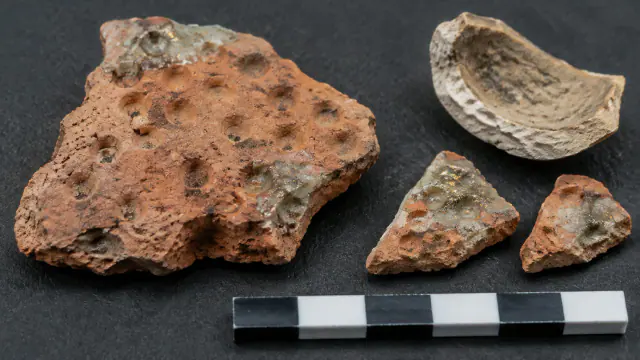
Fragments of moulds for gold from Tadmekka
Traces of gold in the moulds help reconstruct how this metal was processed at Tadmekka.
Museum documentation · free public access, no account required.
Editorial visualisation · Contextual correspondence
Declared editorial visualisation, based on the cartography and sources of the fact sheet; it is not an exact historical frontier.
History and context
Terracotta moulds with residues, together with archaeological experiments, provide evidence for the purification and shaping of high-purity gold pieces.
They provide material evidence of gold processing at a trans-Saharan node, possibly into uninscribed pieces used in exchange. Limitation: the resulting gold piece does not survive, and Tadmekka should not automatically be presented as a city of the Mali Empire.
Evidence and interpretation
ARQ. Terracotta moulds with residues, together with archaeological experiments, provide evidence for the purification and shaping of high-purity gold pieces. What this does not establish: the resulting gold piece does not survive, and Tadmekka should not automatically be presented as a city of the Mali Empire.
Catalogue facts
- Narrative date
- 9th–11th centuries CE
- Location
- Essouk-Tadmekka, northern Mali
- Material
- archaeometallurgical object
- Context
- Bamako, Mali, according to the institutional publication. Custody: Institut des Sciences Humaines, Bamako, according to the Caravans of Gold guide; reconfirm the inventory and conditions.
- Curatorial reading
- The documented fact and its interpretation appear separately in the evidence block.
- Dossier axis
- trade
- Research record
- MANDE · EVI-06
- Documentary coverage
- 2 museum, heritage, primary corpus or research sources for this stop.
A SHARED TOPIC, DIFFERENT MOMENTS
Objects connected through time
Follow a topic across the collections. A shared tag is a way to compare objects, not proof that one culture influenced another.
The order uses the midpoint of each approximate date range; ranges can overlap. Spacing does not represent elapsed time. Swipe, scroll or use the arrows. With the sequence focused, use ← / →, Home or End.
Moulds1 dated object
Also connected, without a comparable date (2)
These objects are not placed after the others: an unknown date does not mean a more recent object.
- Piece-mold castingAncient China · c. 1600–1046 BCE
- The workshop inside the ditchYayoi Japan · 4th century BCE–3rd century CE, peak in Middle and Late Yayoi
A closer look
About 1 min to read · 1 section. Further reading and sources · free access. Editorial review recorded: .
Testing the process
To test the refining hypothesis, researchers from Northwestern mixed gold powder, Lake Michigan sand and recycled glass. When heated, the molten glass retained impurities while the gold formed a separate small mass. They also reproduced the moulds with impression-like cavities, but poured bronze to avoid the cost of gold. These are two distinct experiments: one examines purification and another the ability to mould pieces. Experimental success demonstrates that the proposed procedure works, although it does not by itself recover all the steps carried out in Tadmekka.
Where it is held
Institut des Sciences Humaines · Bamako
Item or group in the record · Documented collection
The institutional exhibition ‘Caravans of Gold’ documents finds from Essouk-Tadmekka and collaboration with the Institut des Sciences Humaines; the inventory must be reconfirmed before any loan or reproduction.
The holding institution is documented; public display may change. Check its official record before visiting.
Sources and references
- Antiquity / Cambridge University Press — New light on the early Islamic West African gold trade: coin moulds from Tadmekka, Mali
- The Block Museum of Art · Northwestern University — Caravans of Gold, Fragments in Time: Art, Culture, and Exchange across Medieval Saharan Africa
- Northwestern University · Scientists prove gold purifying process used in medieval West Africa works, Megan Fellman (2019)
Did you enjoy this exhibit?
Your opinion helps us improve the museum. You can change it whenever you like.
Loading your rating…