
 English
 Español
 Français
 Italiano
 Deutsch
 Русский
 Português
 Polski
 Română
 Svenska
 Norsk bokmål
 Suomi
 Türkçe
 العربية
 简体中文
 한국어
 हिन्दी
 Ελληνικά
09 · Lower Dnieper · Greek jewellery, Scythian theme
A battle on a comb
The gold comb of the Solokha barrow
Three combatants face each other on gold teeth in a work made for a steppe tomb.
Museum documentation · free public access, no account required.
Generated reconstruction · Declared visual hypothesis
Declared visual reconstruction for museographic context; it is not a photograph of the original nor documentary evidence.
History and context
The Solokha comb crowns its teeth with a combat scene of extraordinary detail: warriors, horse, weapons and clothing were modelled in gold. Its manufacture dialogues with Greek workshops of the Black Sea and with high-ranking Scythian clients.
The scene has been related to characters narrated by Herodotus, but it carries no names. What is certain is the cultural collaboration: a Hellenic technique represented steppe equipment and figures to circulate in a Scythian funerary context.
The comb measures 12.6 by 10.2 centimetres and was cast and chased in gold. On the teeth, two foot combatants and a rider form a miniature sculpture where weapons, helmet, shield and horse are understood from several angles.
A 2024 monograph proposes identifying the scene with the dynastic struggle of the sons of Ariapeithes narrated by Herodotus. It is a sophisticated iconographic hypothesis, not an inscription: other mythic or generic readings remain possible.
Evidence and interpretation
Documented fact: the Hermitage dates the comb and examines its provenance from the Solokha kurgan, with a scene of three warriors. Interpretation and caution: identifying the combatants as the sons of King Ariapeithes is a proposal, not an identification recorded in an inscription. Additional documented evidence: the gold comb dates to the late fifth–early fourth centuries BCE, was found in the Solokha kurgan and is classified as a Helleno-Scythian work. Further interpretation and caution: do not name the figures as Octamasades, Oricus and Scyles without indicating that this identification is a recent proposal.
Catalogue facts
- Narrative date
- Early 4th century BCE
- Location
- Solokha barrow, Dnieper valley
- Material
- Gold cast, repoussé and soldered
- Context
- Grave goods of an elite Scythian tomb
- Curatorial reading
- The documented fact and its interpretation appear separately in the evidence block.
- Dimensions
- 12.6 × 10.2 cm
- Technique
- Casting and chasing in gold
- Debate
- Proposed dynastic identification from 2024, not demonstrated
- Documentary coverage
- 2 museum, heritage, primary corpus or research sources for this stop.
- Intercultural biography
- Hellenic workshop of the Black Sea: design-tradition · Scythian elite of Solokha: deposit
- In this grouping
- Prestige comb with a combat scene, not a weapon.
A SHARED TOPIC, DIFFERENT MOMENTS
Objects connected through time
Follow a topic across the collections. A shared tag is a way to compare objects, not proof that one culture influenced another.
The order uses the midpoint of each approximate date range; ranges can overlap. Spacing does not represent elapsed time. Swipe, scroll or use the arrows. With the sequence focused, use ← / →, Home or End.
Gold32 dated objects
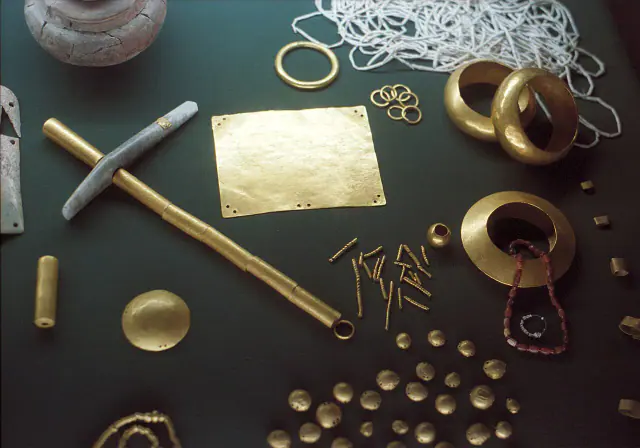
Towards 4600–4200 BCE
The Gold of Varna
Thracians
Date of the Varna funerary assemblage, not of an individual piece.
Read the record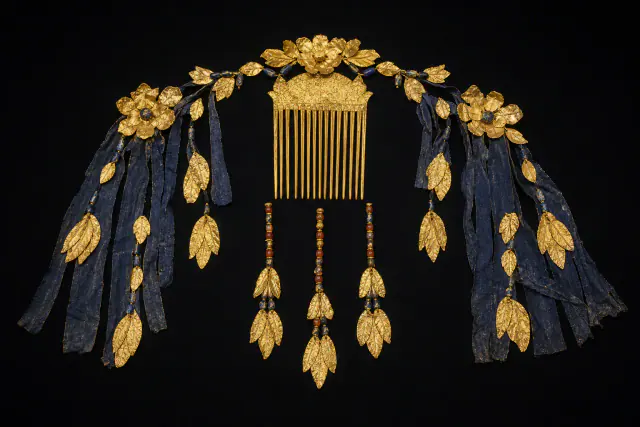
ca. 2600–2450 BCE
Puabi headdress
Sumer
Approximate dating according to the record.
Read the record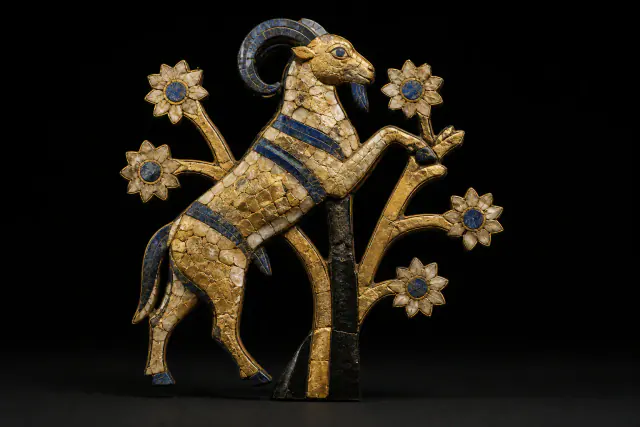
ca. 2600–2400 BCE
The goat from PG 1237
Sumer
The function as support is not resolved.
Read the record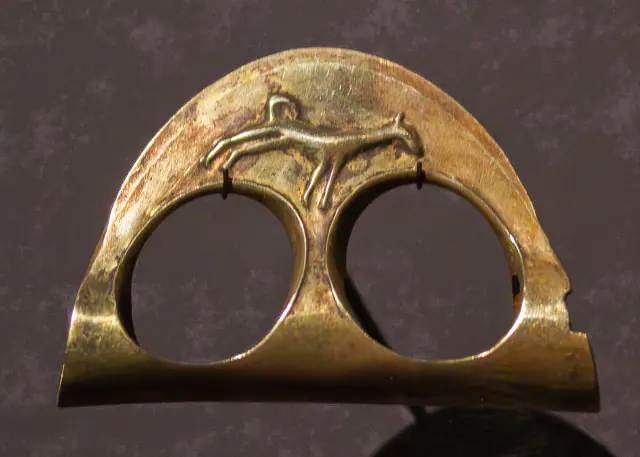
20th–18th centuries BCE
Before Phoenicia
Phoenicians
Approximate dating according to the record.
Read the record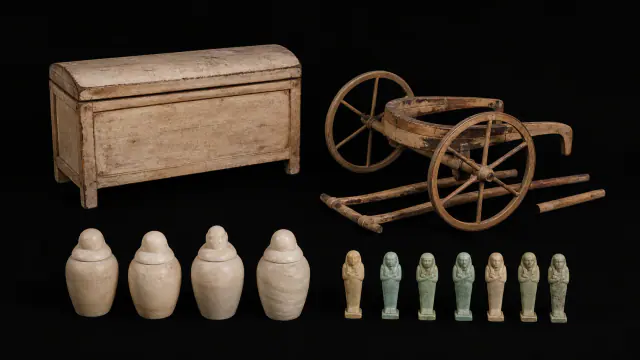
death towards 1323 BCE
Tutankhamun's grave goods
Ancient Egypt
Approximate date of burial, not date of manufacture of the entire trousseau.
Read the record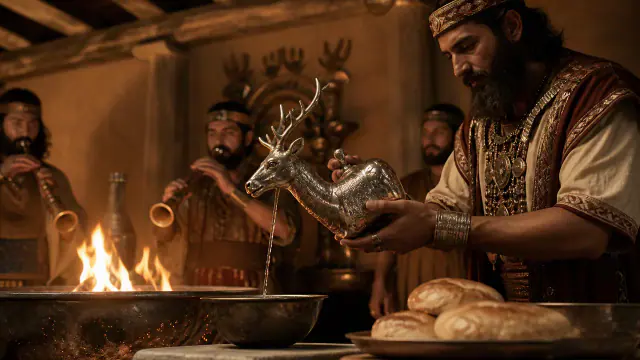
14th–13th centuries BCE
Stag Vessel
Hittites
Approximate dating according to the record.
Read the record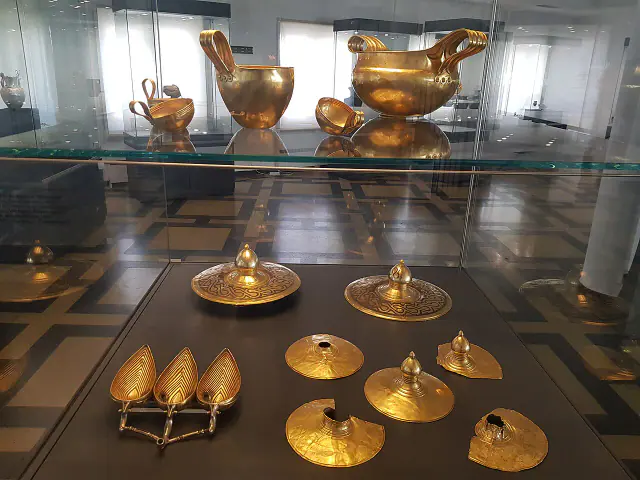
second half of the 14th century–beginning of the 13th century BCE, according to NAIM; other publications use wider intervals from the Late Bronze.
Valchitran
Thracians
The full 14th–13th centuries BCE provide broad limits for chronological ordering; the record specifies the second half of the 14th and early 13th century according to NAIM; other chronologies for the assemblage are broader.
Read the record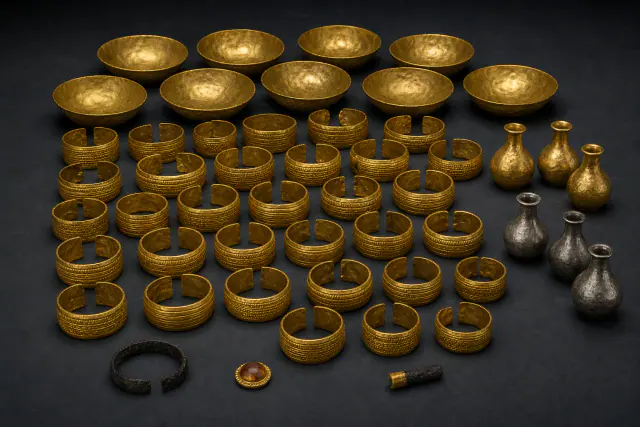
Final Bronze, c. 1000 BCE
Before the Iberias
Iberians
Date of the treasure, not of the preceding general period.
Read the record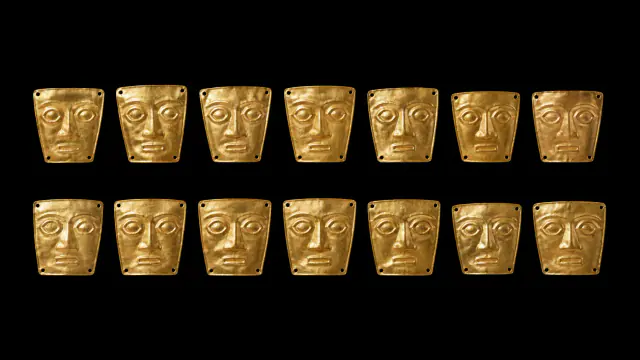
c. 800 BCE
Tomb 1 at Kuntur Wasi
Pre-Inca cultures
Approximate date of the funerary context.
Read the record
c. 721–664 BCE
Kushite king
Nubia, Kerma and Kush
Interval attributed to the specimen in the catalogue.
Read the record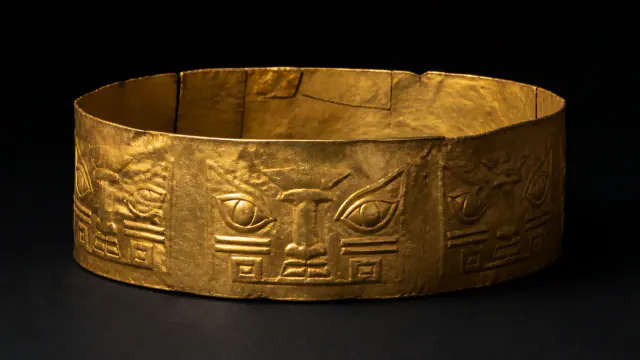
c. 800–550 BCE
Gold at Kuntur Wasi
Pre-Inca cultures
Approximate dating according to the record.
Read the record
ca. 675–650 BCE
Regolini-Galassi tomb
Etruscans and Rome
Date of the funerary assemblage.
Read the record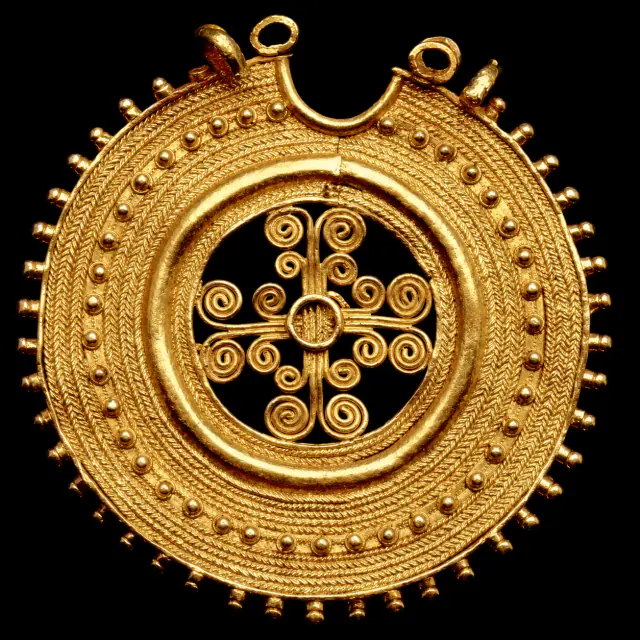
6th century BCE
Condomina Earring
Iberians
Approximate dating according to the record.
Read the record
Towards 510 BCE
Uni was also Astarte
Etruscans and Rome
Approximate dating according to the record.
Read the record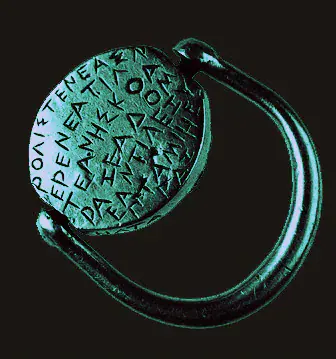
5th century BCE · chronology discussed in the bibliography
Ezerovo Ring
Thracians
The attribution to the 5th century BCE is discussed.
Read the record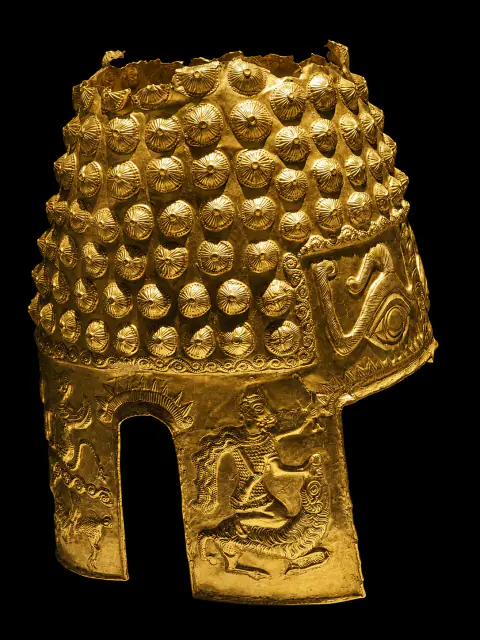
Second half of the 5th century – beginning of the 4th century BCE
Overlapping datesCoțofenești helmet
Thracians
The full 5th–4th centuries BCE provide broad limits for chronological ordering; the record specifies the second half of the 5th and early 4th century.
Read the record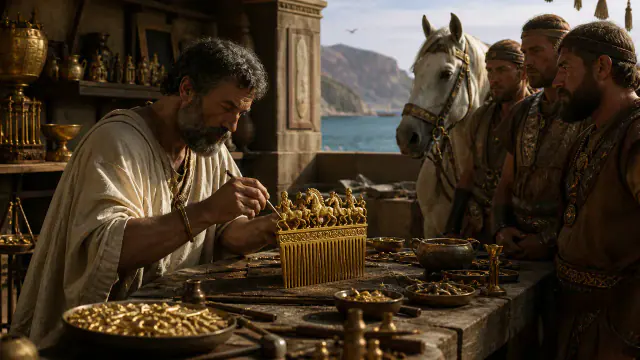 You are viewing
Early 4th century BCE
A battle on a comb
Scythians and Saka
The fourth century BCE is used in its full extent as an outer ordering framework; the entry specifies the beginning.
Current record
4th century BCE
Overlapping datesThe Kul-Oba vase
Greek worlds
Approximate dating according to the record.
Read the record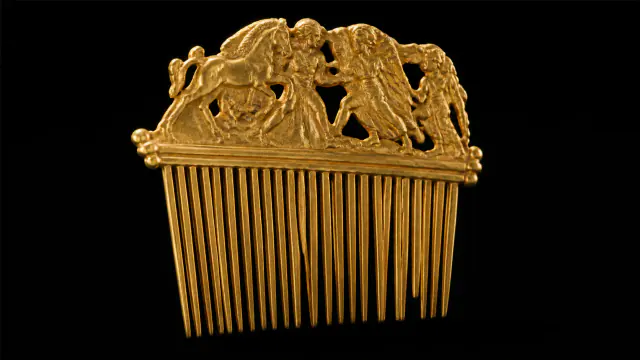
4th century BCE
Overlapping datesThe Solokha gold comb
Greek worlds
Approximate dating according to the record.
Read the record
Type introduced from the late 6th century; specimen from the 4th century BCE.
Overlapping datesThe archer in gold
Achaemenid Persia
Century of the specimen; not an earlier introduction date of the type.
Read the record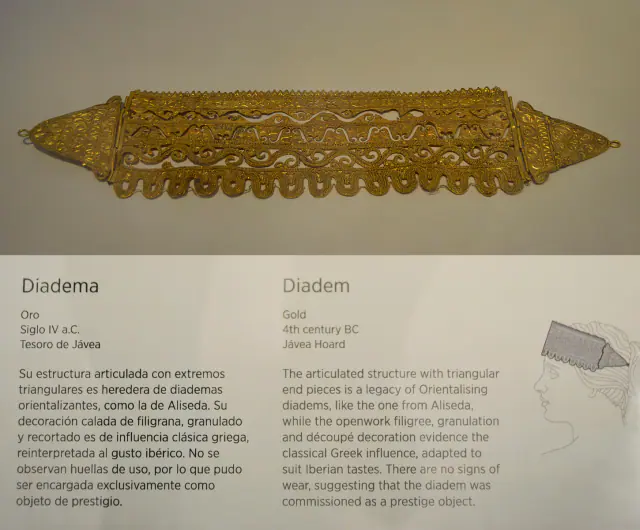
4th century BCE
Overlapping datesTreasure of Jávea
Iberians
Approximate dating according to the record.
Read the record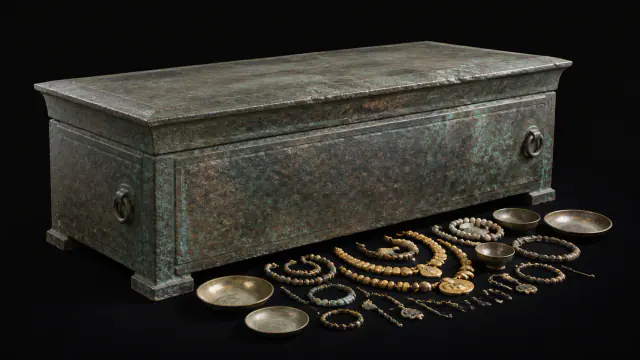
c. 350 BCE
Overlapping datesSusa grave goods
Achaemenid Persia
Date of the funerary assemblage.
Read the record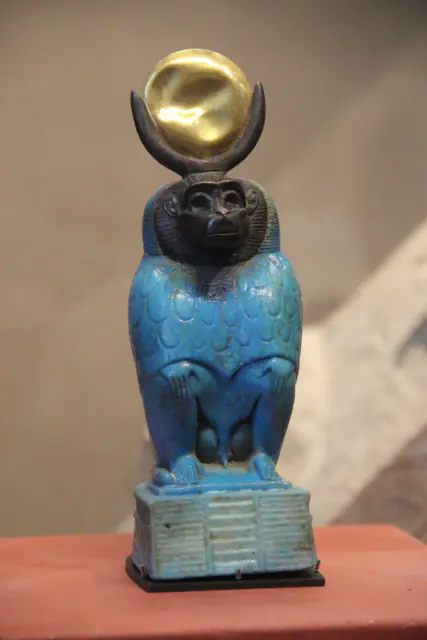
664–30 BCE
Overlapping datesThoth in the form of a baboon
Ancient Egypt
Approximate dating according to the record.
Read the record
Second half of the 4th century BCE
Overlapping datesFaces of the Steppe
Scythians and Saka
Approximate dating according to the record.
Read the record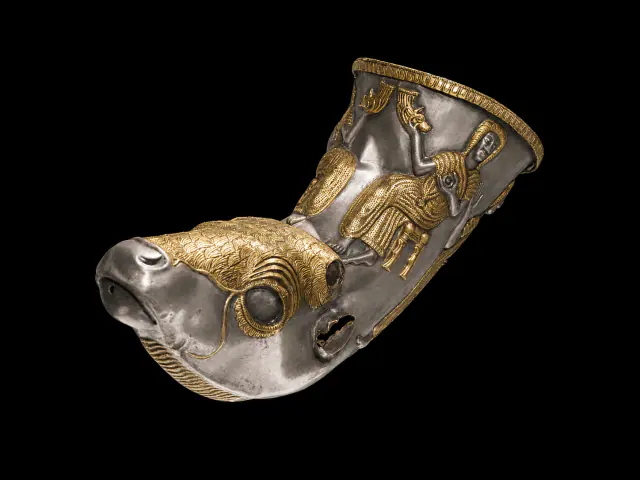
Second half of the 4th century BCE
Overlapping datesPoroina Mare Rhyton
Thracians
Second half of the 4th century BCE; the specific ritual is not known.
Read the record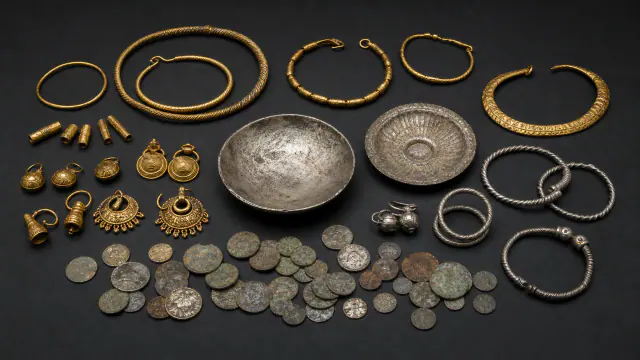
Jewellery from the 4th–3rd centuries BCE; concealment at the end of the 3rd century BCE.
Overlapping datesTreasure of Cheste
Iberians
Interval of the jewellery, not of the later concealment.
Read the record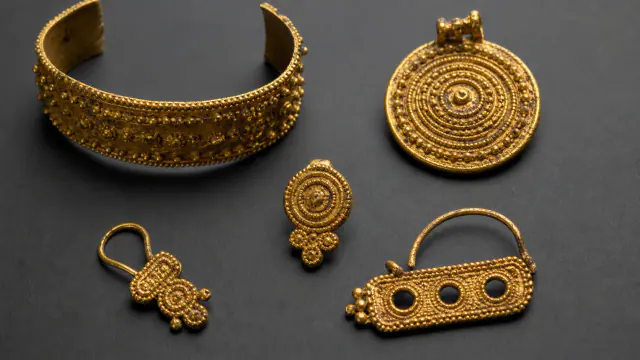
Jewellery: 5th–2nd centuries BCE; concealment probably around 80–73 BCE.
Overlapping datesMarina Alta Hoard
Iberians
Interval of the jewellery, not of the Sertorian concealment.
Read the record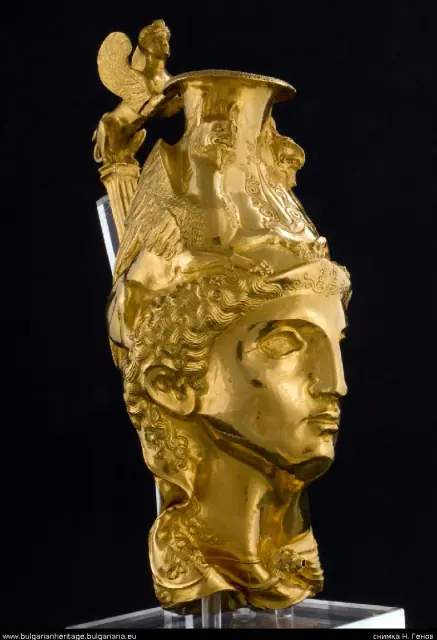
late 4th century – early 3rd century BCE, towards 300 BCE
Panagyurishte
Thracians
«Towards 300 BCE.» It is explicit orientation of the whole.
Read the record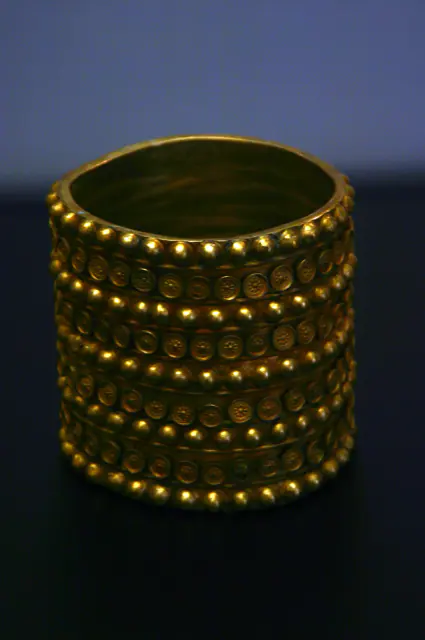
3rd century BCE
Mairena Hoard
Iberians
Approximate dating according to the record.
Read the record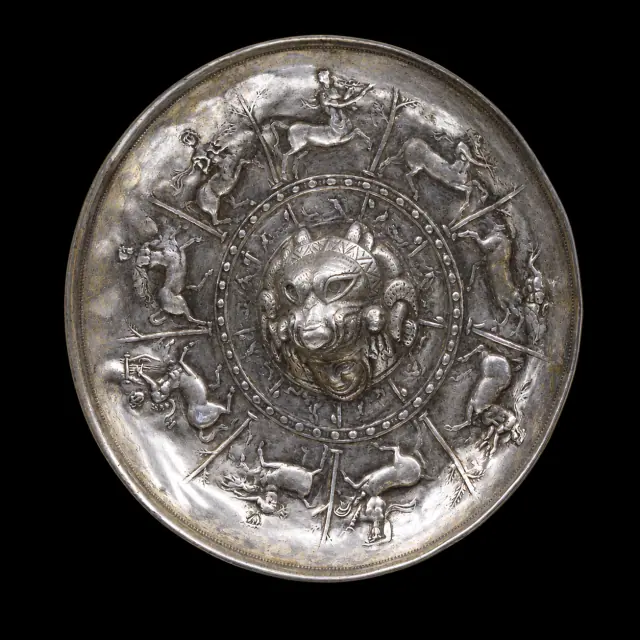
Second half of the 2nd–beginnings of the 1st century BCE
Patera from Perotito
Iberians
The full 2nd–1st centuries BCE provide broad limits for chronological ordering; the record specifies the second half of the 2nd century and the early 1st.
Read the record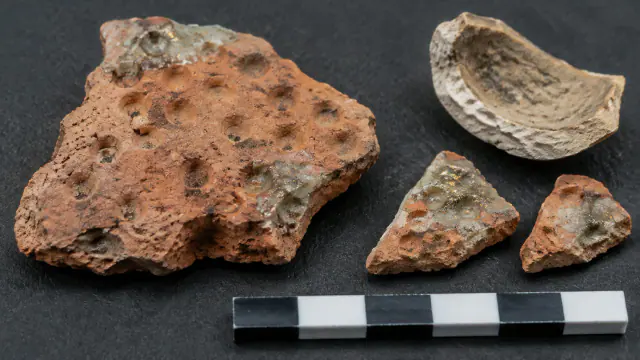
9th–11th centuries CE
Moulds for gold
Mande Worlds
Date range of the archaeometallurgical material in its documented context.
Read the record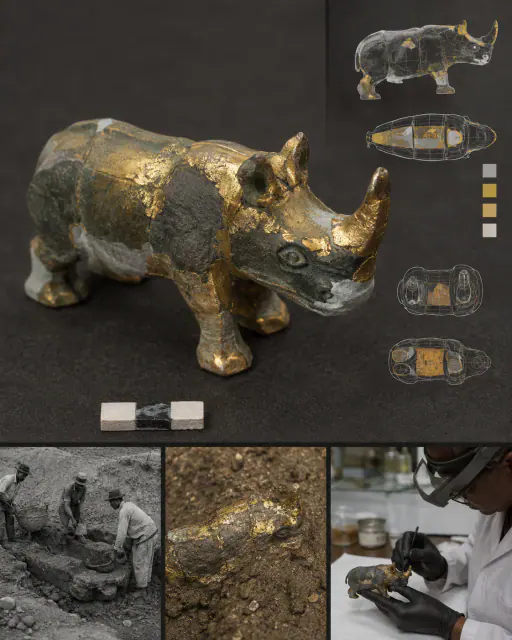
ca. 1220–1290; found in 1933
Gold rhinoceros
Bantu-speaking worlds
Date of the object/context; 1933 is the year of discovery.
Read the record
A closer look
About 1 min to read · 1 section. Further reading and sources · free access. Editorial review recorded: .
The lions also organise the scene
Between the teeth of the comb and the combatants is a row of five reclining lions. Their distribution is not perfectly symmetrical: three face one way and two the opposite. Benjamin Sharkey observes in his 2022 study that this orientation repeats the force distribution of the upper scene, where warriors and horses form two opposing groups. He proposes reading this correspondence as part of the piece’s programme. The observation invites traversing two levels of the composition; its cosmological interpretation remains a proposal, but the irregularity of the frieze is a verifiable detail.
Location and territory
REGIONAL AREA
Solokha barrow, Dnieper valleySteppe corridors; mobility and confederations, not a permanent border. The marker indicates the indicative centre of the area, not a border or an exact point.Where it is held
State Hermitage Museum
Item or group in the record · Documented collection
The holding institution is documented; public display may change. Check its official record before visiting.
Cultural connections
Hellenic workshop of the Black Sea →
The execution relates to Greek craftsmen; the workshop is not identified with absolute certainty.
Probable
Sources and references
Did you enjoy this exhibit?
Your opinion helps us improve the museum. You can change it whenever you like.
Loading your rating…