Its form and decoration have suggested a prestige object, but we do not know who used it or for what purpose.
Museum documentation · free public access, no account required.
CONTRIBUTED RECREATION · VISUAL INTERPRETATION
Reconstruction · Declared visual hypothesis
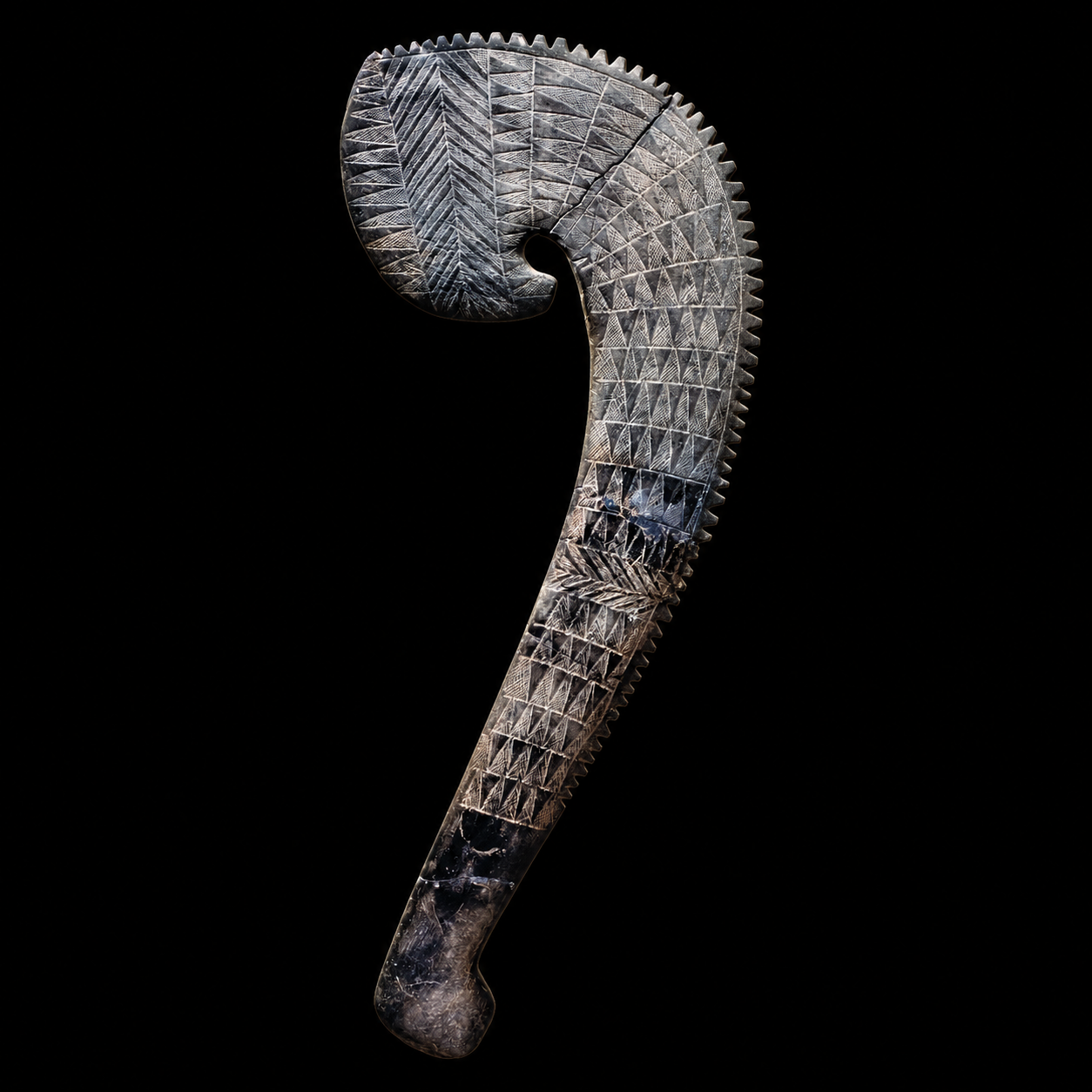
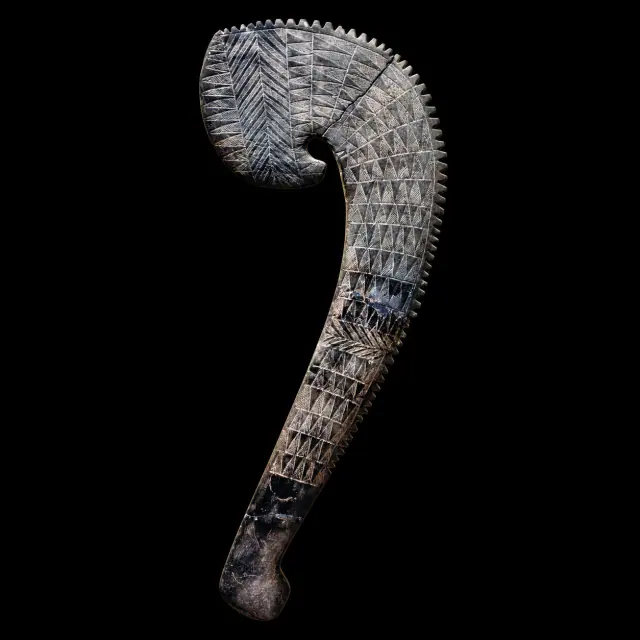
Recreation contributed to the project together with the 3D model of the piece. It is not an archaeological photograph or a metric facsimile. Materials, finish, proportions and visible details may differ from the original. The record and its sources distinguish the documented from the interpreted.
Explore in 3D
Load the model only when you want to explore it. Drag or use the arrow keys to turn it; + and − zoom. Closing it releases its memory.
User-supplied digital reconstruction; file metadata declares Tripo. It is not an archaeological scan or a metric replica; the supplied geometry is preserved intact. The model is displayed at the published height of the original (44.4 cm). The outline, the teeth along the back and the geometric decoration are an interpretation; the model does not replace inventory MNA 989.29.1 or certify the number or arrangement of its motifs.
History and context
Manuel Heleno excavated a slate staff in September 1934 in Anta 4 da Herdade das Antas. One face concentrates geometric decoration, the reverse is smooth, and the back was cut into teeth: costly decisions for a fragile object.
Its silhouette has inspired readings such as a religious emblem or a staff of authority. Without a handle, scene of use, or text, no specific function can be imposed.
Evidence and interpretation
Inventory, context, excavator, date of discovery, material, and dimensions are secure. Power, cult, and mode of manipulation are interpretations.
Catalogue facts
Date
Late 4th–first half of the 3rd millennium BCE.
Location
Anta 4 da Herdade das Antas · Montemor-o-Novo, Portugal
Inventory
MNA 989.29.1
Material and measurements
Slate/schist · 44.4 × 19.2 × 1.8 cm
A SHARED TOPIC, DIFFERENT MOMENTS
Objects connected through time
Follow a topic across the collections. A shared tag is a way to compare objects, not proof that one culture influenced another.
The order uses the midpoint of each approximate date range; ranges can overlap. Spacing does not represent elapsed time. Swipe, scroll or use the arrows. With the sequence focused, use ← / →, Home or End.
About 1 min to read · 1 section. Further reading and sources · free access. Editorial review recorded: .
A name borrowed from much more recent objects
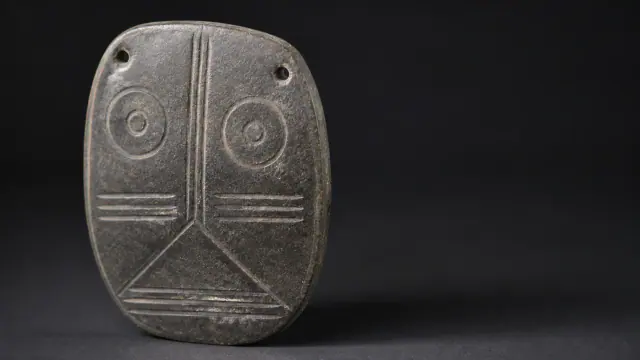
The word “staff” derives from its resemblance to Christian episcopal staffs, not from knowledge of an equivalent Neolithic office. The Portuguese catalogue places these pieces in megalithic funerary contexts and compares them with engraved slate plaques, which are far more numerous. In this specimen, bands of triangles and herringbone motifs alternate, while the grip area remains smooth. The comparison helps to recognise shared repertoires and finishing decisions; it does not turn the form into proof of priesthood.

 English
 Español
 Français
 Italiano
 Deutsch
 Русский
 Português
 Polski
 Română
 Svenska
 Norsk bokmål
 Suomi
 Türkçe
 العربية
 简体中文
 한국어
 हिन्दी
 Ελληνικά
 You are viewing