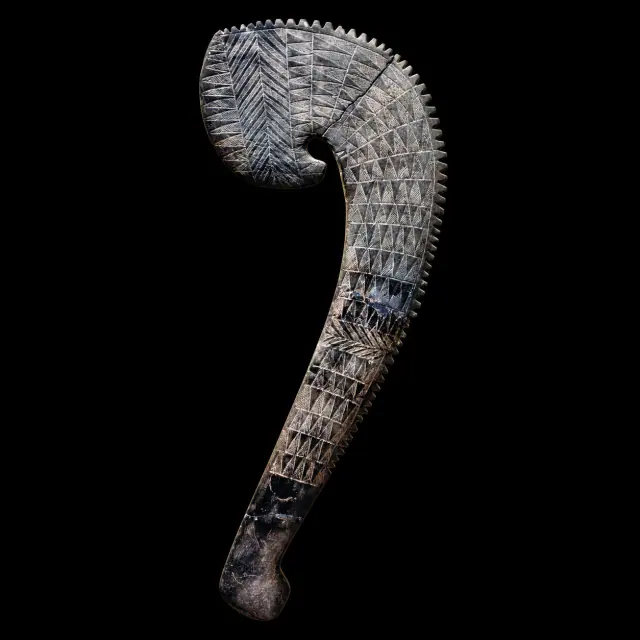
Declared visual reconstruction, created for museographic contextualisation; not a photograph of the original nor does it constitute documentary evidence.
History and context
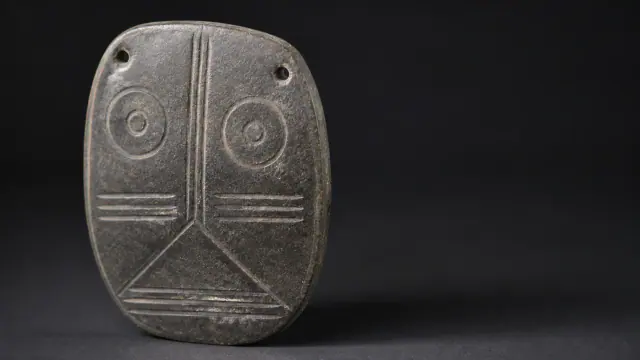
Piece number 358 of the National Archaeological Museum is an anthropomorphic slate plaque, pseudo-rectangular, polished, engraved and perforated. It comes from the dolmens of Guadancil, in Garrovillas de Alconétar, and dates between 3750 and 2500 cal BCE.
The schematic features and perforations construct a recognisable image without providing a name. Comparing it with other plaques from the southwest helps study repertoires; calling it a face, ancestor or deity remains an interpretation.
More than 1,800 engraved plaques known from about 300 sites show that this is not an isolated curiosity. They are usually linked to funerary contexts, but form, decoration, biography and use were not identical across the corpus.
This stop is deliberately comparative: the plaque belongs to the Final Neolithic–Chalcolithic and precedes by millennia the Iberian societies of the Iron Age. The modern name 'idol-plaque' does not demonstrate that it represented a deity.
Evidence and interpretation
Documented fact: CER.ES records material, techniques, inventory, provenance and dating of the piece MAN 358; the comparative study brings together a broad corpus of engraved plaques. Interpretation and caution: represented identity, concrete function and meaning of the motifs are not preserved; it is neither writing nor Iberian culture.
Catalogue facts
Narrative date
3750–2500 cal BCE
Location
Dolmens of Guadancil, Garrovillas de Alconétar (Cáceres)
Material
Polished slate, engraved and perforated
Context
Final Neolithic–Chalcolithic · comparative funerary object
Classification
Comparative connection · must not be presented as an Iberian piece
Visual reference
CER.ES · National Archaeological Museum, inventory 358
A SHARED TOPIC, DIFFERENT MOMENTS
Objects connected through time
Follow a topic across the collections. A shared tag is a way to compare objects, not proof that one culture influenced another.
The order uses the midpoint of each approximate date range; ranges can overlap. Spacing does not represent elapsed time. Swipe, scroll or use the arrows. With the sequence focused, use ← / →, Home or End.
About 1 min to read · 1 section. Further reading and sources · free access. Editorial review recorded: .
Could generations be counted in the bands?
The genealogical hypothesis proposes two levels of information on the classic plaques: the repeated motif at the base would allude to a social group and the number of records to the generational distance from an ancestor. Lillios, Tang and Bowen contrasted this proposal statistically: they found associations between the number of records and geographical distribution, and between certain designs and tomb size. It does not equate to deciphering the Guadancil plaque nor knowing the name of its recipient. Yes, it turns a decorative resemblance into a hypothesis testable with archaeological datasets.

 English
 Español
 Français
 Italiano
 Deutsch
 Русский
 Português
 Polski
 Română
 Svenska
 Norsk bokmål
 Suomi
 Türkçe
 العربية
 简体中文
 한국어
 हिन्दी
 Ελληνικά
 You are viewing