The public thought they saw a death; I was watching a performance.
Museum documentation · free public access, no account required.
CONTEXTUAL DOCUMENTARY IMAGE · CC BY 2.0
Contextual image · Contextual correspondence
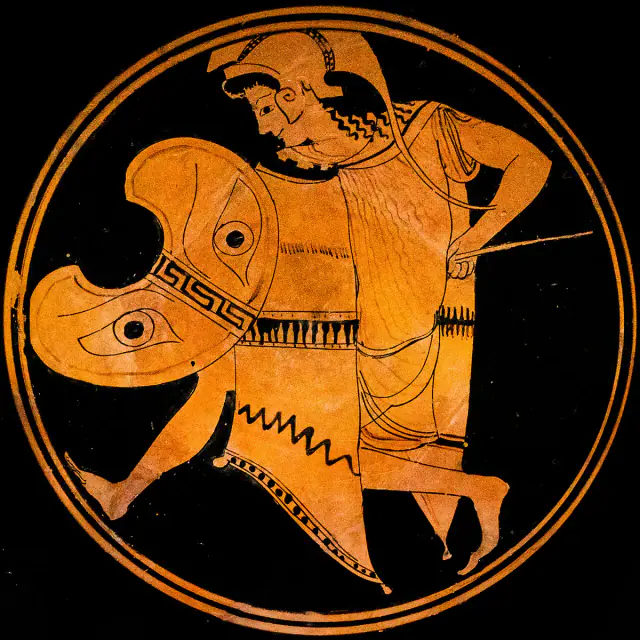
Warrior in Thracian clothing on a Greek vase. Context of the weaponry, not representation of the two dancers of Xenophon. Greek image of clothing and weaponry, not a photograph of a historical person or an individual portrait.
In the Anabasis, two armed Thracians dance to the sound of a wind instrument. They jump, wield their weapons and simulate a fatal blow. The fallen man has acted so well that those present believe he is wounded; The demonstration turns a military skill into a bodily story.
The episode takes place at a gathering outside Thrace, alongside performances by other groups. It documents those performers and the way Xenophon describes them. It does not prove the existence of a Thracian national theatre or preserve the melody that accompanied their movements.
Evidence and interpretation
Anabasis VI, 1, 5–6: explicit literary testimony of armed dance. No choreography or music reconstructed as authentic is offered.
Catalogue facts
Date
Towards 400 BCE. Xenophon's story
Location
Cotyora · current Ordu, Black Sea; performance of Thracian soldiers
A SHARED TOPIC, DIFFERENT MOMENTS
Objects connected through time
Follow a topic across the collections. A shared tag is a way to compare objects, not proof that one culture influenced another.
The order uses the midpoint of each approximate date range; ranges can overlap. Spacing does not represent elapsed time. Swipe, scroll or use the arrows. With the sequence focused, use ← / →, Home or End.
THE CURRENT OBJECT
Its date is not sufficiently established to place it on the timeline. We keep it here, separate from the dated objects.
About 1 min to read · 2 sections. Further reading and sources · free access. Editorial review recorded: .
Surprise as a stage technique
The performance depends on the spectators knowing the danger of weapons and, for a moment, not distinguishing the real gesture from the simulated one. The fall, the withdrawal of the weapon and the exit of the performers build a comprehensible sequence without dialogue. Talking about representation is reasonable; To call it a play with a known author, text and setting would be adding data that the source does not offer.
The text names instrumental accompaniment, but does not convey notes, tempo, or pitch. Old images of instruments help you imagine how sound was produced, not automatically recover the piece played. The museum's background music is contemporary and kept separate from this historical evidence.
Cotyora · current Ordu, Black Sea; performance of Thracian soldiersIndicative location of the site or locality; not a display case coordinate or ancient boundary.

 English
 Español
 Français
 Italiano
 Deutsch
 Русский
 Português
 Polski
 Română
 Svenska
 Norsk bokmål
 Suomi
 Türkçe
 العربية
 简体中文
 한국어
 हिन्दी
 Ελληνικά
 You are viewing