
 English
 Español
 Français
 Italiano
 Deutsch
 Русский
 Português
 Polski
 Română
 Svenska
 Norsk bokmål
 Suomi
 Türkçe
 العربية
 简体中文
 한국어
 हिन्दी
 Ελληνικά
MEASUREMENT · 18TH DYNASTY · MAYA
Maya's cubit
A measure that does not change arms
A ruler divided into seven spans and twenty-eight fingers allowed the same measurement to be repeated.
Museum documentation · free public access, no account required.
Documentary original · Exact correspondence
Rama, Maya’s cubit, Louvre N 1538. Photograph in the black background variant published by the author himself; no AI restoration. Cracks, losses, measurement marks and visible hieroglyphics are preserved. Only format conversion and reduction for web. It does not constitute a metric model nor does it document hidden faces.
branch · Musee du Louvre · Inventory: N 1538 · CC BY-SA 3.0 FR
History and context
Measure a board with your forearm and give it to another person to repeat the work: if their arms are different, the result can be different too. A shared pattern reduces that uncertainty. The wooden ruler inscribed in the name of Maya represents the Egyptian royal cubit, divided into seven palms and twenty-eight fingers. The Louvre records 52,3 centimeters for this specimen; The 52,5 centimeters common in disclosure are an approximation of the unit, not its exact measurement.
Maya managed the treasury under Tutankhamun and Horemheb. His cubit belongs to the group of ceremonial rulers: it brings together measurement, prestige and religious knowledge. We do not know whether he used it personally on a building project. Repeating a measurement matters as much to someone cutting an object as to someone checking a delivery or surveying land. As a modern example, one hundred cubits of 52.3 cm total 52.3 m; one hundred of 51.8 cm total 51.8 m. A small difference becomes half a metre: before measuring together, people must agree on which cubit to use.
Evidence and interpretation
Inventory N 1538 identifies the owner, dimensions, chronology and wood. The Louvre marks the provenance ‘Maya’s tomb’ with a question mark. The ruler’s ceremonial character means it cannot be presented as a tool with demonstrated everyday use. The bodily origin of the name does not make an open hand or a closed hand universal definitions of the royal and small cubits.
Catalogue facts
- Date
- 1330–1295 BCE · end of the 18th dynasty
- Location
- Saqqara-North · Egypt; attribution to Maya tomb uncertain
- Object dimensions
- 52,3 × 3,2 × 2,4 cm · Louvre N 1538
- Material
- African blackwood (Dalbergia melanoxylon), identified in 2022
- Owner
- Maya · director of the treasury under Tutankhamun and Horemheb
- Compare · Egypt
- Small cubit ≈45 cm: 6 palms / 24 digits. Royal cubit ≈52.3–52.5 cm: 7 palms / 28 digits. Maya’s example measures 52.3 cm.
- Compare Nippur
- ≈51,8 cm between reference marks; The complete bar measures about 110 cm. They are not two measurements of the same section.
- Compare · Mesopotamia
- The historical tables also record ≈53,3 cm and ≈49,6 cm for the so-called Babylonian/Lagash cubit. They should not apply to all of Mesopotamia or to any date.
- Compare Persia
- ≈50 cm in comparative tables; at Persepolis, patterns of ≈52,1–52,2 cm have been reconstructed from architectural marks. ‘Persian’ does not identify a single longitude.
- Compare · Greek worlds
- ≈46,3 cm for one of the variants; There were other local patterns as well. The word pēchys does not by itself guarantee a universal conversion.
- Compare · Rome
- ≈44,4 cm for the cubitus of 6 palms / 24 fingers, equivalent to a Roman foot and a half.
- Compare · Later Arab traditions
- The tables distinguish, among other variants, a black cubit of ≈54 cm and a hāšimī of ≈65 cm. They are not Sumerian or Egyptian pharaonic units, nor should they be automatically confused with the one attributed to Omar.
- How to read these equivalences
- They are modern approximations of patterns from different periods and uses. Tunisia, Morocco, Calcutta and Ceylon also had local measures: without dating them and identifying their use, assigning each territory a single number is misleading.
A SHARED TOPIC, DIFFERENT MOMENTS
Objects connected through time
Follow a topic across the collections. A shared tag is a way to compare objects, not proof that one culture influenced another.
The order uses the midpoint of each approximate date range; ranges can overlap. Spacing does not represent elapsed time. Swipe, scroll or use the arrows. With the sequence focused, use ← / →, Home or End.
Wood13 dated objects
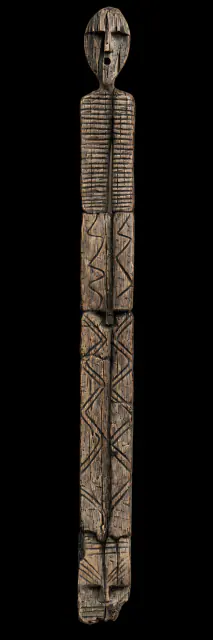
C. 10,000 BCE · approximation; debated dating
Shigir Idol
Prehistory
Approximation expressed in the record; dating debated.
Read the record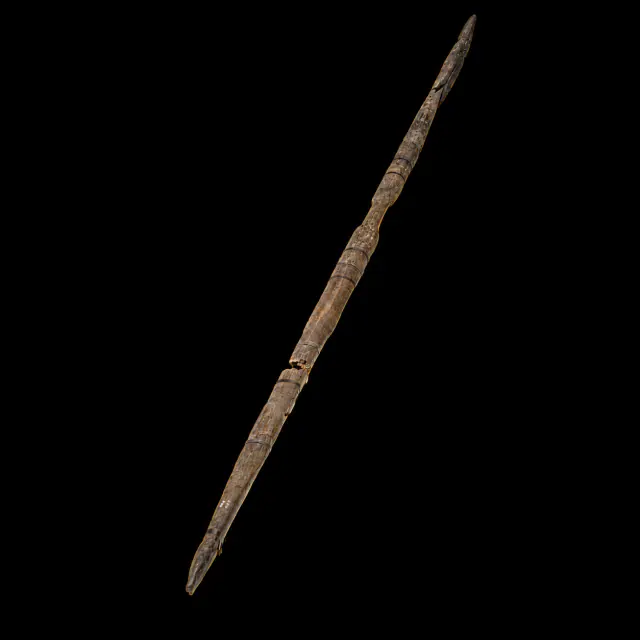
≈7000 BCE
Holmegaard bow
Prehistory
Date of the Holmegård bow; the Albuñol strings compared in the record date to ≈5300–4900 BCE.
Read the record
ca. 3000 BCE
Abydos Boats
Ancient Egypt
Approximate dating of the set of boats.
Read the record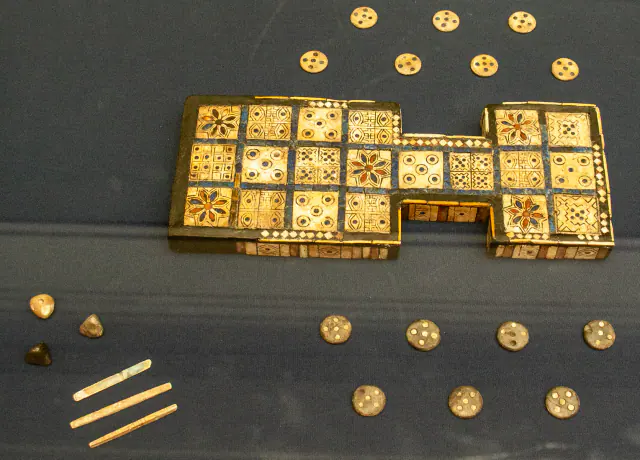
2600–2400 BCE
Royal Game of Ur
Sumer
Approximate dating according to the record.
Read the record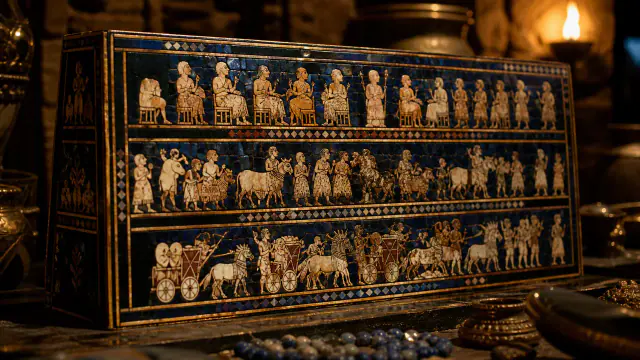
ca. 2600–2400 BCE
Standard of Ur
Sumer
Unknown function; The scenes do not prove that it was a banner.
Read the record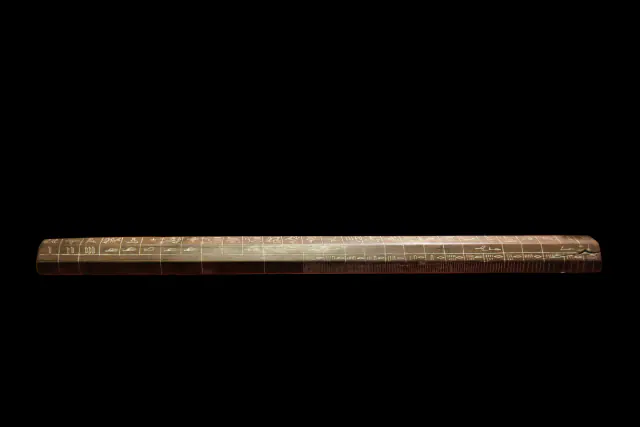 You are viewing
1330–1295 BCE · end of the 18th dynasty
Maya's cubit
Ancient Egypt
Approximate dating according to the record.
Current record
c. 1600–1000 BCE, in several phases
Overlapping datesWooden faces
Maya worlds
Deposit made in several phases; not simultaneous manufacture.
Read the record
Second half of the 7th century BCE
Mazarrón 1
Phoenicians
Second half of the 7th century BCE
Read the record
Second half of the 7th century BCE
Mazarrón 2
Phoenicians
Date of the shipwreck and its context; the cargo brings together several objects.
Read the record
5th–4th centuries BCE
Bow and arrows in a case
Scythians and Saka
Typological set of slings; no date for a single specimen.
Read the record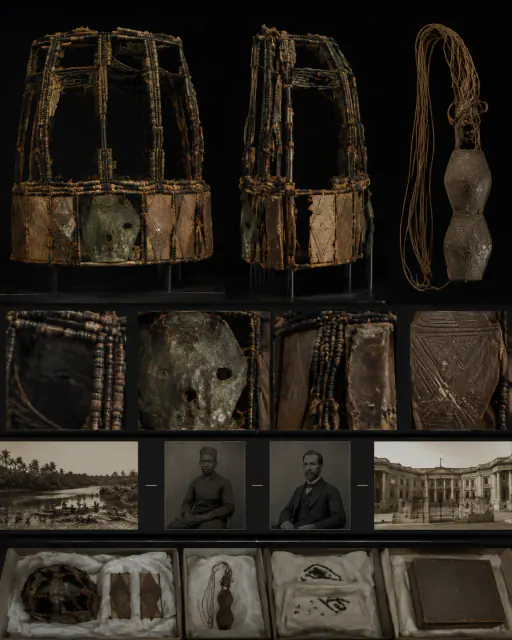
ca. 1760
Kuba ndop
Bantu-speaking worlds
Approximate dating according to the record.
Read the record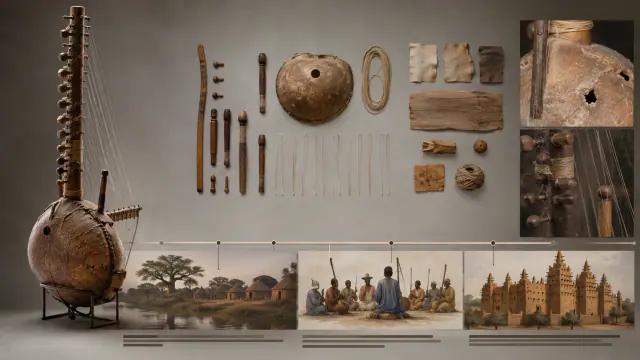
19th century
19th-century kora
Mande Worlds
The century of the surviving instrument, not the origin of the musical tradition.
Read the record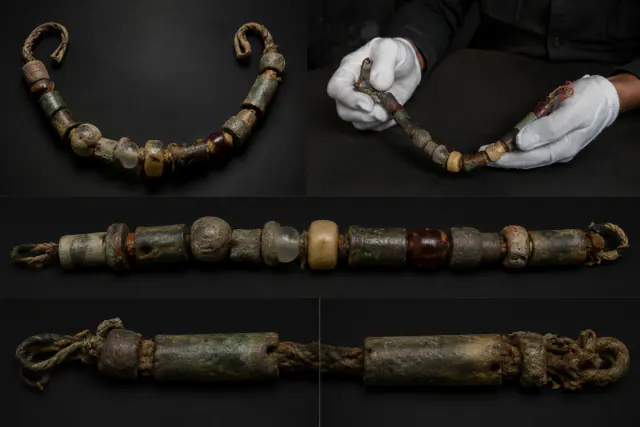
19th–20th centuries
Lukasa
Bantu-speaking worlds
Date range of the catalogued object, not the origin of the memory tradition.
Read the record
Also connected, without a comparable date (4)
These objects are not placed after the others: an unknown date does not mean a more recent object.
- Memory in performanceBantu-speaking worlds · 19th–20th centuries and transmitted practice
- Rice on stiltsYayoi Japan · Especially 1st–3rd centuries CE
- Rome learns in terracottaEtruscans and Rome · End of the sixth century BCE
- Tools in relationBatwa / Twa histories · ca. 1947
A closer look
About 1 min to read · 1 section. Further reading and sources · free access. Editorial review recorded: .
A working ruler cannot be identified by its markings alone
To compare Maya’s ceremonial cubit to a practical tool, Annette Imhausen's study examines the Kha folding ruler, found with a leather sheath. Its articulation allowed it to be reduced by half for transport. Detailed measurements cited in the article show that its seven palms are not exactly the same length, especially in the hinge area. Therefore, the ideal division of the unit does not guarantee physically perfect marks on each object. Shape, mobility, support and context allow you to investigate how a ruler was used, in addition to converting its length to centimeters.
Location and territory
DEBATED LOCATION
Saqqara-North EgyptArea of origin indicated by the Louvre; the attribution to Maya's tomb has a question mark in the catalogue.Where it is held
Musée du Louvre · Department of Egyptian Antiquities
Item or group in the record · Documented collection
Paris · inventory N 1538. Membership in the collection does not guarantee permanent exhibition.
The holding institution is documented; public display may change. Check its official record before visiting.
Sources and references
- Musée du Louvre · Cubit of Maya, N 1538
- Rijksmuseum van Oudheden · Maya and Merit, biography of the official
- Annette Imhausen · Measuring length in ancient Egypt, Revista d’Arqueologia de Ponent 35 (2025)
- UCL Egyptian units of length
- Mark H. Stone (2014) · historical comparison of cubits, §§2–5
- Michael Roaf (1978) · Persepolis metrology and markings
Did you enjoy this exhibit?
Your opinion helps us improve the museum. You can change it whenever you like.
Loading your rating…