
 English
 Español
 Français
 Italiano
 Deutsch
 Русский
 Português
 Polski
 Română
 Svenska
 Norsk bokmål
 Suomi
 Türkçe
 العربية
 简体中文
 한국어
 हिन्दी
 Ελληνικά
SUMER · NIPPUR · LENGTH PATTERN
Nippur Cubit
The agreement is engraved in the metal
The markings on a rod of approximately 110 centimetres allow for the identification of a cubit measure of approximately 51.8 centimetres.
Museum documentation · free public access, no account required.
Documentary original · Exact correspondence
Documentary photograph of the original or the exact site.
Aeroid/Wikimedia Commons · Istanbul Arkeoloji Müzeleri · CC BY-SA 4.0
History and context
A Nippur copper bar bears several marks. It is not necessary to measure it from end to end to find the cubit: the approximately 51,8 centimeters are reconstructed from certain intervals of its scale. The entire object reaches about 110 centimeters. Studies place it in the 3rd millennium BCE, usually towards 2650 BCE, among the material testimonies of oldest preserved length patterns.
The extraordinary thing is not that a person knew how to measure with his arm. It is that a reference could still be available when that person was no longer there. A pattern allows you to compare jobs and review differences without starting from scratch; It also gives power to those who guard the measure. Nippur and the Rule of Maya illustrate different solutions to that problem, separated by more than a millennium. Their close lengths do not prove a single world system or a direct transmission between both pieces.
Evidence and interpretation
The PTB and the Saxony-Anhalt Archaeological Service document the ≈51,8 cm unit and distinguish the complete bar. A three-dimensional documentation study of the piece proposes ≈2650 BCE 'One of the oldest preserved standards' is not equivalent to knowing the first measurement of humanity.
Catalogue facts
- Date
- III millennium BCE · usually towards 2650 BCE; approximate
- Location
- Nippur southern Mesopotamia, present-day Iraq
- Unit and support
- Cubit ≈51.8 cm · complete bar ≈110 cm
- Material
- Copper/copper alloy
- Compare · Egypt
- Small cubit ≈45 cm: 6 palms / 24 digits. Royal cubit ≈52.3–52.5 cm: 7 palms / 28 digits. Maya’s example measures 52.3 cm.
- Compare Nippur
- ≈51,8 cm between reference marks; The complete bar measures about 110 cm. They are not two measurements of the same section.
- Compare · Mesopotamia
- The historical tables also record ≈53,3 cm and ≈49,6 cm for the so-called Babylonian/Lagash cubit. They should not apply to all of Mesopotamia or to any date.
- Compare Persia
- ≈50 cm in comparative tables; at Persepolis, patterns of ≈52,1–52,2 cm have been reconstructed from architectural marks. ‘Persian’ does not identify a single longitude.
- Compare · Greek worlds
- ≈46,3 cm for one of the variants; There were other local patterns as well. The word pēchys does not by itself guarantee a universal conversion.
- Compare · Rome
- ≈44,4 cm for the cubitus of 6 palms / 24 fingers, equivalent to a Roman foot and a half.
- Compare · Later Arab traditions
- The tables distinguish, among other variants, a black cubit of ≈54 cm and a hāšimī of ≈65 cm. They are not Sumerian or Egyptian pharaonic units, nor should they be automatically confused with the one attributed to Omar.
- How to read these equivalences
- They are modern approximations of patterns from different periods and uses. Tunisia, Morocco, Calcutta and Ceylon also had local measures: without dating them and identifying their use, assigning each territory a single number is misleading.
A SHARED TOPIC, DIFFERENT MOMENTS
Objects connected through time
Follow a topic across the collections. A shared tag is a way to compare objects, not proof that one culture influenced another.
The order uses the midpoint of each approximate date range; ranges can overlap. Spacing does not represent elapsed time. Swipe, scroll or use the arrows. With the sequence focused, use ← / →, Home or End.
Copper and its alloys8 dated objects
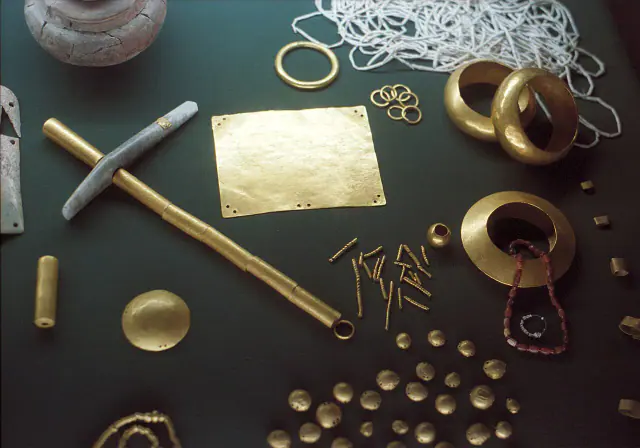
Towards 4600–4200 BCE
The Gold of Varna
Thracians
Date of the Varna funerary assemblage, not of an individual piece.
Read the record You are viewing
III millennium BCE · usually towards 2650 BCE; approximate
Nippur Cubit
Sumer
Explicit indicative date in the 3rd millennium BCE
Current record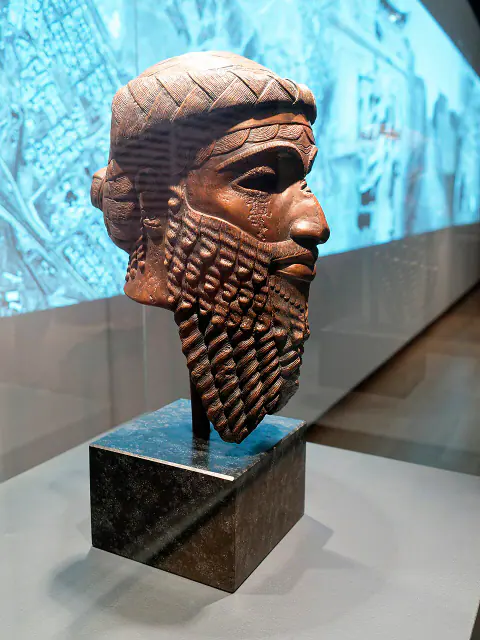
Akkadian period · 23rd century BCE
Akkadian sovereign head
Sumer
Approximate dating according to the record.
Read the record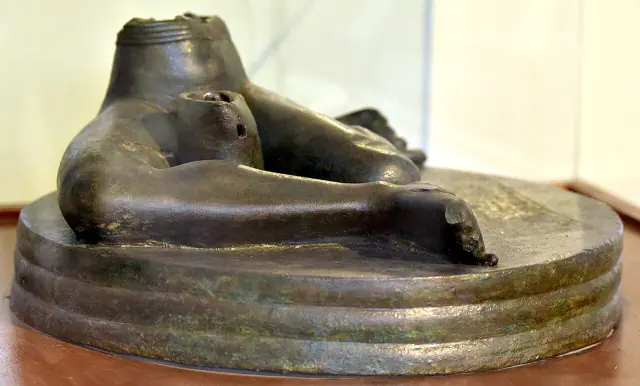
Akkadian period · 23rd century BCE
Bassetki Statue
Sumer
Approximate dating according to the record.
Read the record
Towards 1000–400 BCE
The lute-shaped dagger
Gojoseon and early Korea
Typological framework of daggers; not a single manufacturing date.
Read the record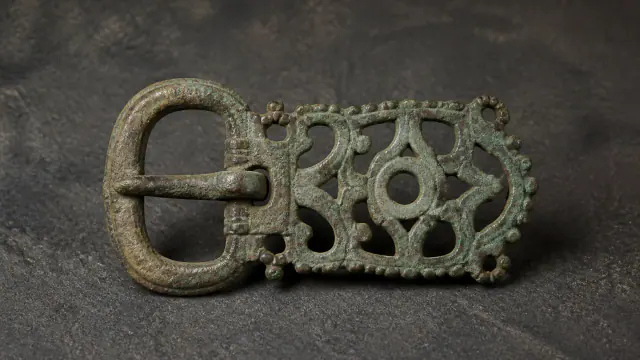
Second half of the IV century–V century CE
Simancas-type belt buckle
Iberians
The full 4th–5th centuries CE provide broad limits for chronological ordering; the record specifies the second half of the 4th century and the 5th.
Read the record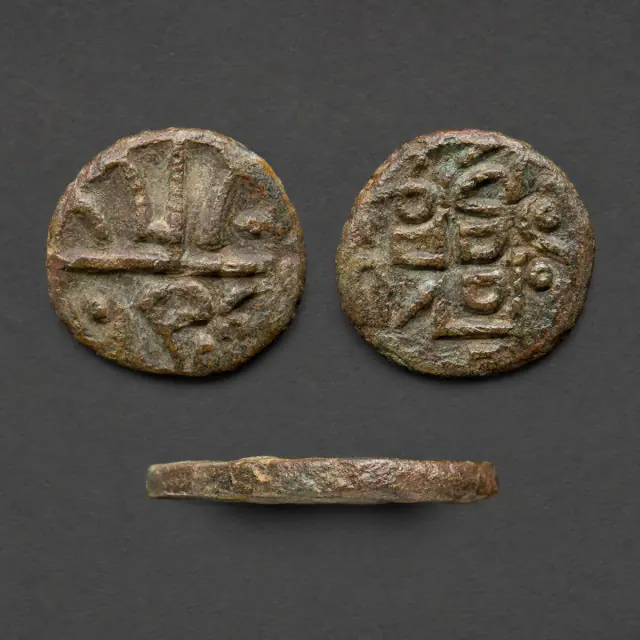
1482–1493
Kilwa coin
Bantu-speaking worlds
Read the record
16th–17th centuries
Kongo crucifix
Bantu-speaking worlds
Read the record
Also connected, without a comparable date (3)
These objects are not placed after the others: an unknown date does not mean a more recent object.
- Copper and stoneAncient Egypt · ca. 3100–2700 BCE
- Early metallurgyAncient China · c. 1900–1500 BCE
- Translating faithBantu-speaking worlds · 16th–18th centuries
A closer look
About 1 min to read · 1 section. Further reading and sources · free access. Editorial review recorded: .
Measure an ancient measuring instrument today
Duran and Aydar published in 2012 a three-dimensional documentation of the bar that combines proximity photogrammetry and laser scanning. They compared the results of both techniques to register the object preserved in the Istanbul Archaeological Museum. The study adds another layer to its story: an old reference becomes the subject of new measurements. A digital model allows you to retrace its geometry without continuously manipulating the original copper, and makes explicit that documenting a scale also requires choosing methods and instruments.
Location and territory
APPROXIMATE LOCATION
Nippur · IraqLocation of the site, not a discovery point or place of current custody.Where it is held
İstanbul Arkeoloji Müzeleri collection of the Ancient East
Item or group in the record · Documented collection
Istanbul · documented custody by the PTB and the study of the piece; unverified inventory number.
The holding institution is documented; public display may change. Check its official record before visiting.
Sources and references
- Archeology of Saxony-Anhalt markings and length of the Nippur rod
- PTB (2012) · history of the Nippur meter and cubit, p.7
- Istanbul Technical University · Duran and Aydar, digital model of the Nippur cubit
- UCL Egyptian units of length
- Mark H. Stone (2014) · historical comparison of cubits, §§2–5
- Michael Roaf (1978) · Persepolis metrology and markings
Did you enjoy this exhibit?
Your opinion helps us improve the museum. You can change it whenever you like.
Loading your rating…