
 English
 Español
 Français
 Italiano
 Deutsch
 Русский
 Português
 Polski
 Română
 Svenska
 Norsk bokmål
 Suomi
 Türkçe
 العربية
 简体中文
 한국어
 हिन्दी
 Ελληνικά
TOOL · LOWER PALAEOLITHIC · ACHEULEAN
Swanscombe handaxe
The Acheulean handaxe from Swanscombe
A planned form in flint, knapped about 400,000 years ago on the banks of an ancient Thames.
Museum documentation · free public access, no account required.
Reconstruction · Declared visual hypothesis
Recreation contributed to the project together with the 3D model of the piece. It is not an archaeological photograph or a metric facsimile. Materials, finish, proportions and visible details may differ from the original. The record and its sources distinguish the documented from the interpreted.
Explore in 3D
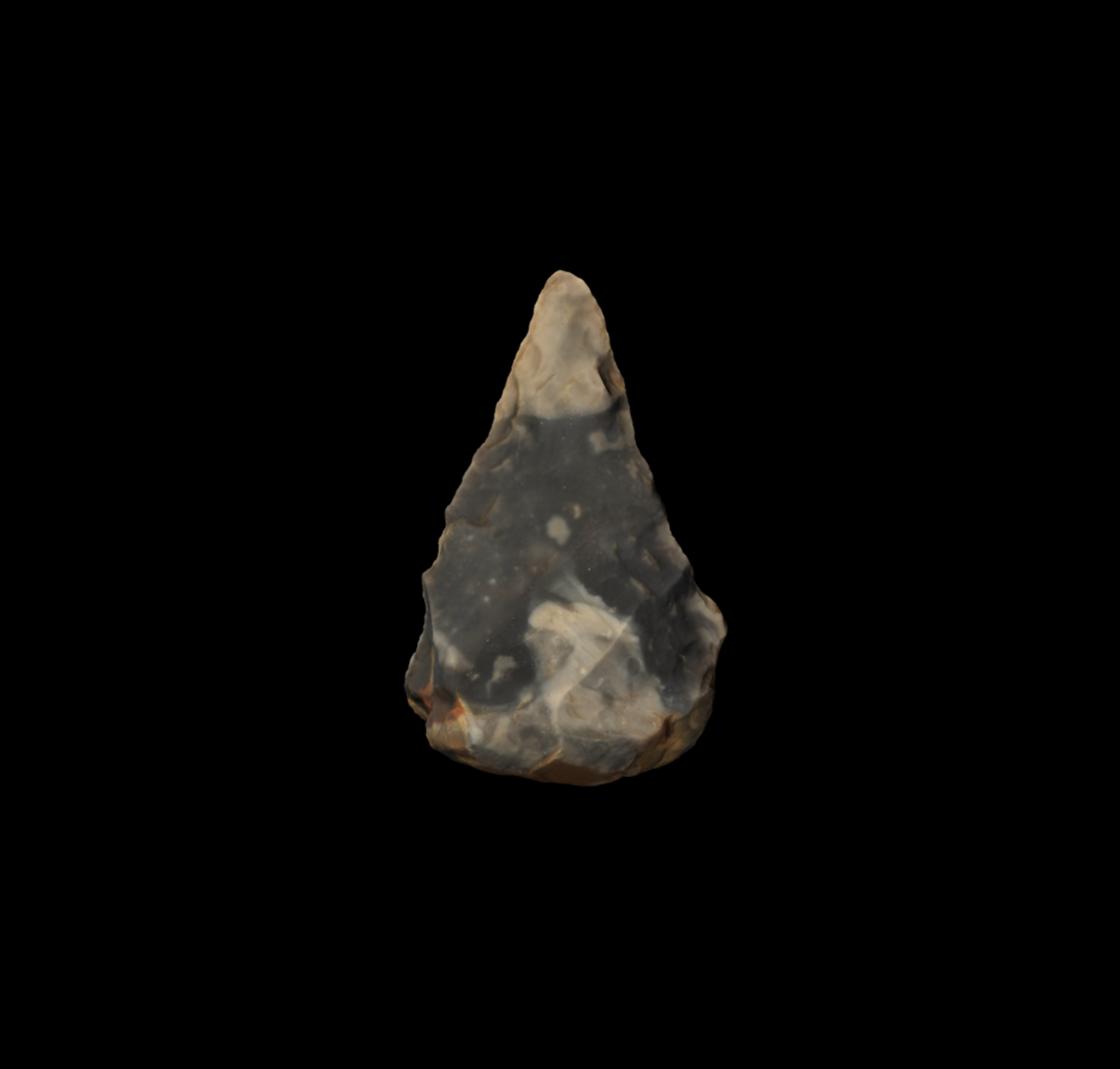
Load the model only when you want to explore it. Drag or use the arrow keys to turn it; + and − zoom. Closing it releases its memory.
User-supplied digital reconstruction; file metadata declares Tripo. It is not an archaeological scan or a metric replica; the supplied geometry is preserved intact. The model represents a pointed handaxe of the type found in the Middle Gravels at Barnfield Pit; it does not reproduce an inventoried piece or its measurements. It is displayed enlarged so that the knapping on both faces can be appreciated, although its flake removals are an interpretation. A handaxe like this fits in the hand.
History and context
At the Barnfield Pit gravel quarry in Swanscombe (Kent, England), the sediments of an ancient Thames preserved thousands of flint tools. The deepest layers contain mainly flakes and cores; the few handaxes that have been attributed to them have a disputed stratigraphic provenance. In the Middle Gravels, by contrast, pointed Acheulean handaxes like the one reconstructed here are abundant. These deposits formed during the Hoxnian interglacial, about 425,000–375,000 years ago.
To make a handaxe, flakes had to be removed from both faces of a nodule until cutting edges and the desired outline were obtained. In those same gravels, between 1935 and 1955, three fragments of a single skull were found, attributed to a population ancestral to the Neanderthals. Tools and skull share landscape and period, but no particular handaxe can be attributed to that person.
Evidence and interpretation
Documented fact: the Barnfield Pit sequence separates a Clactonian assemblage of flakes and cores, almost without handaxes, from the Middle Gravels, rich in pointed Acheulean handaxes; a 2025 study confirms that the handaxes from the upper phase have different shapes. Interpretation: the use of each piece can only be proposed through use-wear traces or comparisons. The model is a typological reconstruction, not the scan of an inventoried piece.
The pointed shape and the flint correspond to the type documented in the Middle Gravels. The image and the 3D model are recreations: they do not reproduce the flake removals, cortex or measurements of a specific piece.
Catalogue facts
- Date
- ≈425,000–375,000 years · Hoxnian interglacial (MIS 11)
- Location
- Barnfield Pit · Swanscombe, Kent, England
- Material
- Flint knapped on both faces
- Technology
- Acheulean · pointed handaxe from the Middle Gravels
- Human context
- Swanscombe skull · attributed to a population ancestral to the Neanderthals
- Caution
- Typological reconstruction; it does not reproduce an inventoried piece
A SHARED TOPIC, DIFFERENT MOMENTS
Objects connected through time
Follow a topic across the collections. A shared tag is a way to compare objects, not proof that one culture influenced another.
The order uses the midpoint of each approximate date range; ranges can overlap. Spacing does not represent elapsed time. Swipe, scroll or use the arrows. With the sequence focused, use ← / →, Home or End.
Flint3 dated objects
 You are viewing
≈425,000–375,000 years
Swanscombe handaxe
Prehistory
Approximate catalogue age for the Hoxnian interglacial (MIS 11); editorial reference 2026 for ordering only, not calibrated dating.
Current record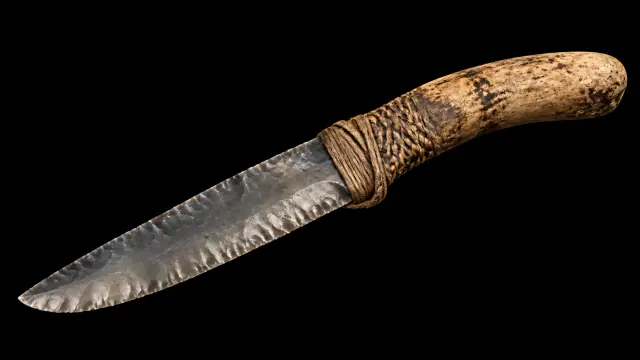
8th millennium BCE · Pre-Pottery Neolithic B context
Nahal Hemar Knives
Prehistory
Date of the blade assemblage and its Pre-Pottery context, not of an inventoried blade.
Read the record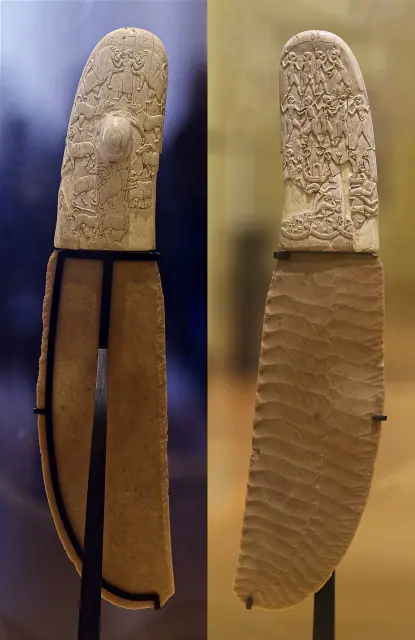
3600–3200 BCE · Naqada II C–D
Gebel el-Arak knife
Ancient Egypt
Approximate dating according to the record.
Read the record
Also connected, without a comparable date (1)
These objects are not placed after the others: an unknown date does not mean a more recent object.
- Copper and stoneAncient Egypt · ca. 3100–2700 BCE
A closer look
About 2 min to read · 3 sections. Further reading and sources · free access. Editorial review recorded: .
Two ways of knapping in the same gravel pit
Barnfield Pit preserves a rare sequence: first, Clactonian flakes and cores, almost without handaxes; then pointed Acheulean handaxes in the Middle Gravels, and higher up oval forms, some with a twisted edge. A 2025 study measured those upper handaxes in three dimensions and confirmed that they differ from the pointed ones. Its authors suggest that the change in technical norms may have begun earlier than was thought.
A date that rests on the landscape
The deposits formed during a temperate period between two glaciations. Later excavations south of the village found tools and animal remains in equivalent gravels, which their authors place at about 400,000–380,000 years ago. The date comes from correlating the deposits, not from a measurement on this tool.
A person in the same gravels
The Swanscombe skull consists of three fragments found between 1935 and 1955 that fit together; the face is missing. It probably belonged to a woman and is considered a form ancestral to the Neanderthals. It is held at the Natural History Museum in London. Kent’s heritage record mentions replicas displayed at the Swanscombe leisure centre and at Dartford Museum; their current display is not verified here. Sharing a site does not tell us who knapped each handaxe.
- Heritage · Kent Historic Environment Record · Swanscombe skullAccess recorded: .
Location and territory
LOCATED SITE
Barnfield Pit · Swanscombe (Kent)Marker for the former gravel pit, now within Swanscombe Heritage Park; it does not mark the exact spot of any piece.Sources and references
Did you enjoy this exhibit?
Your opinion helps us improve the museum. You can change it whenever you like.
Loading your rating…