
 English
 Español
 Français
 Italiano
 Deutsch
 Русский
 Português
 Polski
 Română
 Svenska
 Norsk bokmål
 Suomi
 Türkçe
 العربية
 简体中文
 한국어
 हिन्दी
 Ελληνικά
PRE-POTTERY NEOLITHIC B · 8TH MILLENNIUM BCE · FLINT
Nahal Hemar Knives
What we can learn from a used edge
Wear helps study these knives. Their possible link to funerary practices remains an interpretation.
Museum documentation · free public access, no account required.
Reconstruction · Declared visual hypothesis
Reconstruction provided to the project. It is not an archaeological photograph nor a metric facsimile. Materials, finish, proportions and visible details may differ from the original. The handle and its binding are a visual proposal; they do not represent a hafting from this assemblage confirmed by research.
Explore in 3D
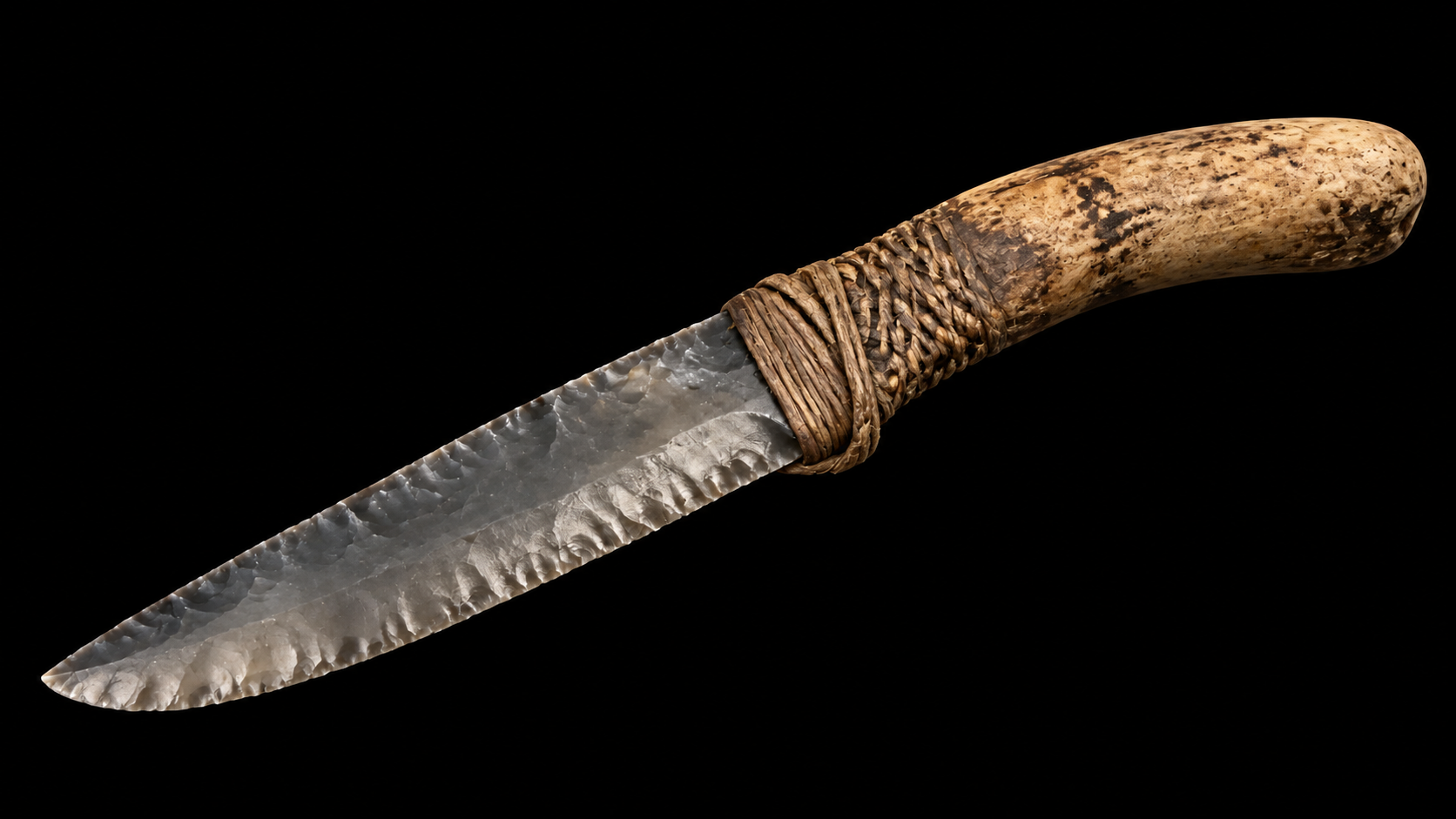
Load the model only when you want to explore it. Drag or use the arrow keys to turn it; + and − zoom. Closing it releases its memory.
User-provided digital reconstruction; file metadata declares Tripo. It is not an archaeological scan nor a metric replica. The display scale is indicative, not a measurement of the original; the supplied geometry is preserved intact. Representation provided for the Nahal Hemar knives record. The thematic association alone does not identify an inventoried piece; edges, handles and assemblies are interpretive.
History and context
In Nahal Hemar Cave, near the Dead Sea, numerous flint blades were deposited. Many have two opposing notches near the base: this shape characterises the so-called Nahal Hemar knives. Wear analysis shows that several blades were used before being left there.
The presence of human remains and unusual objects led to the proposal of funerary practices. A 2020 study suggested that some knives may have been involved in the treatment of corpses. This is an interpretation of the assemblage, not a proven scene for each blade.
Evidence and interpretation
The blades, their notches and use-wear traces are documented. The reconstruction provided is not linked to a specific inventory: its long handle is not presented as a confirmed archaeological hafting. Nor does it prove who used the knives or a precise ritual.
Catalogue facts
- Date
- 8th millennium BCE · Pre-Pottery Neolithic B context
- Location
- Nahal Hemar Cave · Judean Desert, Israel
- Archaeological material
- Flint blades · many with two basal notches
- Scope
- Record of an assemblage · not of an inventoried blade
A SHARED TOPIC, DIFFERENT MOMENTS
Objects connected through time
Follow a topic across the collections. A shared tag is a way to compare objects, not proof that one culture influenced another.
The order uses the midpoint of each approximate date range; ranges can overlap. Spacing does not represent elapsed time. Swipe, scroll or use the arrows. With the sequence focused, use ← / →, Home or End.
Flint3 dated objects
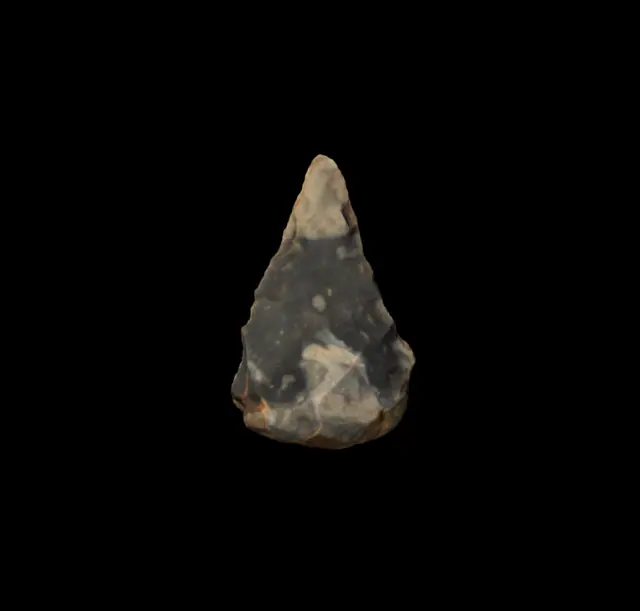
≈425,000–375,000 years
Swanscombe handaxe
Prehistory
Approximate catalogue age for the Hoxnian interglacial (MIS 11); editorial reference 2026 for ordering only, not calibrated dating.
Read the record You are viewing
8th millennium BCE · Pre-Pottery Neolithic B context
Nahal Hemar Knives
Prehistory
Date of the blade assemblage and its Pre-Pottery context, not of an inventoried blade.
Current record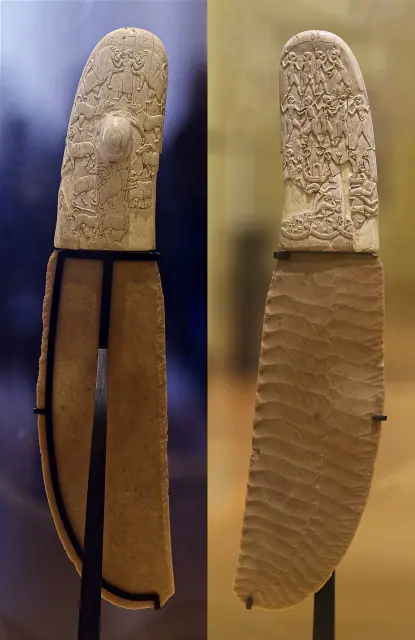
3600–3200 BCE · Naqada II C–D
Gebel el-Arak knife
Ancient Egypt
Approximate dating according to the record.
Read the record
Also connected, without a comparable date (1)
These objects are not placed after the others: an unknown date does not mean a more recent object.
- Copper and stoneAncient Egypt · ca. 3100–2700 BCE
A closer look
About 4 min to read · 9 sections. Further reading and sources · free access. Editorial review recorded: .
The edge holds a history of work
To investigate a blade, it is not enough to call it a knife. Its manufacture and microscopic edge traces are compared. The study of the assemblage indicates uses prior to deposition and proposes the entry of objects at different times. It does not describe a single ceremony that gathered all the pieces at once.
A hypothesis on the treatment of the dead
The team linked evidence of animal tissue cutting with a context that included human remains and objects of possible ritual use. They proposed that some blades may have been used to treat human bodies. That combination of evidence allows the idea to be investigated, but does not turn every cut into proof of sacrifice, violence or a specific funerary practice.
The reconstruction’s handle is not an identification
The record concerns an archaeological assemblage, not a piece whose inventory number has been linked to the supplied file. Its long-handled knife is a reconstruction; that handle does not prove an original hafting system. The documentation of the tools must be consulted separately. The basketry, location or agricultural use of the Charavines knife are not transferred to it.
It was not a knapping workshop
One clue lies in what is missing. The assemblage studied in 2020 contained hundreds of blades, but no flint cores or the abundant waste from their manufacture. The researchers concluded that the tools arrived prepared. It is not the waste of a workshop, but a selection transported to the cave. The absence of production waste also limits the investigation: to know all the working steps, the blades must be compared with documented workshops at other sites.
The blade already had much of its shape before retouch
These knives were made mainly on pointed blades obtained by knapping from opposite ends of the core. Many already emerged with a usable shape; it was not necessary to retouch the entire surface. Notches near the base completed the characteristic type. There were different sizes, not a single repeated measure. Scars from previous removals allow us to recognise a work plan that is not evident if we only look at the edge or the silhouette of the finished knife.
Technique helps trace relationships between communities
Who brought the pieces to Nahal Hemar? The CSIC team compared their technology with that of neighbouring communities. They considered a link with the farming settlements to the north more likely than with the hunter-gatherer groups to the south. It is a proposal based on manufacturing methods, not on a name written in stone. The cave thus allows us to ask about movements and contacts: living in a settlement did not imply that all activities took place within it, nor that objects circulated only among nearby houses.
A tool can take part in different activities
The research compares the cave with different ways of treating and remembering the dead: burials beneath dwellings, bone removals, and modelled faces on skulls. The opposition between 'useful tool' and 'ceremonial object' may be too rigid. The researchers propose that some blades participated in those practices, not that they were merely gifts deposited afterwards. An object could acquire importance through what it intervened in, as well as through its material or the effort of making it.
Other knives of the same type appeared at Kharaysin
Nahal Hemar also names a type of knife, not the provenance of all its specimens. At Kharaysin, Jordan, two deposits of blades with the characteristic notches were found, studied in 2022. Some fitted together because they came from successive removals from the same flint block. The deposits were near a funerary area and contained still-usable tools, circumstances that led the team to distinguish them from a reserve for future domestic tasks.
The marks can also tell how they were transported
The Kharaysin study identified on one blade abrasions interpreted as contact with other blades during packing and transport. In other areas, damage pointed to hafting. These are observations distinct from cut marks: they allow several stages of a tool's life to be separated. They do not automatically reconstruct the haft of the knives in this entry, but they show why the faces and base are also examined, not just the edge.
Location and territory
APPROXIMATE LOCATION
Nahal Hemar · Judean Desert, IsraelSurroundings of the cave where the assemblage was deposited; the recreation is not linked to an individual find.Where it is held
Israel Antiquities Authority · part of the assemblage in the Israel Museum
Item or group in the record · Documented collection
The 2020 study locates the studied lithic collection in Bet Shemesh, except for 21 blades/knives and a sickle in the Israel Museum, Jerusalem. It does not identify the reconstruction with a piece from those collections.
The holding institution is documented; public display may change. Check its official record before visiting.
Sources and references
- Borrell, Ibáñez and Bar-Yosef · study of the flint tools (2020)
- CSIC · research team explanation on producer communities and funerary context (2020)
- Borrell, Ibáñez and Bar-Yosef · technology and selection of the Nahal Hemar tools (Quaternary International, 2020; copy at the Centre de recherche français à Jérusalem)
- Borrell et al. · Production and Use of Nahal Hemar Knives: New Evidence from Kharaysin (Sidestone Press, 2022; author's text)
Did you enjoy this exhibit?
Your opinion helps us improve the museum. You can change it whenever you like.
Loading your rating…