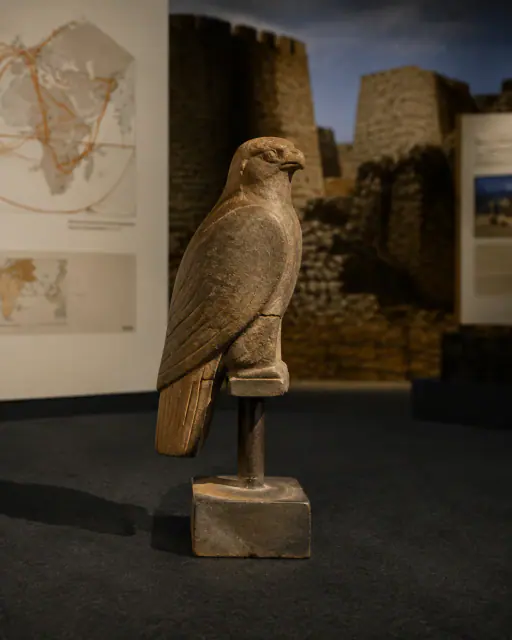
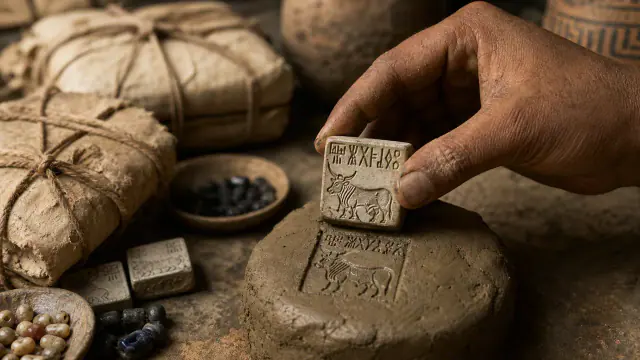
Declared visual reconstruction; not a photograph of the original nor documentary evidence.
History and context
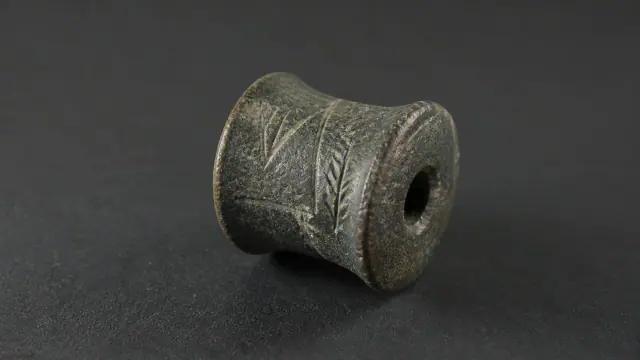
Objects and tablets with Linear A show that Minoan centres employed writing. A steatite seal from the Met presents linear signs, a minimal scale for an enormous question: what language they recorded.
The label does not translate what nobody has deciphered. The signs suffice to speak of administration and communication, but do not authorise kings’ names or secret tales.
The steatite seal measures only 1.2 by 1.4 cm and bears possible papyrus motifs and Linear A signs. A grand historical question thus fits in a minuscule object.
The repertoire can be classified and compared even if not translated. That difference between recognising signs and understanding language is central.
Evidence and interpretation
Documented fact: Linear A appears in Minoan contexts and remains undeciphered; the Met catalogues a seal with Linear A signs. Interpretation and caution: Linguistic reading proposals and exact functional proposals for each inscription lack full consensus.
Expanded documentation: The Met dates the seal to c. 1700–1500 BCE and catalogues Linear A signs on steatite.
Expanded interpretation and caution: The function of the object and the reading of each sign are uncertain; no invented words must be added.
Catalogue facts
Narrative date
c. 1700–1500 BCE
Location
Crete, Greece
Material
Inscribed steatite
Context
Minoan writing
Curatorial reading
The documented fact and its interpretation appear separately in the evidence block.
Dimensions
1.2 × 1.4 cm
Material
Steatite
Documentary coverage
3 museum, heritage, primary corpus or research sources for this stop.
A SHARED TOPIC, DIFFERENT MOMENTS
Objects connected through time
Follow a topic across the collections. A shared tag is a way to compare objects, not proof that one culture influenced another.
The order uses the midpoint of each approximate date range; ranges can overlap. Spacing does not represent elapsed time. Swipe, scroll or use the arrows. With the sequence focused, use ← / →, Home or End.
About 1 min to read · 1 section. Further reading and sources · free access. Editorial review recorded: .
Writing also left the archive
The small seal fits into a panorama of supports much more varied than tablets. The repertoire studied by Mnamon includes Linear A inscriptions on gold or silver pins and rings, stone vessels and architectural elements. Approximately nine out of ten known documents are on clay, so stone supports represent an important minority. Sanctuary offering tables repeat formulae, while warehouse documents combine signs and quantities. Comparing those categories allows situating this miniature without automatically assigning it the accounting function of a tablet.

 English
 Español
 Français
 Italiano
 Deutsch
 Русский
 Português
 Polski
 Română
 Svenska
 Norsk bokmål
 Suomi
 Türkçe
 العربية
 简体中文
 한국어
 हिन्दी
 Ελληνικά
 You are viewing