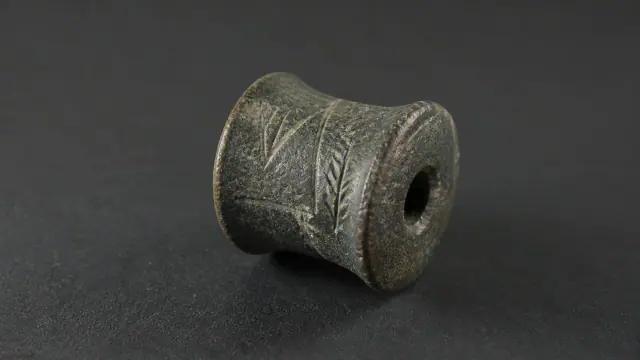
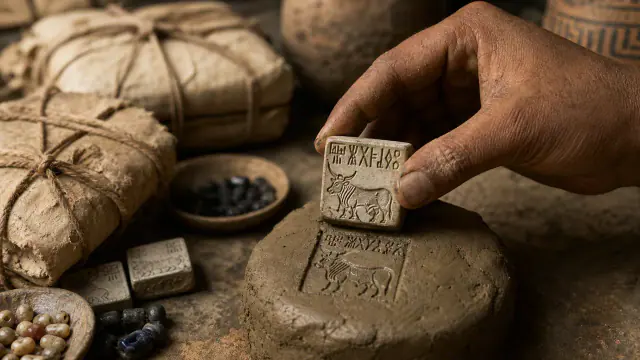
Declared visual reconstruction for museographic context; it is not a photograph of the original nor documentary evidence.
History and context
Steatite seals show animals and sequences of signs; some carry a perforated posterior protuberance for attaching them. Their short inscriptions circulate between objects and places, but do not provide a bilingual text that would allow decipherment.
The display leaves the enigma open. The visitor can see the repetition of signs without receiving an invented translation nor the name of a non-existent dynasty.
The seal was carved in negative to produce an impression. The posterior protuberance allowed it to be held or carried, while animal and signs defined a visual identity.
The inscriptions are so brief that even robust patterns are insufficient to translate them. Preserving their silence is a scientific decision, not a narrative lack.
Evidence and interpretation
Documented fact: The Indus sign system is documented on seals and other media, and remains undeciphered. Interpretation and caution: Readings that identify a language, a king, a religion or complete messages lack academic consensus.
Expanded documentation: Steatite seals with animals and signs appear in the Indus and beyond; the system remains undeciphered.
Expanded interpretation and caution: “Unicorn”, owner, merchant or official are functional hypotheses; no consensus translation exists.
Catalogue facts
Narrative date
ca. 2600–1900 BCE
Location
Harappa, Mohenjo-daro and other Indus centres
Material
Carved and fired steatite
Context
Sealing and inscription
Curatorial reading
The documented fact and its interpretation appear separately in the evidence block.
Reading
Inscriptions normally very brief
Technique
Carved, treated and fired steatite
Documentary coverage
3 museum, heritage, primary corpus or research sources for this stop.
A SHARED TOPIC, DIFFERENT MOMENTS
Objects connected through time
Follow a topic across the collections. A shared tag is a way to compare objects, not proof that one culture influenced another.
The order uses the midpoint of each approximate date range; ranges can overlap. Spacing does not represent elapsed time. Swipe, scroll or use the arrows. With the sequence focused, use ← / →, Home or End.
About 1 min to read · 1 section. Further reading and sources · free access. Editorial review recorded: .
The shared animal preserves differences of hand
Kenoyer notes that the unicorn motif maintains basic elements during the mature phase, but presents minor variations in engraving and ornamentation. Comparative studies investigate whether these differences correspond to workshops, artists or regions. Repetition therefore does not eliminate technical diversity. Enlarging an image and comparing horns, neck, body and object situated in front of the animal allows formulation of questions about production. It is another avenue of research that works alongside the study of the signs and does not depend on translating them.

 English
 Español
 Français
 Italiano
 Deutsch
 Русский
 Português
 Polski
 Română
 Svenska
 Norsk bokmål
 Suomi
 Türkçe
 العربية
 简体中文
 한국어
 हिन्दी
 Ελληνικά
 You are viewing