
 English
 Español
 Français
 Italiano
 Deutsch
 Русский
 Português
 Polski
 Română
 Svenska
 Norsk bokmål
 Suomi
 Türkçe
 العربية
 简体中文
 한국어
 हिन्दी
 Ελληνικά
AMÉRICA · MUSEUM-UMBRELLA · SEVEN ANDEAN TRADITIONS
Pre-Inca cultures
Caral, Chavín, Nazca, Moche, Tiahuanaco, Wari and Chimú had their own histories before the Inca Empire.
Museum documentation · free public access, no account required.
Generated reconstruction · Declared visual hypothesis
Declared visual reconstruction; not a photograph of the original nor documentary evidence.
Why this doorway leads to another museum
«Pre-Inca» is an editorial retrospective label, not the name of a single civilisation. The museum brings together seven trajectories with succeeding and overlapping chronologies: Caral, Chavín, Nazca, Moche, Tiwanaku, Wari and Chimú.
Sunken plazas, pilgrimage sanctuaries, geoglyphs, regional cuts, highland cities, expansive states and adobe capitals transformed the Andes long before the Tawantinsuyu. The temporal bands overlap: Nazca and Moche coexisted; Tiwanaku and Wari were contemporary and distinct powers. Contact, shared iconography or conquest must be demonstrated in each region.
Period covered by the destination museum: Caral ≈3000 BCE—Chimú until ≈1470 CE
BEFORE YOU ENTER
An introduction to Pre-Inca cultures
Find your place in time, explore the changes and choose where to go next.
- When
- Caral ≈3000 BCE—Chimú until ≈1470 CE · AMÉRICA
- Where
- Central Andes and connected areas · Pacific coast, valleys and Altiplano
- What this collection brings together
- Several Andean cultures and political formations, not a single civilisation
Long before the Inca Empire, different societies built cities, temples and exchange networks in the Andes. This museum tours Caral, Chavín, Nazca, Moche, Tiwanaku, Wari and Chimú. They were not stages of a single people: they lived in different landscapes, some coexisted and each had its own history.
The desert coast, the valleys and the highlands posed different needs. To compare these cultures we must look at how they obtained water and food, organised labour and expressed authority and beliefs. A textile, a vessel or a musical instrument offer other entries, beyond the great monuments. The word «pre-Inca» orients the chronology, but does not mean that their sole destiny was to become Incas.
PLACE MATTERS
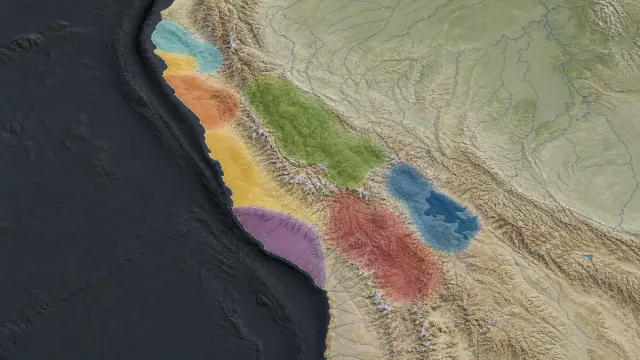
Territory and connections
The tour focuses on present-day Peru and the Titicaca basin, including Bolivia. The areas of influence overlapped and changed; they do not form a common frontier for all these cultures.
A HISTORY OF CHANGE
The main periods
Dates are approximate. Periods help us navigate the past, but their boundaries were not always the same in every region.
c. 3000–1800 BCE
Caral-Supe
Monumental centres are articulated in Supe and neighbouring valleys; they are not the unique nor direct origin of all later Andean societies.
c. 1200–400 BCE
Chavín and Early Horizon
Chavín de Huántar connects pilgrimage and images across distinct regions; iconographic diffusion does not demonstrate a territorial empire.
c. 200 BCE–600 CE
Nazca and Moche
Nazca and Moche flourish in parallel in separate valleys; they are not stages of the same coastal state.
c. 500–1000 CE
Wari and Tiwanaku
Two contemporary powers reorganise distinct regions; their zones of contact and control remain debated.
Continue the story: 3 more periods
c. 1000–1200 CE
Post-Wari reconfiguration
After the loss of the great Wari and Tiwanaku centres, regional kingdoms and lordships reorganise landscapes and networks.
c. 900–1470 CE
Chimor and Chan Chan
Chimor expands its control along the north coast from Chan Chan; tributary valleys and the administrative nucleus had distinct degrees of integration.
c. 1470 CE
Inca conquest of Chimor
The Tawantinsuyu incorporates Chimor; the new colour marks political domination, not the immediate disappearance of communities, workshops or Chimú memories.
BEYOND THE DATES
How people lived and saw the world
Different ways of gathering and governing
Caral brought together monumental architecture and ceremonial spaces many centuries before Wari or Chimú. Later, Wari and Tiwanaku were distinct powers, although they shared some visual motifs. Chan Chan was the capital of the Chimú kingdom. Comparing these centres allows us to understand that a ceremonial plaza, a city and the capital of a kingdom do not mean exactly the same thing.
Living in very different landscapes
The coast and the Altiplano did not offer the same resources. In Chan Chan, urban organisation included spaces of artisanal production, while Tiwanaku articulated a highland society. Food, labour and movement depended on these local conditions. That is why the museum places each piece in a place and a date, rather than proposing an identical «pre-Inca» daily life for all.
Textiles that also showed social position
Textiles required preparing fibres, spinning, dyeing and mastering complex techniques. Tunics from different regions allow comparison of forms, materials and designs. Some elite garments communicated rank and identity, besides clothing. Wari artisans combined traditions and motifs from other areas in their own works: innovation also arose from contact.
Gathering in plazas and ceremonial centres
Caral and Chavín show that the construction of spaces for ceremonies was important at very different times. In Chavín, plazas, galleries and images of beings with animal traits formed part of a religious set. Centuries later, Tiwanaku developed its own monumental centre. That several places gathered pilgrims or celebrations does not demonstrate that all worshipped the same gods.
Connecting the coast with the highlands
Camelid fibres, feathers and shells circulated between distant regions. Llama caravans participated in exchange networks linked to the Wari world. In Chavín, conch trumpets show another consequence of those contacts: a material arriving from afar could become an object used during a ceremony.
Instruments from different periods
In Caral bone flutes were found; in Chavín, conch trumpets. The Nazca made ceramic instruments, among them drums and antaras, and Moche images show musicians in processions. They do not form a single orchestra: they allow us to follow concrete traditions separated by centuries and many kilometres.
PEOPLE AND TESTIMONIES
Meet the people
The records distinguish historical figures, representations and reconstructions. They explain their context, the available sources and their connections with other people.
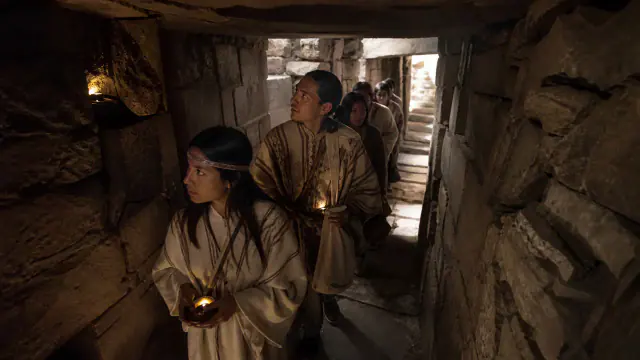
The Sensory Labyrinth
The interior passages of Chavín altered light, sound and orientation.
Read the record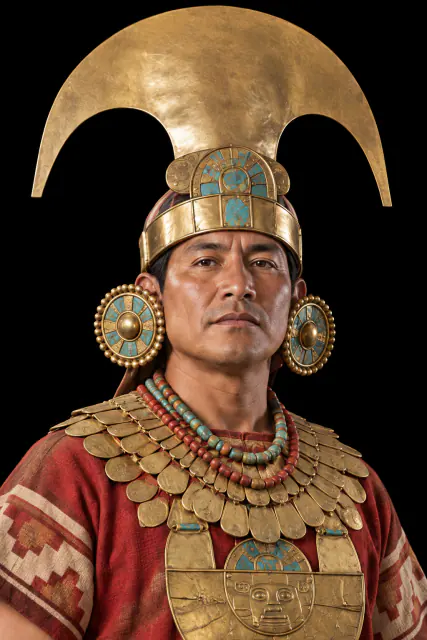
Lord of Sipán
The jewellery and emblems from the tomb show the importance of the Lord of Sipán, although we do not know his name.
Read the recordLOOK CLOSER
Objects and places to start with
A selection from the destination museum. Open each record to explore its documentation and images.
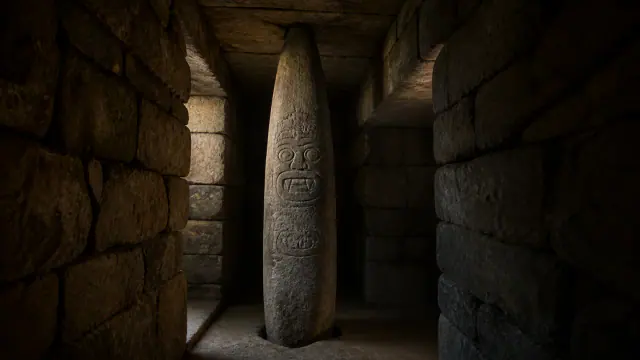
The Lanzón
The Lanzón is a granite sculpture over four metres tall, installed inside a gallery at Chavín.
Read the record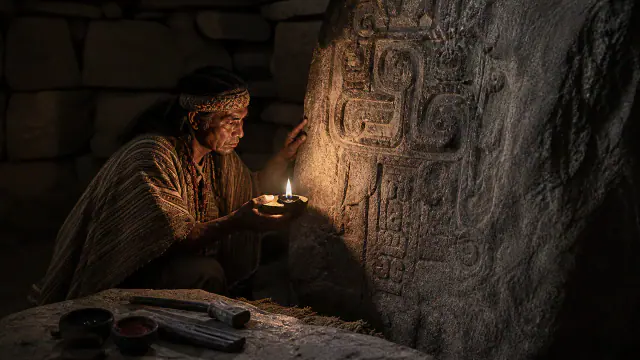
The Raimondi Stele
Some lines on the Raimondi Stele form more than one figure depending on how the image is viewed.
Read the record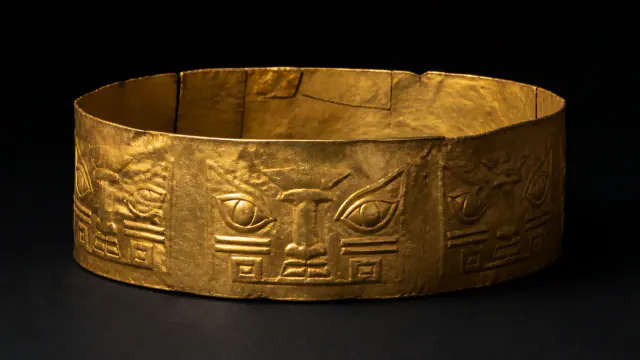
Gold at Kuntur Wasi
The jewellery from Kuntur Wasi shares motifs with other regions, without proving dependence on Chavín.
Read the record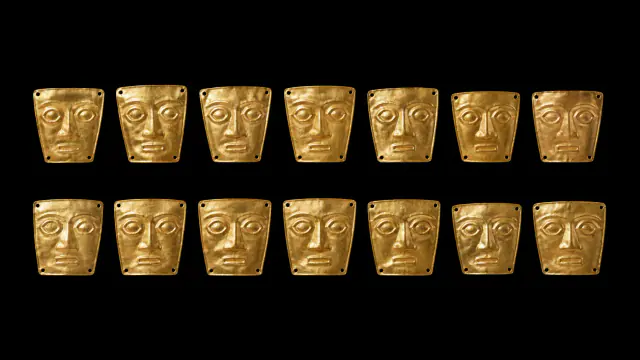
Tomb 1 at Kuntur Wasi
The tombs at Kuntur Wasi preserved a gold crown, other ornaments, beads and ceramics.
Read the recordWHAT REMAINS
Its legacy and ongoing research
The Incas incorporated knowledge and territories from earlier societies, but those societies also deserve to be known in their own right. Their buildings, textiles, exchange systems and images allow us to trace both continuities and ruptures throughout Andean history.
CHOOSE YOUR NEXT STOP
Inside this museum
Sources for this introduction
Each theme links to its documentation. The full bibliography also brings together sources for the chronology, the people and the connection between the museums.
View all sources and references →Evidence and interpretation
This window distinguishes the documented core from its historical reach: Coast, highlands and Altiplano of the central Andes: Caral, Chavín, Nazca, Moche, Tiwanaku, Wari and Chimú. The label «Pre-Inca cultures» summarises a changing trajectory, not an immobile population nor a universal stage of progress.
Catalogue facts
- Narrative date
- Caral ≈3000 BCE—Chimú until ≈1470 CE
- Location
- Coast, highlands and Altiplano of the central Andes: Caral, Chavín, Nazca, Moche, Tiwanaku, Wari and Chimú.
- Type of entity
- Museum-umbrella · seven Andean traditions
- Scope
- Coastal valleys of present-day Peru, central Andes and Bolivian-Peruvian Altiplano, with distinct reaches and changing frontiers.
- Key innovation
- Monumental urbanism of Caral and Chan Chan
- Legacy
- The Incas inherited landscapes, techniques and memories from earlier societies, but were not the inevitable outcome nor the direct continuation of a single pre-Inca tradition.
A closer look
About 1 min to read · 1 section. Further reading and sources · free access. Editorial review recorded: .
Entering the Andes can also begin by listening
The publication of the Caral-Supe project presents sets of thirty-two transverse flutes and thirty-eight trumpets as evidence of a collective musical practice. The instruments add another dimension to plazas and buildings: those spaces could also organise gatherings and sounds. The quantity preserved invites investigation of coordination and learning, without reconstructing a melody that has not been transmitted. This example belongs to Caral; it does not equally describe Chavín, Nazca or Chimú. The pre-Inca gateway brings together distinct histories, and sound is a way to begin differentiating them.
Location and territory
LOCATED SITE
Caral-Supe · PeruMarker of the Sacred City of Caral-Supe.Cultural connections
Sources and references
- UNESCO · Sacred City of Caral-Supe
- UNESCO World Heritage Centre · Chavin
- UNESCO · Tiwanaku
- Caral Archaeological Zone · Caral-Supe, the civilisation, 2008
- UNESCO · Chan Chan
- The Met · Imperial Wari Art
- The Met · The Andean Tunic, 400 BCE–1800 CE
- The Met · Golden Kingdoms, Sipán
- The Met · music in the ancient Andes
- Stanford Report · Origins of authority at Chavín
- UNESCO · Chavin Archaeological Site
- Stanford University · Chavín archaeoacoustics research
- The Met · Moche chronology and Sipán tomb
- Royal Tombs Museum of Sipán
- MINCETUR · Royal Tombs Museum of Sipán
YOUR NEXT VISIT
Explore Pre-Inca cultures
The same collection, two ways to explore. Choose the experience that suits you.
Did you enjoy this exhibit?
Your opinion helps us improve the museum. You can change it whenever you like.
Loading your rating…