
 English
 Español
 Français
 Italiano
 Deutsch
 Русский
 Português
 Polski
 Română
 Svenska
 Norsk bokmål
 Suomi
 Türkçe
 العربية
 简体中文
 한국어
 हिन्दी
 Ελληνικά
AMERICA · LIVING CULTURAL TRADITION · FORMATIVE ROOTS · CITY-STATES
Mayas
The Maya peoples developed cities, writing and calendars, and maintained contact with other societies of Mesoamerica.
Museum documentation · free public access, no account required.
Generated reconstruction · Declared visual hypothesis
Declared visual reconstruction, created for museographic contextualisation; not a photograph of the original nor does it constitute documentary evidence.
Why this doorway leads to another museum
The earliest Maya communities grew within a Mesoamerica already connected. They exchanged goods and ideas with Olmec-style societies and reworked shared repertoires, but were not a direct ethnic, linguistic or political continuation of the Olmecs.
While the Olmec centres of the Gulf Coast articulated their own networks, local processes in the Maya area transformed plazas, calendars, writing and dynastic memory into forms of authority. Early Olmec and Maya centres participated in networks of jade, obsidian, images and ceremonial practices. Later, Maya cities formed alliances, wars and trade circuits; they never constituted a single, stable empire.
Period covered by the destination museum: Villages from c. 2500 BCE · centres from c. 1000 BCE
BEFORE YOU ENTER
An introduction to Maya
Find your place in time, explore the changes and choose where to go next.
- When
- Villages from c. 2500 BCE · centres from c. 1000 BCE · AMERICA
- Where
- Maya area of Guatemala, Belize, Yucatán and southern Mexico; the formative prologue incorporates the Gulf Olmec networks without confusing them with a Maya phase.
- What this collection brings together
- Living cultural tradition · formative roots · city-states
The earliest Maya communities grew within a Mesoamerica already connected. They exchanged goods and ideas with Olmec-style societies and reworked shared repertoires, but were not a direct ethnic, linguistic or political continuation of the Olmecs.
While the Olmec centres of the Gulf Coast articulated their own networks, local processes in the Maya area transformed plazas, calendars, writing and dynastic memory into forms of authority.
PLACE MATTERS
Territory and connections
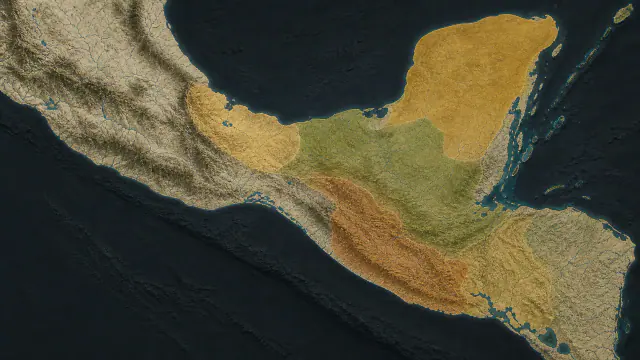
Maya area of Guatemala, Belize, Yucatán and southern Mexico; the formative prologue incorporates the Gulf Olmec networks without confusing them with a Maya phase. Twenty-four stops trace San Lorenzo and La Venta as Mesoamerican context, and then the cities, dynasties and Maya communities.
A HISTORY OF CHANGE
The main periods
Dates are approximate. Periods help us navigate the past, but their boundaries were not always the same in every region.
c. 1800–1000 BCE
Early Formative Mesoamerican
Gulf and Maya area villages grow in parallel spheres; proximity and exchange do not prove linear ethnic descent.
c. 1400–400 BCE
San Lorenzo and La Venta
Gulf centres project repertoires and exchanges across Mesoamerica; they are not an early Maya state nor a unique 'mother culture'.
c. 1000 BCE–250 CE
Preclassic Maya
Maya centres raise plazas, platforms and large complexes within several regions; there is no common empire.
250–600 CE
Early Classic
Dynasties and city-states articulate networks of alliance, war and writing; Tikal is a centre among many.
Continue the story: 4 more periods
600–900 CE
Late Classic
Numerous courts reach high urban density and compete through alliances and wars; cultural extent does not define shared sovereignty.
c. 800–1000 CE
Terminal Classic
Many courts of the southern lowlands reconfigure or lose population, while northern centres and rural communities continue.
c. 900–1524 CE
Postclassic
Chichén Itzá, Mayapán and highland kingdoms represent successive and parallel trajectories, not an imperial Maya restoration.
16th century–present
Conquest, reduction and living peoples
Colonisation alters territories and authorities, but Maya peoples and languages continue; the map must never be left empty after the Classic period.
BEYOND THE DATES
How people lived and saw the world
How they were organised
The Maya lowlands did not form a single empire: dynasties of cities like Tikal and Calakmul built hegemonies through marriages, war, captives and alliances with lesser centres. Those networks shifted direction over the course of the Classic.
Monuments fixed accessions, anniversaries and victories from the perspective of the commissioning court. Comparing rival inscriptions allows recovery of negotiation and defeat behind a carefully selected royal memory.
What daily life was like
Stored water, stuccoed surfaces, pottery and domestic spaces sustained urban life far beyond the palaces. Uneven conservation makes kings and rituals more visible than farmers, porters and artisans.
The early community at Ceibal combined mobility and sedentism instead of shifting from one way of life to another instantaneously. Everyday practices varied between forest, coast, highland and very separate periods.
What they knew how to do
Tikal's reservoirs converted quarries and depressions into water infrastructure; their function depended on slopes, sealed surfaces and periodic cleaning. Engineering and urban authority reinforced each other.
Maya blue stabilised an organic dye within a fibrous clay by heat. The Dresden Codex shows another complex technology: bark paper, stuccoed, folded and painted to organise astronomical cycles.
What they believed
The murals of San Bartolo link plants, supernatural beings and authority in a preclassical narrative of great maturity. Their cosmological reading arises from comparative iconography, not from a direct translation of the colonial Popol Vuh.
The bleeding of K’ab’al Xook and the iconography of the ballgame show bodies producing legitimacy through pain, offering and spectacle. Not all ceremonies followed the same script nor ended in sacrifice.
Who they interacted with
Separate cities exchanged materials, images and knowledge by land, river and coastal routes. The provenance of palygorskite allows tracing some movements, but does not by itself reconstruct contracts or itineraries.
Chichén Itzá connected northern Yucatán with wide networks during the early Postclassic, while codices and shared styles show circulation of specialists. Contact does not equal political control from a single capital.
Art, music and storytelling
Murals, lintels and stelae were originally polychrome and dialogued with rooms, doors and plazas. Seeing bare limestone or isolated fragments today changes the scale and motion with which they were conceived.
Rabinal Achí maintains voice, dance, music, masks and costume as a living community work. Its current staging contains continuity and transformation, not an intact recording from the 15th century.
PEOPLE AND TESTIMONIES
Meet the people
The records distinguish historical figures, representations and reconstructions. They explain their context, the available sources and their connections with other people.
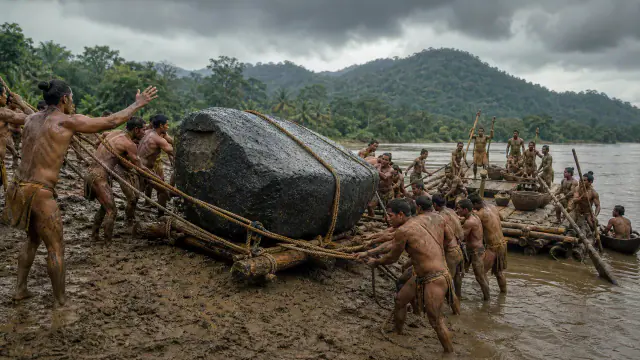
The basalt route
The basalt blocks for the colossal heads were transported from the Tuxtlas over tens of kilometres.
Read the record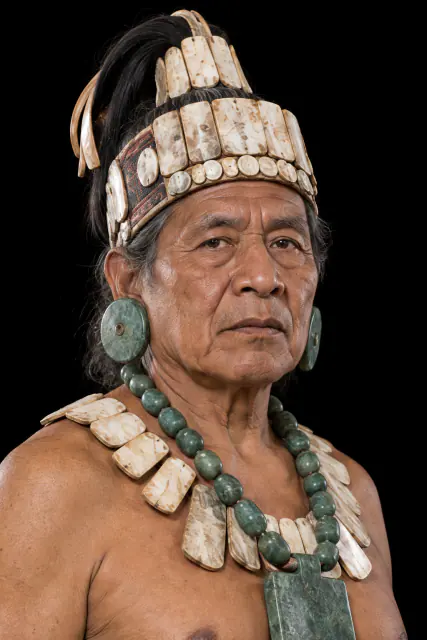
K’inich Yax K’uk’ Mo’
Inscriptions and a tomb allow us to approach the founder without turning later memory into a photograph.
Read the record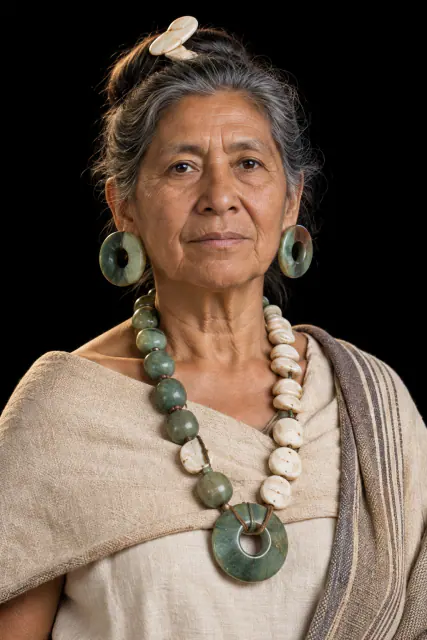
The woman from the Margarita Tomb
A burial documents a life; her name and kinship remain open.
Read the recordLOOK CLOSER
Objects and places to start with
A selection from the destination museum. Open each record to explore its documentation and images.
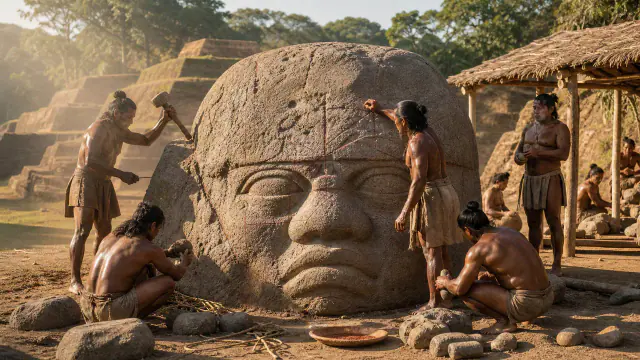
Head 2
The head is usually interpreted as the portrait of a ruler whose name we do not know.
Read the record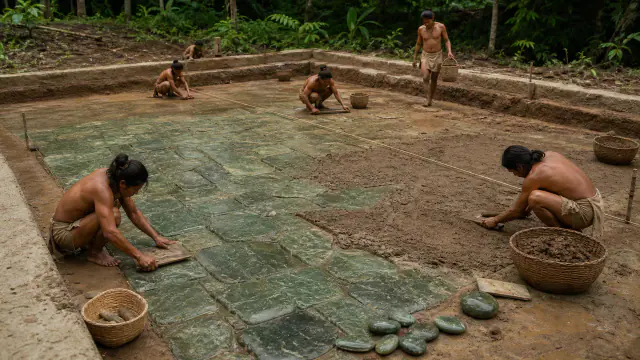
The invisible mosaic
The green stone blocks were placed to form designs and then covered with clay.
Read the record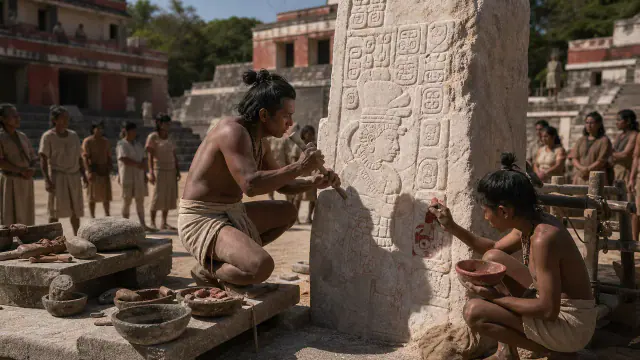
The date of 292
The stela preserves a date equivalent to 292 CE, the earliest Long Count date known at Tikal.
Read the record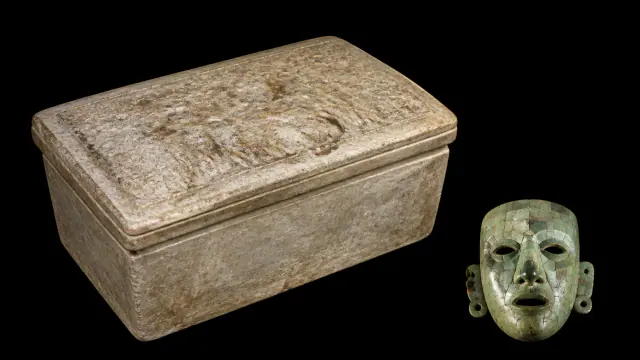
Pakal’s grave goods
Pakal’s tomb preserved his sarcophagus, a mask and jade jewellery, together with other offerings.
Read the recordWHAT REMAINS
Its legacy and ongoing research
Maya traditions continue in communities, languages and living practices; their history does not end with the abandonment of some Classic cities.
CHOOSE YOUR NEXT STOP
Inside this museum
Sources for this introduction
Each theme links to its documentation. The full bibliography also brings together sources for the chronology, the people and the connection between the museums.
View all sources and references →Evidence and interpretation
This window distinguishes the documented core of its historical reach: Maya area of Guatemala, Belize, Yucatán and southern Mexico; the formative prologue incorporates the Gulf Olmec networks without confusing them with a Maya phase. The label 'Maya' summarises a changing trajectory, not an immobile population nor a universal stage of progress.
Catalogue facts
- Narrative date
- Villages from c. 2500 BCE · centres from c. 1000 BCE
- Location
- Maya area of Guatemala, Belize, Yucatán and southern Mexico; the formative prologue incorporates the Gulf Olmec networks without confusing them with a Maya phase.
- Type of entity
- Living cultural tradition · formative roots · city-states
- Scope
- Twenty-four stops trace San Lorenzo and La Venta as Mesoamerican context, and then the cities, dynasties and Maya communities.
- Key innovation
- Logosyllabic hieroglyphic writing
- Legacy
- Maya traditions continue in communities, languages and living practices; their history does not end with the abandonment of some Classic cities.
A closer look
About 1 min to read · 1 section. Further reading and sources · free access. Editorial review recorded: .
Monumentality does not always begin with a royal portrait
At Aguada Fénix, Tabasco, the study published in 2020 combined lidar and excavation to identify an artificial platform about 1,400 metres long, with nine causeways. Construction was dated approximately between 1000 and 800 BCE. The team proposed an important role for communal labour and less marked inequality than at San Lorenzo. It is an interpretation of the evidence, not proof of a conflict-free society. The comparison shows that connections with Olmec centres coexisted with local solutions: they do not oblige drawing a simple ethnic succession between Olmecs and Maya.
Location and territory
REGIONAL AREA
Maya area of Guatemala, Belize, Yucatán and southern Mexico; the formative prologue incorporates the Gulf Olmec networks without confusing them with a Maya phase.Gulf Olmec coast and Maya lands brought together in a museum; contact does not equal lineal descent. The footprint marks the orienting centre of the scope, not a boundary nor an exact point.Cultural connections
Sources and references
- UNESCO · Tikal National Park
- UNESCO Intangible Heritage · Rabinal Achí dance drama tradition
- Peabody Museum, Harvard · Hieroglyphic Stairway of Copán
- Nature · Monumental architecture at Aguada Fénix and the rise of Maya civilization, 2020
- UNESCO · Ancient Maya City and Protected Tropical Forests of Calakmul
- PNAS · Development of sedentary communities in the Maya lowlands: Coexisting mobile groups and public ceremonies at Ceibal
- USGS · First direct evidence of pre-Columbian sources of palygorskite for Maya Blue
- Science Advances · The earliest Maya calendar in the San Bartolo mural fragments
- British Museum · Yaxchilán Lintel 24
- UNESCO · Chichen-Itza
- INAH · San Lorenzo Tenochtitlán Archaeological Zone
- The Met · Olmec Art
- National Museum of Anthropology · Colossal Head 2 of San Lorenzo
- INAH · San Lorenzo Tenochtitlán
- Penn Museum · John F. Harris, inscriptions of the founder of Copán
- Penn Museum · excavation of the Hunal and Margarita tombs (1999)
- Penn Museum · Margarita Tomb, excavation update (2000)
- Florida Museum · Margarita context research
YOUR NEXT VISIT
Explore Mayas
The same collection, two ways to explore. Choose the experience that suits you.
Did you enjoy this exhibit?
Your opinion helps us improve the museum. You can change it whenever you like.
Loading your rating…