
 English
 Español
 Français
 Italiano
 Deutsch
 Русский
 Português
 Polski
 Română
 Svenska
 Norsk bokmål
 Suomi
 Türkçe
 العربية
 简体中文
 한국어
 हिन्दी
 Ελληνικά
EUROPE · BALKANS, AEGEAN AND LOWER DANUBE
Thracians
Thracians · kingdoms, treasures and memory
The settlements, graves and treasures allow us to know the Thracian peoples and their contacts with other cultures.
Museum documentation · free public access, no account required.
Documentary original · Exact correspondence
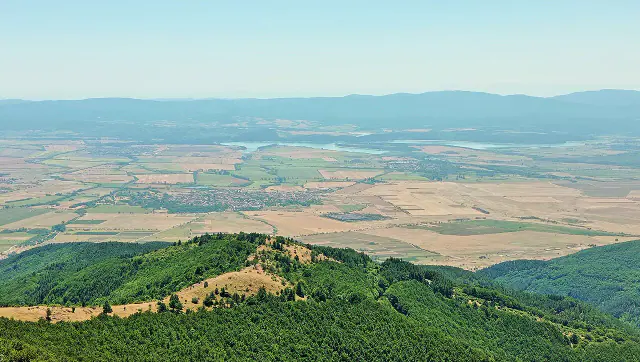
Documentary photograph of the original or the exact site.
Laci3 · CC0 1.0 Universal
Why this doorway leads to another museum
From prehistoric antecedents to the Roman province, the museum brings together an atlas by periods, persons, treasures, painted tombs, culture and beliefs. The Coțofenești helmet and the Poroina Mare rhyton now dialogue with major Balkan assemblages and with the lives of their rulers.
Documented gates link to Greeks, Perses, Scythians, Celts and Rome. Each relationship preserves its differences: no prestige object identifies an entire people nor do all groups called Thracian share the same kingdom. Extended readings explain what we know and what remains open.
Period covered by the destination museum: Bronze Age–Roman period · prehistoric prologue
BEFORE YOU ENTER
An introduction to Thracians
Find your place in time, explore the changes and choose where to go next.
- When
- Bronze Age–Roman period · antecedents from the Neolithic
- Where
- Eastern Balkans · northern Aegean, Black Sea and Lower Danube
- What this collection brings together
- Diverse Balkan communities and kingdoms; not a permanent Thracian empire
The Thracian world occupied part of the Balkans, between the Aegean, the Black Sea and the Danube environs. There lived different communities and kingdoms, related to Greeks, Persians and, later, Romans. Their gold, silver and bronze objects allow us to know the wealth of certain elites, but they are only a part of a much wider society.
To understand it, it is useful to join three types of evidence: settlements and their everyday objects, tombs and sanctuaries, and ancient texts. The paintings of Kazanlak and the sculptures of Sveshtari show local artistic solutions; the Pistiros inscription allows us to approach agreements between rulers and merchants. None of these places represents all Thracians by itself.
PLACE MATTERS
Territory and connections
Includes areas of present-day Bulgaria and parts of Greece, Turkey and Romania. Ancient borders changed and do not coincide with those of these countries.
A HISTORY OF CHANGE
The main periods
Dates are approximate. Periods help us navigate the past, but their boundaries were not always the same in every region.
2nd millennium–8th century BCE
Before the kingdoms
Agricultural communities, metallurgy and the circulation of objects precede the known kingdoms from written sources.
8th–6th centuries BCE
Coastal peoples and cities
The interior and the Greek cities of the Aegean and the Black Sea enter into trade networks, conflicts and agreements.
Towards 513–479 BCE
Achaemenid pressure
Persian campaigns alter the relations between cities, local chieftaincies and passages towards Europe.
5th century–mid-4th century BCE
The power of the Odrysians
Terēs and Sitalces build a kingdom of alliances, tributes and local powers; Cotis I intervenes afterwards in the politics of the northern Aegean.
Continue the story: 4 more periods
Towards 340–323 BCE
Between Macedonia and the local dynasties
Philip II and Alexander impose a new military superiority, while communities and local authorities remain.
323–3rd century BCE
Seuthes, Lysimachus and the Getae
After Alexander, Seuthes III, Lysimachus and the Getic powers negotiate and fight. Seuthopolis offers an identifiable royal centre.
1st century BCE–mid-1st century CE
Kings under Roman hegemony
The local monarchy survives for a time within unequal relations with Rome.
Towards 46–3rd century CE
Thrace within the Empire
The annexion under Claudius modifies the government. Cities, roads and local cults continue under imperial institutions.
BEYOND THE DATES
How people lived and saw the world
Kings who also had to negotiate
Power did not depend solely on conquest. The Pistiros inscription records merchants' rights and commitments of Thracian authorities. By recalling privileges granted under Cotis I, it shows that the security of persons, goods and routes formed part of the relations between rulers and communities.
Beyond the treasures
At Vetren-Pistiros, storage vessels, cooking pottery, portable hearths and animal remains have been documented. These materials allow us to study what was stored, how food was prepared and what activities were carried out in the settlement. They are less striking than gold, but indispensable for knowing the people who lived there.
Working metal and building in stone
Helmets, leg protections, vessels and horse ornaments show the skill of the workshops that worked gold, silver and bronze. In another sphere, tombs combine carefully constructed spaces with reliefs and painting. Luxury objects allow us to study techniques and commissions, as well as the taste of those who could afford them.
How the dead were remembered
Monumental tombs were places of burial and social representation. Kazanlak preserves a painted programme; Sveshtari combines sculpted female figures with mural decoration. Comparing them helps to recognise different ways of honouring the dead and displaying rank, without supposing that all communities followed the same ritual.
The interior and the coasts were connected
The Vetren-Pistiros assemblage brings together local and imported ceramics and testimonies of commercial activity. The inscription associated with Pistiros mentions merchants from Aegean cities and guarantees for their business. The exchanges implied agreements, obligations and possible conflicts: they were not simply the arrival of Greek objects to a territory without its own organisation.
Paintings, banquets and ceremonial scenes
In Kazanlak, the paintings allow us to observe people and actions chosen for a funerary context. In Sveshtari, sculpture and colour organise the space of the chamber. The images help us to ask about the banquet, the ceremony and the representation of the body. They do not by themselves preserve a complete explanation of each gesture nor a music that we can certainly reproduce.
PEOPLE AND TESTIMONIES
Meet the people
The records distinguish historical figures, representations and reconstructions. They explain their context, the available sources and their connections with other people.
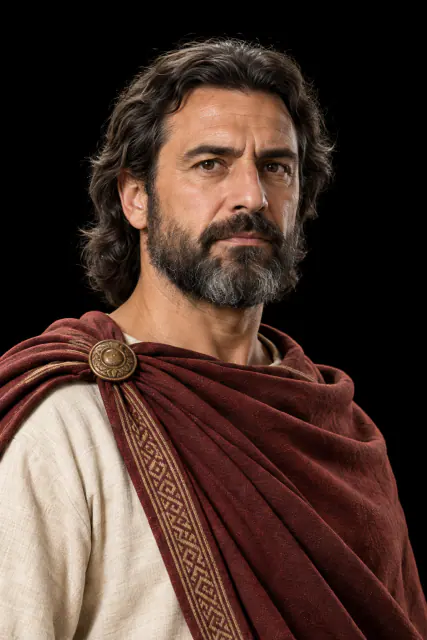
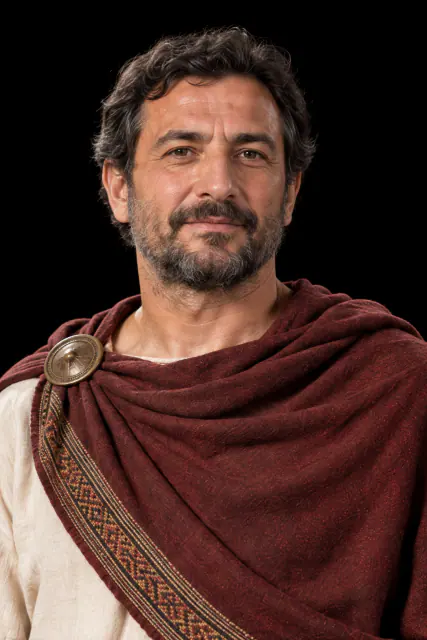
Cotys I
A coin preserves the name of Cotis I alongside a horse and a cup, without showing his portrait.
Read the record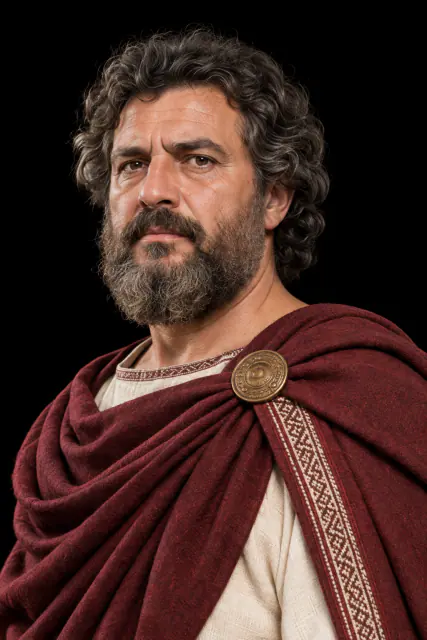
Seuthes III
The head found alongside Golyama Kosmatka preserves beard, hair and eyes of different materials.
Read the record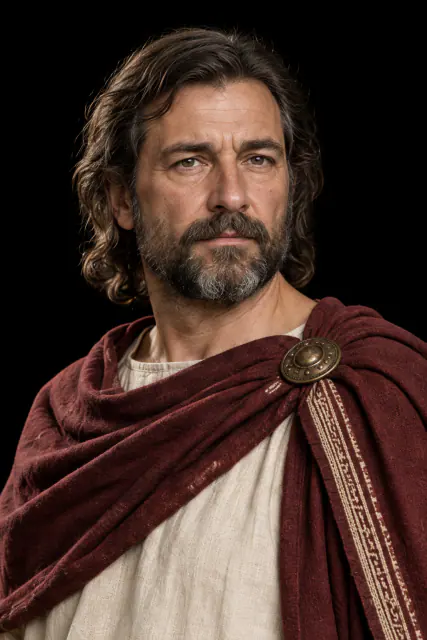
Dromichaetes
Greek sources recount that he defeated Lysimachus and then negotiated his release.
Read the recordLOOK CLOSER
Objects and places to start with
A selection from the destination museum. Open each record to explore its documentation and images.
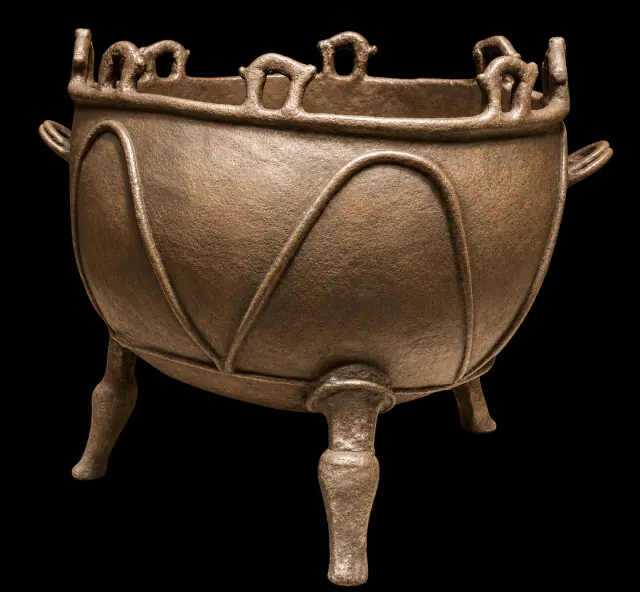
Scorțaru cauldron
An object arrived at the museum with an ancient repair and a lost context.
Read the record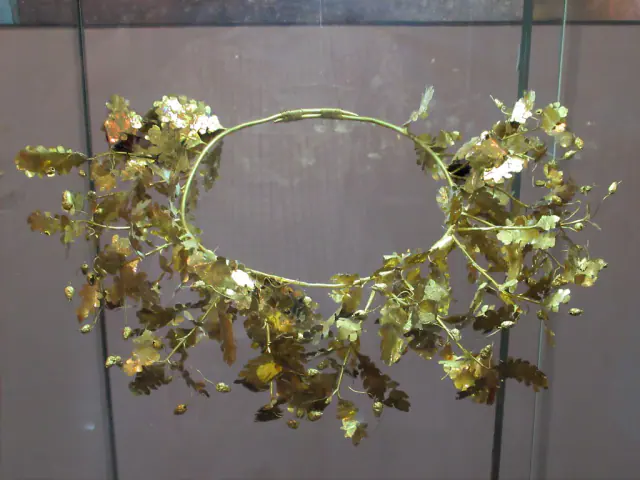
Golyamata Kosmatka
The tomb contained a gold crown, valuable vessels, weapons and horse ornaments.
Read the record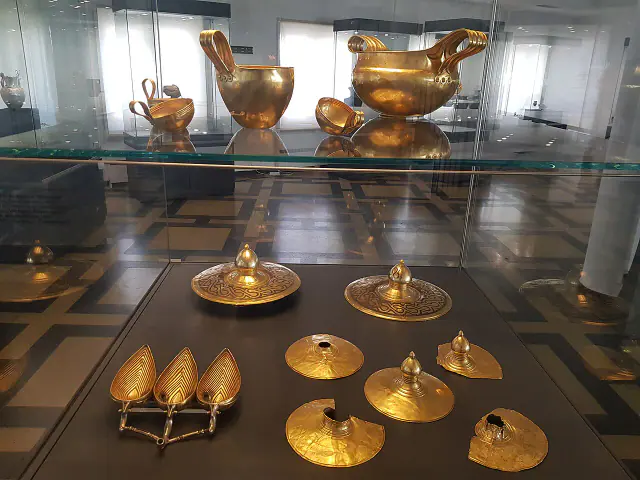
Valchitran
Among the gold vessels stands out a piece of three joined cavities whose exact use is unknown.
Read the record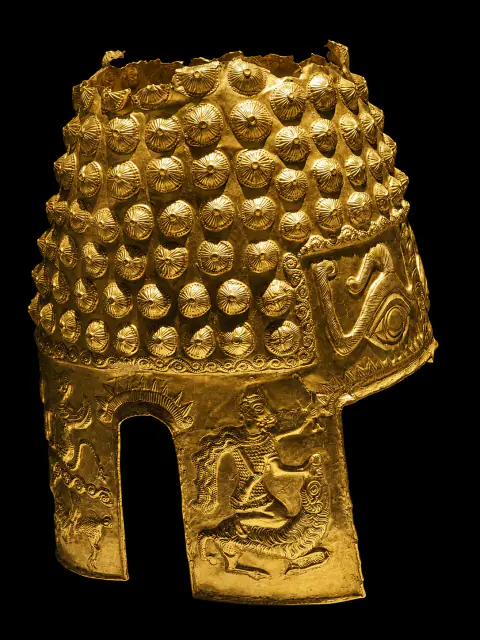
Coțofenești helmet
The helmet combines large eyes on the front with scenes of sacrifice and fantastic animals.
Read the recordWHAT REMAINS
Its legacy and ongoing research
The painted tombs, architecture and metal objects show a local creation that participated in wider networks. Their study allows us to know the Thracians as protagonists of Balkan history, not only as neighbours described by Greeks and Romans.
CHOOSE YOUR NEXT STOP
Inside this museum
Sources for this introduction
Each theme links to its documentation. The full bibliography also brings together sources for the chronology, the people and the connection between the museums.
View all sources and references →Evidence and interpretation
Synthesis of different societies and periods. Bronze Age antecedents do not demonstrate an ethnic genealogy; Getic and Scythian testimonies are expressly distinguished.
Catalogue facts
- Period
- Bronze Age–Roman period · prehistoric prologue
- Location
- Eastern Balkans · Northern Aegean · Lower Danube
- Tour
- Context, persons, treasures, culture, architecture, beliefs and connections
A closer look
About 1 min to read · 1 section. Further reading and sources · free access. Editorial review recorded: .
Prestige was also painted around the dead
The Kazanlak tomb preserves a painted programme that the Iskra Museum interprets as a funerary banquet, accompanied by musicians, servants, horses and a chariot race. Its grave goods were looted in antiquity, while the paintings preserved a distinct part of the representation of power. The contrast expands the Thracian doorway beyond gold: architecture, the positioning of images and the gathering of figures matter. The figures do not by themselves provide names or biographies; they document how a scene of memory and prestige was intended to be constructed.
- Museum · Historical Museum Iskra · Kazanlak TombAccess recorded: .
Location and territory
REGIONAL AREA
Eastern Balkans · Northern Aegean · Lower DanubeRegional framework of the northern Aegean to the eastern Balkans and Lower Danube; not the border of a single state. The museum breaks down changes by period. The footprint indicates the orientative centre of the area, not a border nor an exact point.Cultural connections
Sources and references
- MAN · Archaeological Treasures of Romania, catalogue 2022
- MNIR · Thracian-Getic goldwork
- Getty Museum · Thrace and the Classical World
- Historical Museum Iskra · Kazanlak Tomb
- Thucydides · History of the Peloponnesian War II, 29 and 95–101
- Herodotus · Histories V, 1–27, edition of A. D. Godley
- Pausanias · Description of Greece I, 9–10: Lysimachus and the Getae
- Polybius · Histories IV, 45–46: the kingdom of Tylis
- Britannia / Cambridge · Claudius and the annexation of Thrace (2023)
- Ethnological Museum of Thrace · regional history
- Arrian · Anabasis I, 1–4, translation Chinnock
- Velkov and Domaradzka · Kotys I et l'emporion Pistiros de Thrace, BCH 118 (1994)
- Diodorus · Historical Library XVIII, 14
- Denise Demetriou · Pistiros and the Commercial Networks of the Northern Aegean
- University of Liverpool / ADS · Vetren-Pistiros excavations
- UNESCO · Thracian tomb of Sveshtari
- UNESCO · Thracian tomb of Kazanlak
- Thucydides II.29 · edition Richard Crawley, ToposText
- Herodotus IV.80 · edition A. D. Godley, Perseus
- NAIM-BAS · ring and grave goods from Svetitsa
- The Met · The Thracians
- The Met · Man and the Horse
- Corpus Nummorum · type 5044 of Cotis I
- Demosthenes · Against Aristocrates 8, 118–119 and 127; edition A. T. Murray, Loeb 1939
- Getty · Portrait of Seuthes III, exhibition label
- Getty · Power and Pathos, catalogue of works, no. 8; inventory NAIM 8594
- Ministry of Culture of Bulgaria · UNESCO nomination 6085
- Diodorus XIX.73 · Historical Library, Loeb edition
- Diodorus XXI.11–12 · Historical Library, Loeb edition
- Strabo VII.3.14 · Geography, edition H. L. Jones, Loeb
- UNESCO · Thracian tomb of Sveshtari
- Diodorus XXI · capture and banquet; translation by George Booth (1814)
- Diodorus XXI · the two tables; George Booth (1814)
YOUR NEXT VISIT
Explore Thracians
The same collection, two ways to explore. Choose the experience that suits you.
Did you enjoy this exhibit?
Your opinion helps us improve the museum. You can change it whenever you like.
Loading your rating…