
 English
 Español
 Français
 Italiano
 Deutsch
 Русский
 Português
 Polski
 Română
 Svenska
 Norsk bokmål
 Suomi
 Türkçe
 العربية
 简体中文
 한국어
 हिन्दी
 Ελληνικά
COTIS I · ODRISIAN KINGDOM
Cotys I
Cotys I: the king's name in metal
A coin preserves the name of Cotis I alongside a horse and a cup, without showing his portrait.
Museum documentation · free public access, no account required.
Reconstruction · Declared visual hypothesis
Portrait recreated with AI of Cotis I. The clothing is supported by the historical context of the card; the face, the age represented, the coloration and the unpreserved details are interpretive. It is neither an authentic photograph nor a scientific facial reconstruction.
Tracekeepers
History and context
A coin can preserve a ruler’s name without showing his face. On a coin issue of Cotys I, a horse occupies one side; the other combines a two-handled cup with the inscription ΚΟΤΥ. The object gives the royal name a material presence.
Cotys ruled in a world of negotiations and conflicts with Athens. Demosthenes remembers the honors that the Athenians had granted him and recounts the division of power after his death. His speech shows the extent to which the fate of the kingdom affected Aegean politics.
Evidence and interpretation
The selected coin documents its issuer, not a portrait. Corpus Nummorum preserves dating c. 383–359 BCE; other chronologies place his death at 360. Do not infer a secure genealogy from the numerous reconstructions discussed.
Portrait recreated with AI of Cotis I. The clothing is supported by the historical context of the card; the face, the age represented, the coloration and the unpreserved details are interpretive. It is neither an authentic photograph nor a scientific facial reconstruction.
Catalogue facts
- Chronology
- c. 383–360/359 BCE · variable bibliographic chronologies
- Location
- Kypsela and Thrace Odrysia · present-day İpsala, Türkiye
A closer look
About 1 min to read · 3 sections. Further reading and sources · free access. Editorial review recorded: .
Read both sides
Type 5044 is a bronze coin attributed to Kypsela. The front part of a jumping horse is combined with a kotyle within a sunken square. The images and the inscription complement each other; No human figure appears on this coin issue.
- Research · Corpus Nummorum · type 5044 of Cotis IAccess recorded: .
A source with a cause to defend
Against Aristocrates is a judicial and political speech. Demosthenes uses the recent history of Thrace to persuade his listeners. His information on Cotys should be read for that purpose, without turning every judgment of the speaker into a neutral description of the king.
after the king
Demosthenes lists three rulers after the death of Cotys: Berisades, Amadochus, and Cersobleptes. The coexistence and rivalry between powers explains why a map of the kingdom cannot automatically extend the same borders after each succession.
Reference images and provenance
You can enlarge the documentary photograph of the piece related to this figure. It is not listed as an input of a generated portrait. The identification of the figure, when discussed, is explained in the file.
 View full-size photograph ⛶
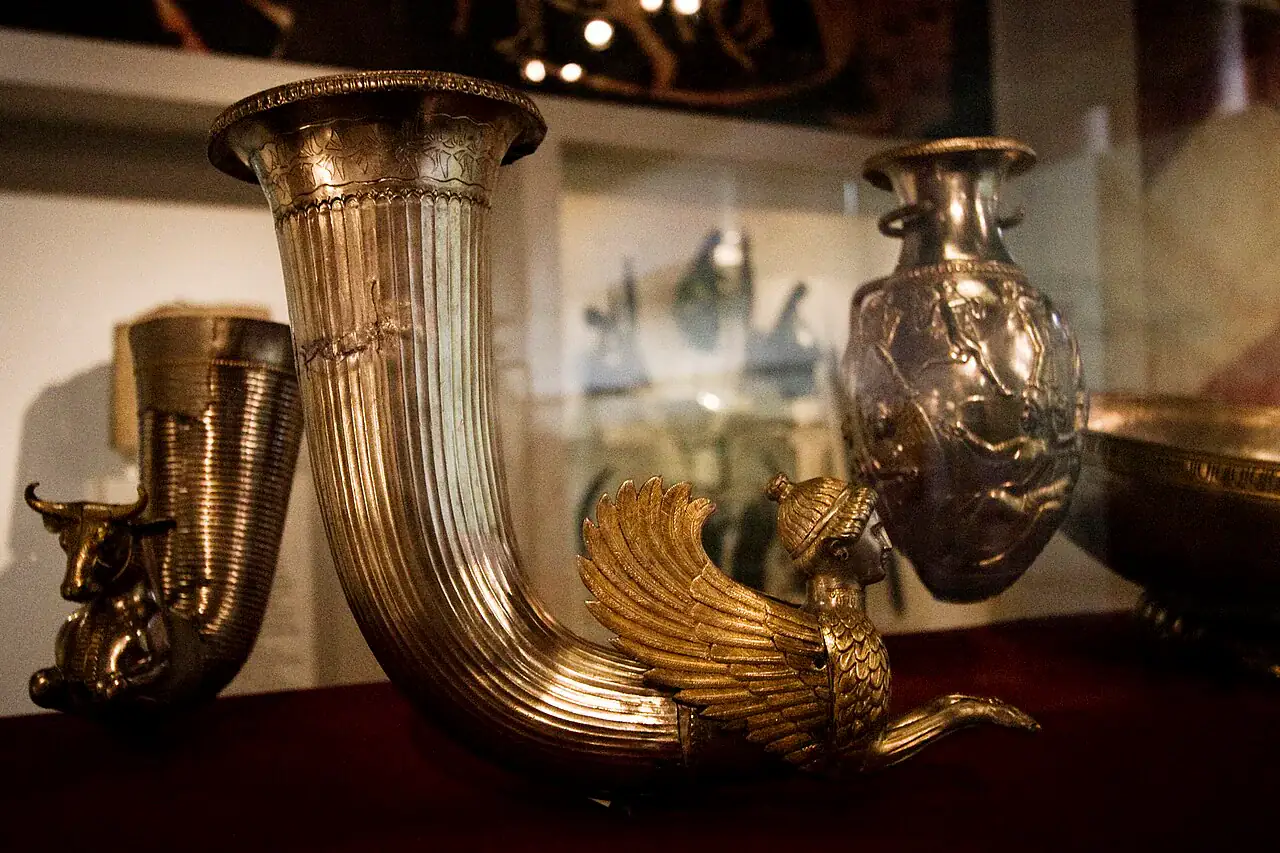
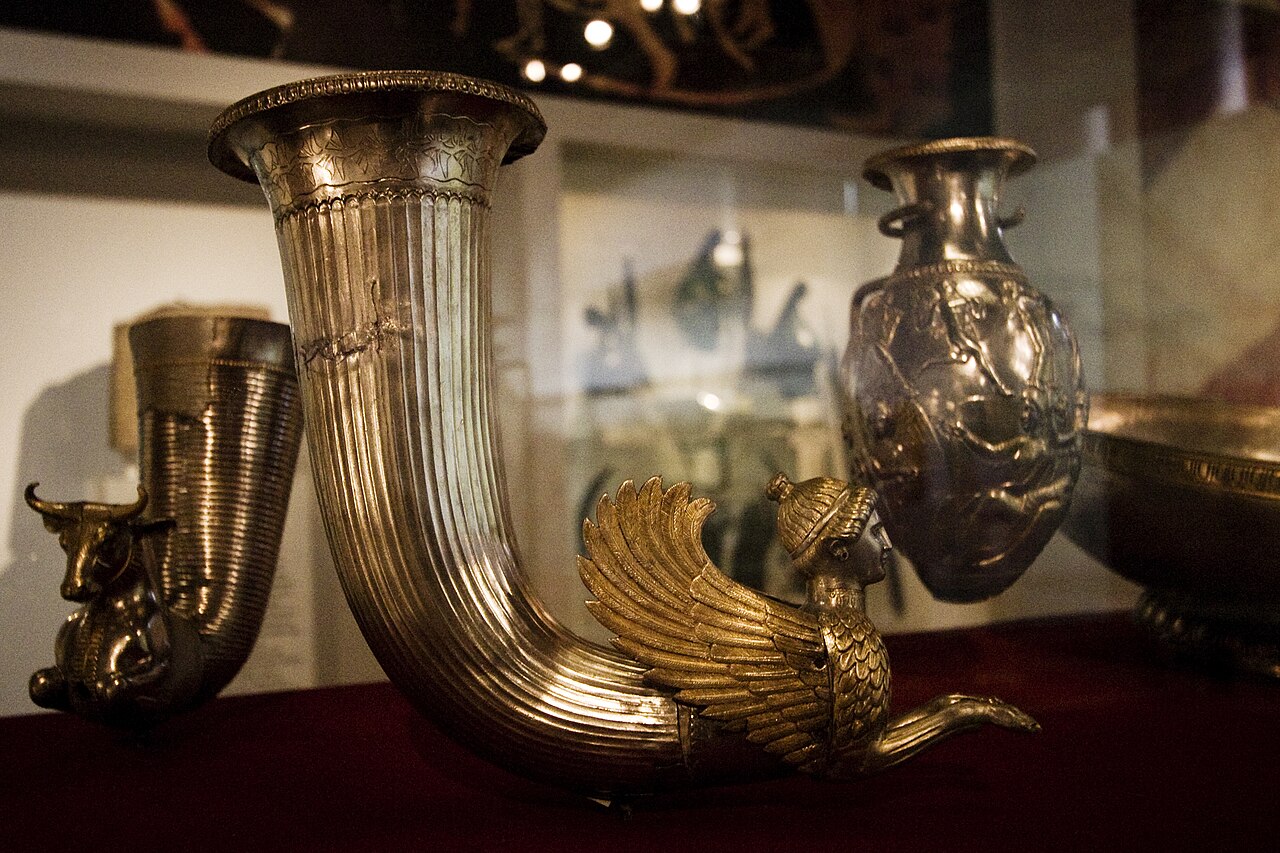
Borovo ware as material context of inscriptions with the name of Cotis. It is not a portrait of the king nor a photograph of the coin analyzed in the reading. Material context of Cotis I, not portrait; The photograph does not allow a specific inscription to be attributed to each visible vessel.
Contextual image · Contextual correspondence
Ann Wuyts

 View full-size reference ⛶
Documentary photograph of the reference object
This photograph is the registered source of the documentary image currently displayed; it is not presented as an input photograph for another generated portrait.
This photograph is the registered source of the documentary image currently displayed; it is not presented as an input photograph for another generated portrait.
Documentary original · Contextual correspondence
Ann Wuyts
Additional visual documentation
A cited publication does not establish which image was used to create the character.
Location and territory
REGIONAL AREA
Kypsela and Thrace Odrysia · present-day İpsala, TürkiyeApproximate surroundings of Kypsela, mint assigned by Corpus Nummorum; not place of birth.Sources and references
Did you enjoy this exhibit?
Your opinion helps us improve the museum. You can change it whenever you like.
Loading your rating…