
 English
 Español
 Français
 Italiano
 Deutsch
 Русский
 Português
 Polski
 Română
 Svenska
 Norsk bokmål
 Suomi
 Türkçe
 العربية
 简体中文
 한국어
 हिन्दी
 Ελληνικά
CHARACTER · GUIDE
Kael
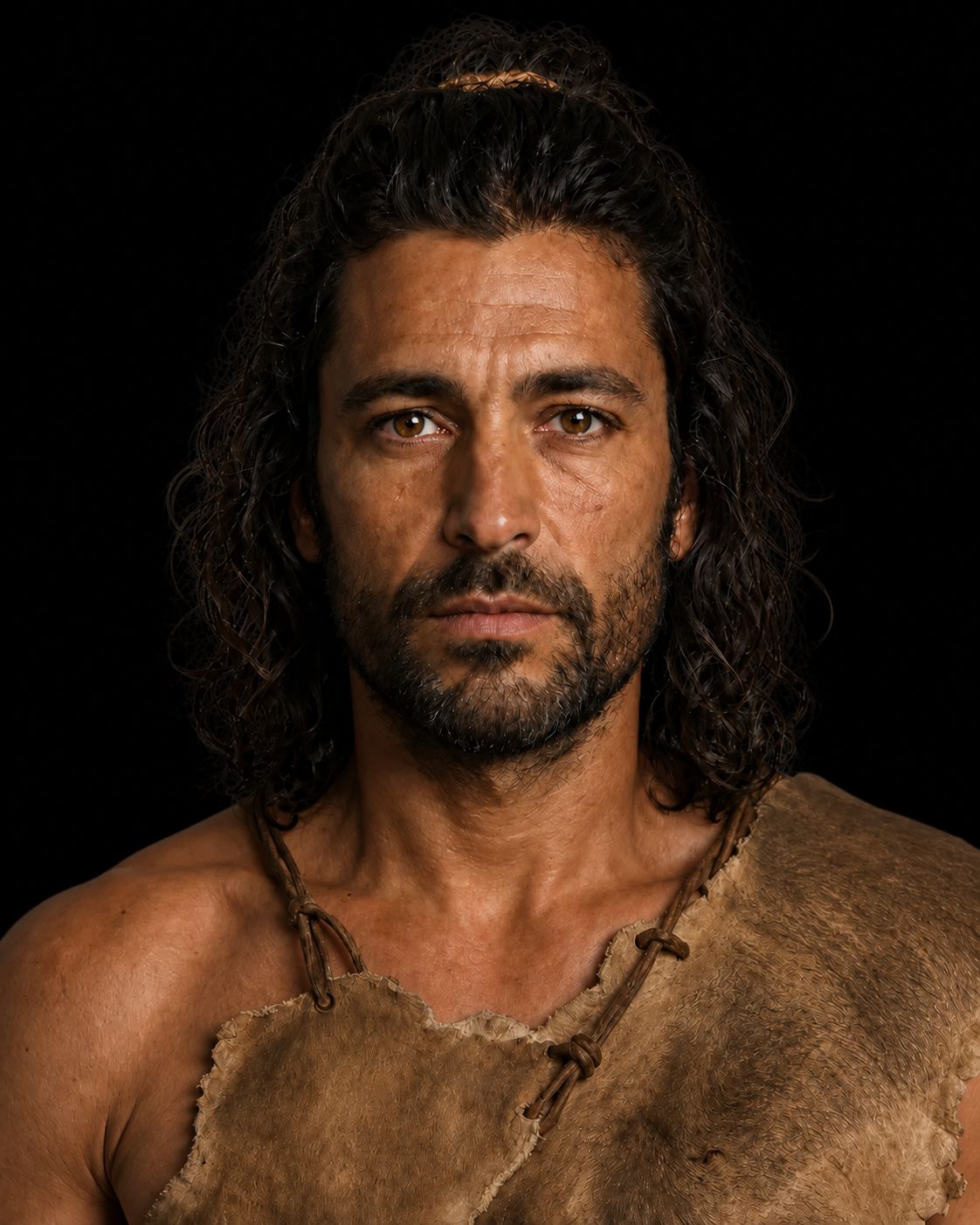
Kael, hunter and guide
Hunter, protector and first guide of Sarımğara.
Museum documentation · free public access, no account required.
Generated reconstruction · Declared visual hypothesis
Concept art of a fictional project character. AI edit of the background of the existing portrait, preserving its identity and framing; does not represent an archaeologically documented person or an exact preserved costume.
Tracekeepers
Explore in 3D
Load the model only when you want to explore it. Drag or use the arrow keys to turn it; + and − zoom. Closing it releases its memory.
Digital reconstruction supplied by the project and generated with Tripo. It is not an archaeological scan or a metric replica. The model is displayed at approximately life size: 1.74 m tall, the same height as in the Sarımğara game; this is a design decision for a fictional character, not an archaeological measurement. Kael is a fictional character representing an inhabitant of Sarımğara, a setting inspired by Çakmaktepe; Göbekli Tepe is a later destination in the story. The figure is shown in the technical T-pose in which the model was delivered, without a skeleton or animation; face, clothing and accessories are an interpretation, not an archaeological portrait.
History and context
Kael welcomes Aletheia and Veritas and introduces them to some people of the camp. He knows the paths, coordinates hunting trips and organises shifts for tending the fire. He shares that work with more inhabitants than appear as protagonists.
He is the elder brother of Daro and the uncle of Luma. When Daro promises help to another group, Kael asks him to discuss it with those who would have to accompany him. He trusts his experience, but does not want him to take others' time for granted.
Evidence and interpretation
Flint, fire and coordination are compatible with the period. Kael, his leadership and each specific scene are documented fiction of the game.
Canonical project design; tools, clothing and context are archaeologically documented, but the identity is fictional.
Catalogue facts
- Narrative date
- c. 9600 BCE
- Narrative setting
- Sarımğara · fictional setting inspired by Çakmaktepe, Anatolia
- Apparent age
- 39 years
- Function
- Hunter · protector · coordinator
- Customary object
- Flint core and hammerstone
- Status
- Fictional character · reconstruction
A closer look
About 1 min to read · 1 section. Further reading and sources · free access. Editorial review recorded: .
Coordinating without a palace
The excavated buildings at Çakmaktepe require thinking in different scales of cooperation: semi-subterranean circular dwellings and special buildings reaching up to sixteen metres in diameter. Their execution required working the rock and organising shared tasks. That is the historical ground of Kael's dilemma; not proof that a chief with his name existed. Fiction turns a problem visible in the architecture — how to gather labour and people — into individual decisions, without attributing to the settlement a monarchy or an administration that are not documented.
One history, two perspectives
What connects Kael with other people, and how the view changes from the other side. These interpretations are based on sources; they are not quotations or reconstructions of private thoughts.
COLLABORATION · FICTITIOUS NARRATIVE CANON
Kael ↔ Bora
Expedition coordinator
Kael incorporates Bora's observations and doubts before deciding routes, withdrawal and safety.
From Kael’s perspective
Bora contributes the terrain information that Kael cannot replace with authority. From the coordination, recognising a doubt of the tracker is part of deciding when to advance and when to turn back.
Read Bora’s perspective on Kael →FAMILY · FICTITIOUS NARRATIVE CANON
Kael ↔ Daro
Daro, his younger brother
Kael trusts that Daro knows how to move outside the camp. He worries that he promises help on behalf of others without consulting them. The discussion is between brothers, but it affects the whole group.
From Kael’s perspective
Kael trusts that Daro knows how to move outside the camp. He worries that he promises help on behalf of others without consulting them. The discussion is between brothers, but it affects the whole group.
Read Daro’s perspective on Kael →COLLABORATION · FICTITIOUS NARRATIVE CANON
Kael ↔ Lorn
Coordinator and companion
Kael refers the first test to Lorn and coordinates with him fire, materials and collective tasks.
From Kael’s perspective
From Kael's responsibility, Lorn turns a decision into something hands can do. Coordinating is not enough if the material fails: listening to the craftsman allows recognising the limits of an order.
Read Lorn’s perspective on Kael →FAMILY · FICTITIOUS NARRATIVE CANON
Kael ↔ Luma
Luma, his niece
Kael sees Luma grow up alongside other children of the camp. Being her uncle gives him a closeness different from the one he has when coordinating an expedition; he can listen to her questions without turning them into another task.
From Kael’s perspective
Kael sees Luma grow up alongside other children of the camp. Being her uncle gives him a closeness different from the one he has when coordinating an expedition; he can listen to her questions without turning them into another task.
Read Luma’s perspective on Kael →COLLABORATION · FICTITIOUS NARRATIVE CANON
Kael ↔ Oru
Coordinator and companion
Kael organises collective moments with Oru without confusing cohesion, memory and explanation of nature.
From Kael’s perspective
Oru offers Kael a way to gather the group around a shared memory. From the coordination, ceremony can sustain cooperation without thereby becoming a proven explanation of nature.
Read Oru’s perspective on Kael →COLLABORATION · FICTITIOUS NARRATIVE CANON
Kael ↔ Sira
Coordinator and companion
Kael needs Sira's calculation of food, distances and seasons before committing the group.
From Kael’s perspective
Sira contributes to Kael's coordination a concrete measure of what the group can sustain. A route or a task cease to be abstract decisions when compared with the distance and the reserves available.
Read Sira’s perspective on Kael →COLLABORATION · FICTITIOUS NARRATIVE CANON
Kael ↔ Tala
Decision-making companion
Kael needs Tala's tally of care before allocating shifts, shelter, fuel and risk.
From Kael’s perspective
Tala brings into Kael's decisions those who cannot wait for the end of the work. From the coordination, her intervention forces a priority to be measured also by the people it leaves unattended.
Read Tala’s perspective on Kael →Reference images and provenance
No verifiable entrance photograph is preserved for this representation. You may consult its documentation, but we would not present its face as an exact reconstruction.
Additional visual documentation
A cited publication does not establish which image was used to create the character.
Sources and references
- Canonical character sheet for Kael
- Arkeoloji Dergisi · Çakmaktepe excavations (2025)
- Taş Tepeler Project · Çakmaktepe
- Şahin and Miyake · New Evidence on Hunter-Gatherer Settlers from Çakmaktepe, 2025
- TRACEKEEPERS · canonical ten-adventure campaign
- TRACEKEEPERS · Ena, Daro and Luma · fictional characters
- TRACEKEEPERS · canonical community history
Did you enjoy this exhibit?
Your opinion helps us improve the museum. You can change it whenever you like.
Loading your rating…