
 English
 Español
 Français
 Italiano
 Deutsch
 Русский
 Português
 Polski
 Română
 Svenska
 Norsk bokmål
 Suomi
 Türkçe
 العربية
 简体中文
 한국어
 हिन्दी
 Ελληνικά
CHARACTER · ARTISAN
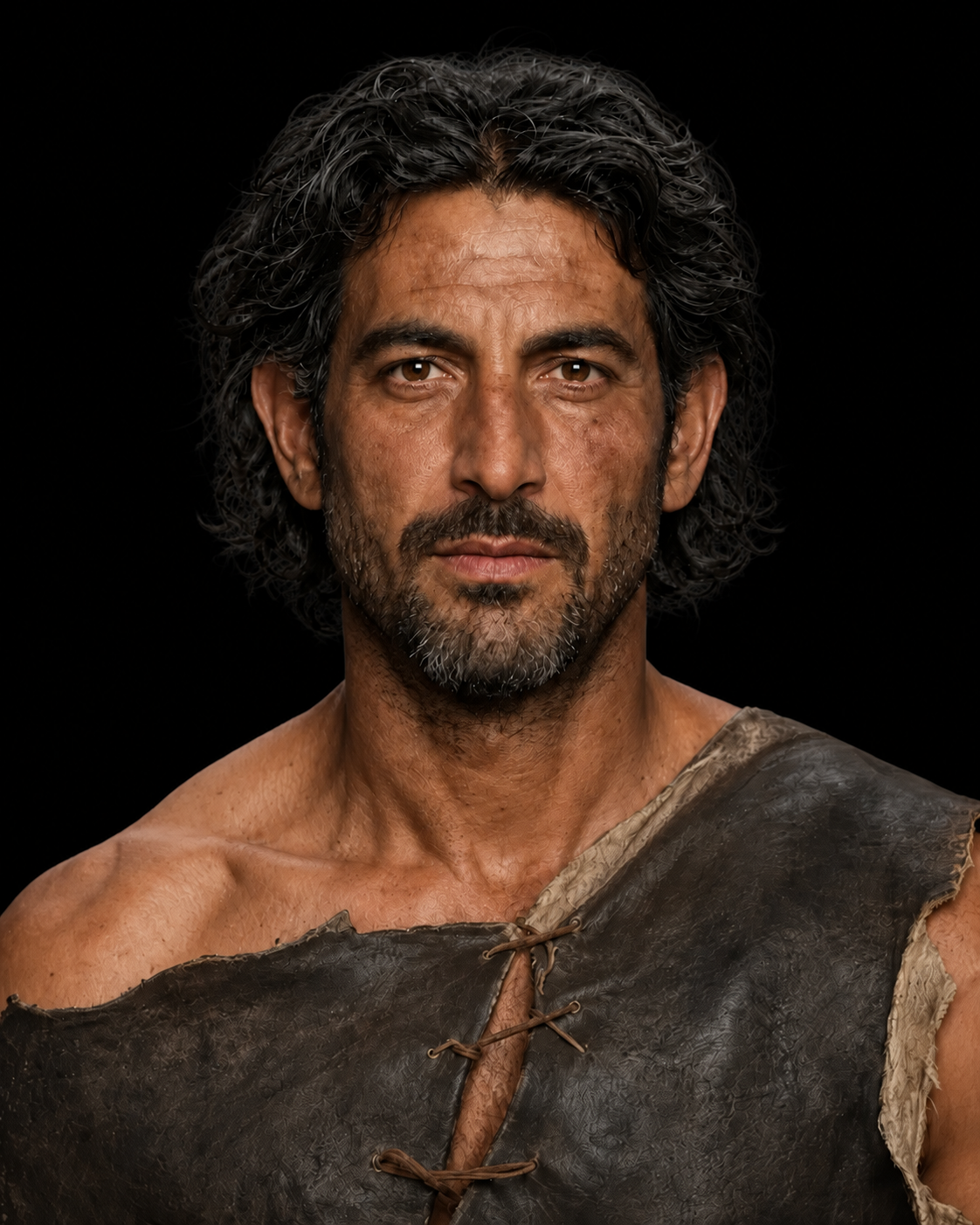
Lorn
Lorn's tools
Works stone, bone, and wood, and tests what each material is good for.
Museum documentation · free public access, no account required.
Generated reconstruction · Declared visual hypothesis
Concept art of a fictional project character. AI edit of the background of the existing portrait, preserving its identity and framing; does not represent an archaeologically documented person or an exact preserved costume.
Tracekeepers
Explore in 3D
Load the model only when you want to explore it. Drag or use the arrow keys to turn it; + and − zoom. Closing it releases its memory.
Digital reconstruction supplied by the project and generated with Tripo. It is not an archaeological scan or a metric replica. The model is displayed at approximately life size: 1.68 m tall, the same height as in the Sarımğara game; this is a design decision for a fictional character, not an archaeological measurement. Lorn is a fictional character from Sarımğara, a setting inspired by Çakmaktepe around 9600 BCE. His build is compact and broad. The figure is shown in the technical T-pose in which the model was delivered, without a skeleton or animation; face, clothing and accessories are an interpretation, not an archaeological portrait.
History and context
Lorn rubs a stone with his thumb before deciding what to do with it. He helps Ena prepare the beads for Luma's necklace. He shows her which pieces he can work and which break easily; afterwards Ena decides how to arrange them.
During a later visit to Göbekli Tepe, an air-dried clay form looks promising until water softens it. Lorn does not pretend to have created a pot: he keeps the sample so the group does not repeat the mistake. The technological leap remains open for another era.
Evidence and interpretation
The beads from Çakmaktepe and the stone vessels from Göbekli are documented. The spoon and the specific tests are playable reconstruction; Lorn does not make fired pottery.
Canonical project design; flint, bone, wood, and fibres allow a practice to be reconstructed, not a real name recovered.
Catalogue facts
- Narrative date
- c. 9600 BCE
- Narrative setting
- Sarımğara · fictional setting inspired by Çakmaktepe, Anatolia
- Apparent age
- 43 years old
- Function
- Stone · bone · wood · fibres
- Customary object
- Stones, beads, and tools
- Status
- Fictional character · reconstruction
A closer look
About 1 min to read · 1 section. Further reading and sources · free access. Editorial review recorded: .
A composite piece of decisions
The small finds from Çakmaktepe include beads, stone vessels, perforators, blades and points. Not all follow the same chaîne opératoire: perforating an ornament poses different demands from obtaining a cutting edge. That is why Lorn functions as a fictional craftsperson who compares problems, not as the inventor of all techniques. The variety of tools allows a material repertoire to be documented; who taught whom, how long it took to learn, and how each result was valued are questions the record does not yet resolve.
- Heritage · Taş Tepeler · Çakmaktepe, small findsAccess recorded: .
One history, two perspectives
What connects Lorn with other people, and how the view changes from the other side. These interpretations are based on sources; they are not quotations or reconstructions of private thoughts.
COLLABORATION · FICTITIOUS NARRATIVE CANON
Lorn ↔ Bora
Craftsperson and companion
Lorn prepares and repairs tools whose form depends on the terrain and the needs Bora communicates.
From Lorn’s perspective
Bora feeds back to Lorn information on how tools behave outside the workshop. From the perspective of material work, a failure in the field matters because it reveals the limit of a decision about form, weight or durability.
Read Bora’s perspective on Lorn →COLLABORATION · FICTITIOUS NARRATIVE CANON
Lorn ↔ Ena
Ena, with whom she prepares the beads
Lorn helps Ena prepare the necklace beads. She can show her how to work a stone and warn her if it breaks easily; choosing the order and stringing them remains in the hands of Ena and Luma.
From Lorn’s perspective
Lorn helps Ena prepare the necklace beads. She can show her how to work a stone and warn her if it breaks easily; choosing the order and stringing them remains in the hands of Ena and Luma.
Read Ena’s perspective on Lorn →COLLABORATION · FICTITIOUS NARRATIVE CANON
Lorn ↔ Kael
Craftsperson and companion
Lorn puts her knowledge of materials at the service of the decisions Kael must coordinate.
From Lorn’s perspective
From Lorn's craft, Kael is the one who must allocate the time a good repair needs. Their bond pits two scales of the same problem against each other: finishing a tool and sustaining the whole community.
Read Kael’s perspective on Lorn →SAME COMMUNITY · FICTITIOUS NARRATIVE CANON
Lorn ↔ Oru
Community companion
Lorn and Oru share community and path; the entry preserves that bond without fabricating a conversation the narrative does not document.
From Lorn’s perspective
Lorn knows Oru as a member of her community. From the perspective of the craft, this connection invites us to look at the support behind collective gestures, without inventing a specific commission or dialogue between the two.
Read Oru’s perspective on Lorn →COLLABORATION · FICTITIOUS NARRATIVE CANON
Lorn ↔ Sira
Craftsperson and collaborator
Lorn explains to Sira how much work and material is required to maintain grinding tools and vessels.
From Lorn’s perspective
Sira allows the wear on a tool to be read as part of a chaîne opératoire. From Lorn's craft, repairing means restoring the capacity to prepare food, not merely recovering the shape of a piece.
Read Sira’s perspective on Lorn →COLLABORATION · FICTITIOUS NARRATIVE CANON
Lorn ↔ Tala
Tool specialist
Lorn adapts tools to the needs Tala identifies in clothing, shelter and care.
From Lorn’s perspective
Tala shows Lorn where a tool ceases to serve and what repair is urgent. From the workshop, listening to the tool user allows the craft to be adjusted to a concrete need.
Read Tala’s perspective on Lorn →Reference images and provenance
No verifiable entrance photograph is preserved for this representation. You may consult its documentation, but we would not present its face as an exact reconstruction.
Additional visual documentation
A cited publication does not establish which image was used to create the character.
Sources and references
Did you enjoy this exhibit?
Your opinion helps us improve the museum. You can change it whenever you like.
Loading your rating…