
 English
 Español
 Français
 Italiano
 Deutsch
 Русский
 Português
 Polski
 Română
 Svenska
 Norsk bokmål
 Suomi
 Türkçe
 العربية
 简体中文
 한국어
 हिन्दी
 Ελληνικά
CHARACTER · MEMORY
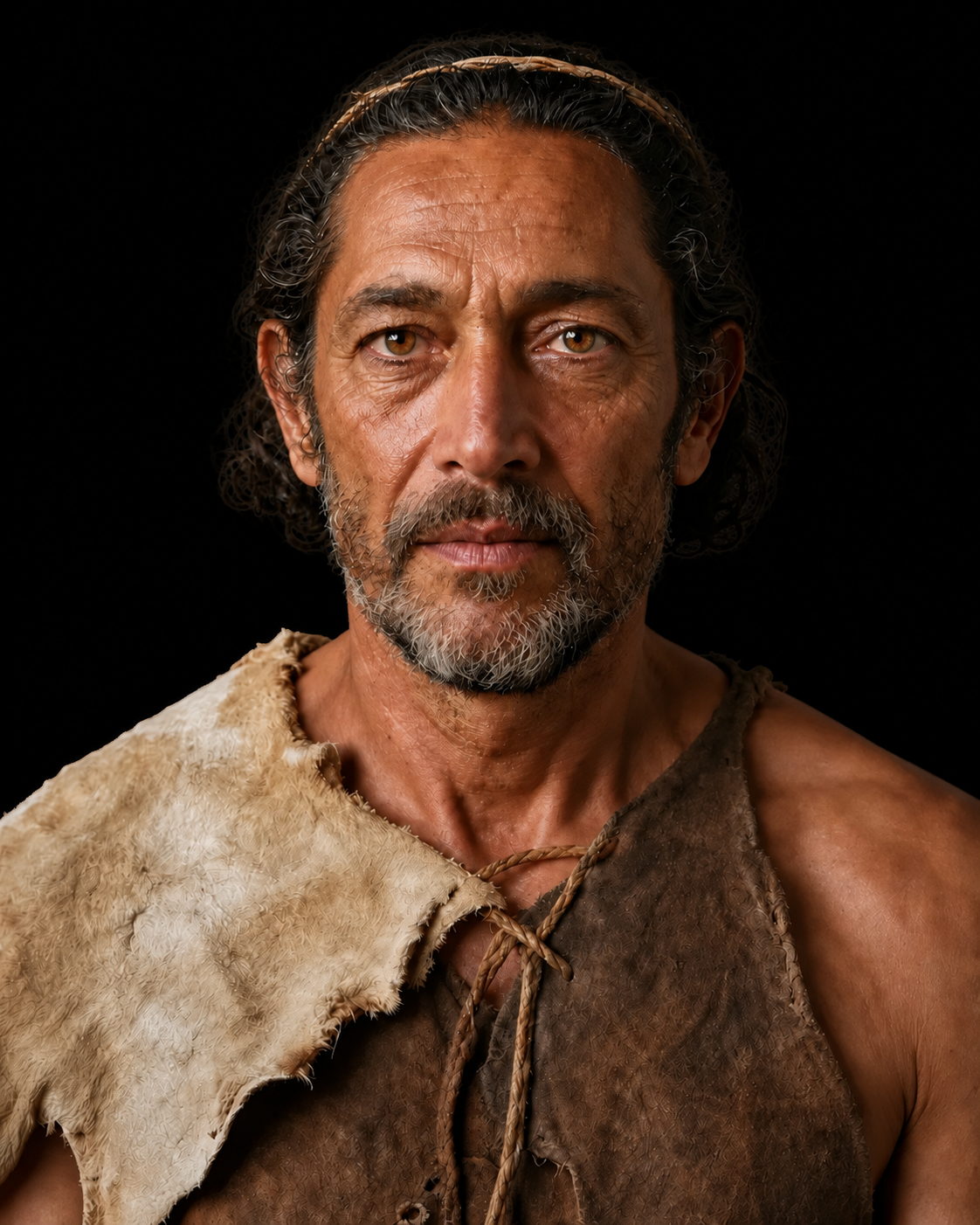
Oru
Oru paints and tells stories
After dinner, some people stay by the fire to listen to him.
Museum documentation · free public access, no account required.
Generated reconstruction · Declared visual hypothesis
Concept art of a fictional project character. AI edit of the background of the existing portrait, preserving its identity and framing; does not represent an archaeologically documented person or an exact preserved costume.
Tracekeepers
Explore in 3D
Load the model only when you want to explore it. Drag or use the arrow keys to turn it; + and − zoom. Closing it releases its memory.
Digital reconstruction supplied by the project and generated with Tripo. It is not an archaeological scan or a metric replica. The model is displayed at approximately life size: 1.66 m tall, the same height as in the Sarımğara game; this is a design decision for a fictional character, not an archaeological measurement. Oru is a fictional character from Sarımğara, a setting inspired by Çakmaktepe around 9600 BCE. The figure is shown in the technical T-pose in which the model was delivered, without a skeleton or animation; face, clothing and accessories are an interpretation, not an archaeological portrait.
History and context
Oru works with ochre, charcoal, and various surfaces. He tests how a mark turns out and how long it takes to come off. After dinner he tells how a fox stole food from his grandfather while the latter was watching a boar. Then he recalls a fall he suffered as a child trying to move a hide. Luma and other children interrupt him; adults also ask questions and laugh.
Sometimes he tells what he saw, and other times what he was told. These stories belong to the book's fiction, not to a tradition recovered by archaeologists. When Luma is ill, he can keep her company and tell her another story; he does not guarantee that a rite or a necklace will cure her.
Evidence and interpretation
Çakmaktepe preserves objects of possible ritual use and deliberately placed skulls. They prove intentional action, not its meaning. Oru is not a historical shaman.
Canonical project design; pigments and tools are contextual evidence, not proof of a specific individual.
Catalogue facts
- Narrative date
- c. 9600 BCE
- Narrative setting
- Sarımğara · fictional setting inspired by Çakmaktepe, Anatolia
- Apparent age
- 54 years old
- Function
- Painting · narration · memory
- Customary object
- Ochre, charcoal, and grindstone
- Status
- Fictional character · reconstruction
A closer look
About 1 min to read · 1 section. Further reading and sources · free access. Editorial review recorded: .
Colour requires a preparation chain
Oru's fictional work can be compared with much older evidence, without confusing their contexts: at Blombos, an ochre-rich mixture stored in two abalone shells was documented around a hundred thousand years ago. Ochre, bone, charcoal, and grinding tools were part of the assemblage. The interest lies in obtaining, combining, and preserving substances, not merely in finding a red stone. The study does not determine what that mixture was applied for; therefore it does not serve to prove the ceremonies the game attributes to Oru.
One history, two perspectives
What connects Oru with other people, and how the view changes from the other side. These interpretations are based on sources; they are not quotations or reconstructions of private thoughts.
SAME COMMUNITY · FICTITIOUS NARRATIVE CANON
Oru ↔ Bora
Community companion
Oru and Bora are members of the group presented by Kael and know each other; no specific undepicted collaboration is assigned to them.
From Oru’s perspective
Oru and Bora know each other within Kael's group. From the perspective of narration, their roles allow us to ask how an observation of the terrain is preserved; the question is editorial, not an additional canon adventure.
Read Bora’s perspective on Oru →COLLABORATION · FICTITIOUS NARRATIVE CANON
Oru ↔ Kael
Narrator and companion
Oru contributes memory, rhythm, and ceremony to decisions whose practical cost Kael must continue coordinating.
From Oru’s perspective
Kael introduces the practical organisation that makes collective moments possible. From Oru's role, memory needs gathered people, time, and resources: the story also has material conditions.
Read Kael’s perspective on Oru →SAME COMMUNITY · FICTITIOUS NARRATIVE CANON
Oru ↔ Lorn
Community companion
Oru and Lorn belong to the group Kael presents to the player; the canon establishes they know each other without attributing an exclusive scene to them here.
From Oru’s perspective
Oru shares the journey with Lorn, but the canon does not fix an exclusive exchange here. From memory and ritual, the meaning of an object can be compared with the material work that makes it possible.
Read Lorn’s perspective on Oru →SAME COMMUNITY · FICTITIOUS NARRATIVE CANON
Oru ↔ Luma
Luma, who asks questions during his stories
Oru tells a story after dinner and Luma interrupts him with questions. Sometimes she amuses him; other times he has to clarify what he remembers and what he was told, before continuing with the others listening.
From Oru’s perspective
Oru tells a story after dinner and Luma interrupts him with questions. Sometimes she amuses him; other times he has to clarify what he remembers and what he was told, before continuing with the others listening.
Read Luma’s perspective on Oru →COLLABORATION · FICTITIOUS NARRATIVE CANON
Oru ↔ Sira
Narrator and companion
Oru turns observations shared with Sira into memory without presenting them as supernatural certainty.
From Oru’s perspective
Sira contributes observations that can be cross-checked to the memory Oru works with. From the narrative, the challenge is to transmit them without erasing the difference between what was learned by experience and what is still not known.
Read Sira’s perspective on Oru →COLLABORATION · FICTITIOUS NARRATIVE CANON
Oru ↔ Tala
Ritual interlocutor
Oru defends the value of the ceremony to Tala and takes part with her in the search for a collective agreement.
From Oru’s perspective
Tala makes visible the cost of what Oru proposes to give. From ritual practice, her objection opens a negotiation: the group's cohesion cannot be separated from the food and care that keep it alive.
Read Tala’s perspective on Oru →Reference images and provenance
No verifiable entrance photograph is preserved for this representation. You may consult its documentation, but we would not present its face as an exact reconstruction.
Additional visual documentation
A cited publication does not establish which image was used to create the character.
Sources and references
- Oru's canonical profile
- Arkeoloji Dergisi · Çakmaktepe excavations (2025)
- Taş Tepeler Project · Çakmaktepe
- Henshilwood et al. · Science, Blombos ochre processing workshop, 2011
- TRACEKEEPERS · canonical community history
- TRACEKEEPERS · canonical ten-adventure campaign
- TRACEKEEPERS · Ena, Daro and Luma · fictional characters
Did you enjoy this exhibit?
Your opinion helps us improve the museum. You can change it whenever you like.
Loading your rating…