
 English
 Español
 Français
 Italiano
 Deutsch
 Русский
 Português
 Polski
 Română
 Svenska
 Norsk bokmål
 Suomi
 Türkçe
 العربية
 简体中文
 한국어
 हिन्दी
 Ελληνικά
CHARACTER · CARE
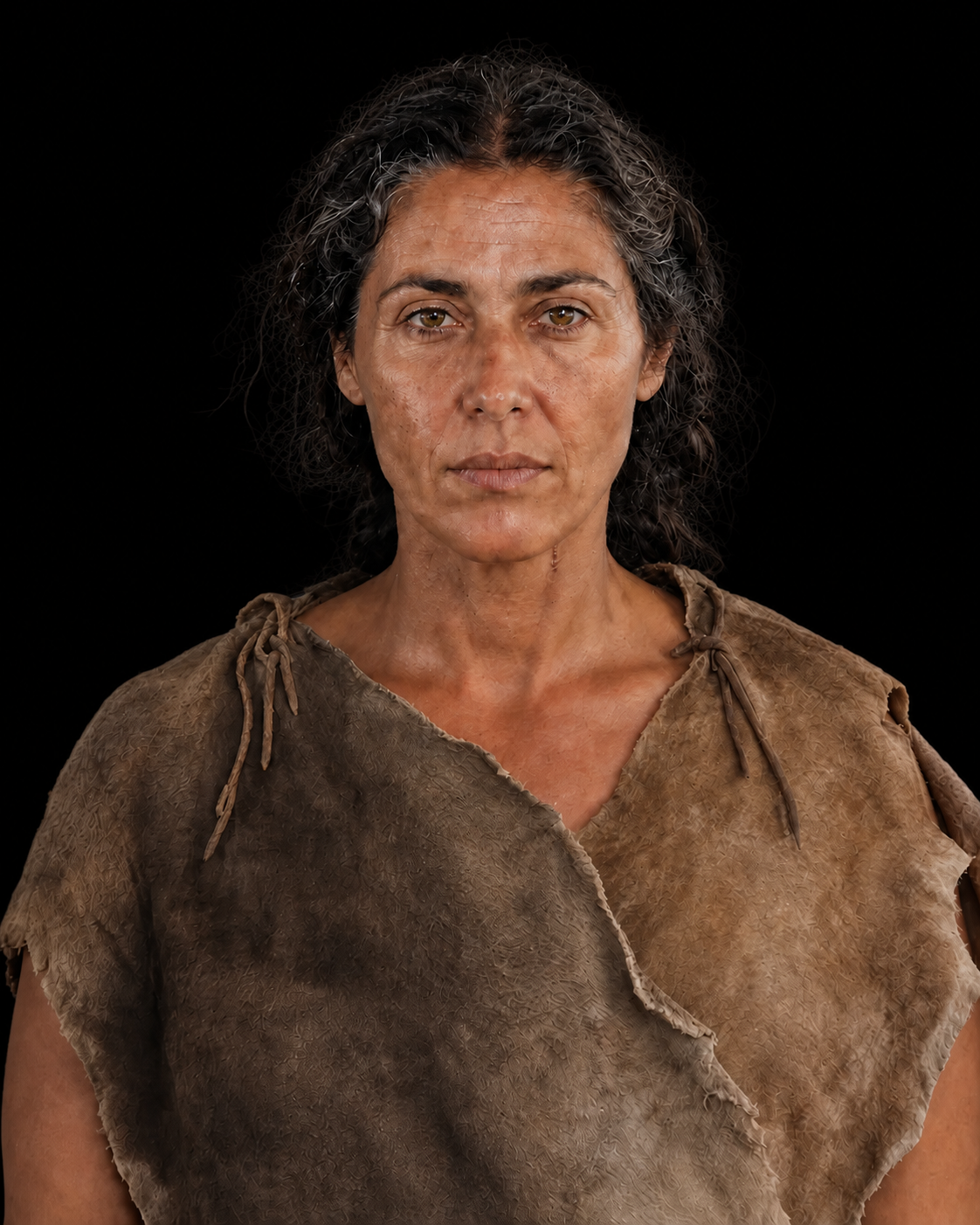
Tala
Tala prepares the shelter
Repairs hide clothing and helps organise camp tasks.
Museum documentation · free public access, no account required.
Generated reconstruction · Declared visual hypothesis
Concept art of a fictional project character. AI edit of the background of the existing portrait, preserving its identity and framing; does not represent an archaeologically documented person or an exact preserved costume.
Tracekeepers
Explore in 3D
Load the model only when you want to explore it. Drag or use the arrow keys to turn it; + and − zoom. Closing it releases its memory.
Digital reconstruction supplied by the project and generated with Tripo. It is not an archaeological scan or a metric replica. The model is displayed at approximately life size: 1.58 m tall, the same height as in the Sarımğara game; this is a design decision for a fictional character, not an archaeological measurement. Tala is a fictional character from Sarımğara, a setting inspired by Çakmaktepe around 9600 BCE. The figure is shown in the technical T-pose in which the model was delivered, without a skeleton or animation; face, clothing and accessories are an interpretation, not an archaeological portrait.
History and context
Tala observes a seam where the air gets in. She can repair a garment with great care, several quickly, or devote that time to the shelter; any choice leaves someone waiting.
Tala is the mother of Ena and grandmother of Luma. When the child is ill, she takes on tasks Ena had pending and asks others for help. If she proposes giving a skin for an offering, she remembers that someone needs it for warmth. Participating in a shared gesture does not require renouncing that warmth.
Evidence and interpretation
Skin, leather and bone tools are compatible with the period, although the clothing is not preserved complete. Tala and her conflict are fiction.
Canonical project design; sewing, skins and fibres are material anchors, not an excavated biography.
Catalogue facts
- Narrative date
- c. 9600 BCE
- Narrative setting
- Sarımğara · fictional setting inspired by Çakmaktepe, Anatolia
- Apparent age
- 47 years
- Function
- Skin preparation · care
- Customary object
- Bone tool and strips
- Status
- Fictional character · reconstruction
A closer look
About 1 min to read · 1 section. Further reading and sources · free access. Editorial review recorded: .
Why a rib could be a suitable tool
As a technological comparison, not as Tala's object, the Neanderthal bone lissoirs from southwestern France show a particularly interesting choice: the structure of a rib combines resistance and flexibility when bent. A study identified large bovids via proteins preserved even in the modern containers where the tools were stored. This allows explaining that working skins required selecting materials for their properties. Tala belongs to another period and is fictional; the comparison illustrates a long-standing craft problem, not a proven transmission to her community.
One history, two perspectives
What connects Tala with other people, and how the view changes from the other side. These interpretations are based on sources; they are not quotations or reconstructions of private thoughts.
COLLABORATION · FICTITIOUS NARRATIVE CANON
Tala ↔ Bora
Carer and companion
Tala incorporates Bora's fatigue and fear into the allocation of tasks, without turning them into a lack of courage.
From Tala’s perspective
Bora incorporates into Tala's care the risks and fatigue of an expedition. Their bond allows understanding rest as part of collective safety, not as what is left over after work.
Read Bora’s perspective on Tala →FAMILY · FICTITIOUS NARRATIVE CANON
Tala ↔ Ena
Ena, her daughter
Tala can help Ena with tasks she knows well, but her daughter now decides how she wants to organise things. When Luma is ill, she shares the work with other adults without removing Ena from the decisions.
From Tala’s perspective
Tala can help Ena with tasks she knows well, but her daughter now decides how she wants to organise things. When Luma is ill, she shares the work with other adults without removing Ena from the decisions.
Read Ena’s perspective on Tala →COLLABORATION · FICTITIOUS NARRATIVE CANON
Tala ↔ Kael
Decision-making partner
Tala discusses with Kael which task can wait and makes visible who pays for each of the group's priorities.
From Tala’s perspective
Kael must turn the needs Tala identifies into shifts and resources. From the perspective of care, the question is not just approving a plan: it is being able to explain who bears its costs and for how long.
Read Kael’s perspective on Tala →COLLABORATION · FICTITIOUS NARRATIVE CANON
Tala ↔ Lorn
Skin specialist
Tala works with Lorn when a repair requires combining skin, sinew, and a suitable tool.
From Tala’s perspective
From Tala's work, a tool is judged by the skin it manages to mend and the warmth it restores. Lorn provides a material solution to a care need, not an object isolated from its use.
Read Lorn’s perspective on Tala →FAMILY · FICTITIOUS NARRATIVE CANON
Tala ↔ Luma
Luma, her granddaughter
Tala knows Luma's games and protests. When the girl does not want to go out with the other children, she accompanies the family and organises help, without claiming to know for certain what is wrong.
From Tala’s perspective
Tala knows Luma's games and protests. When the girl does not want to go out with the other children, she accompanies the family and organises help, without claiming to know for certain what is wrong.
Read Luma’s perspective on Tala →COLLABORATION · FICTITIOUS NARRATIVE CANON
Tala ↔ Oru
Critical interlocutor
Tala discusses with Oru what can be given in an offering without putting reserves, care, and the group's safety at risk.
From Tala’s perspective
Oru puts forward a collective value that cannot be reduced to calories or fuel. Tala introduces the material limit of the offering: sustaining a ceremony also requires caring for those who give up their reserves.
Read Oru’s perspective on Tala →COLLABORATION · FICTITIOUS NARRATIVE CANON
Tala ↔ Sira
Caregiver
Tala checks with Sira how many people must receive food, warmth, or work time.
From Tala’s perspective
Sira explains to Tala what resources exist and what they cost to prepare. From the perspective of care, knowing that effort allows one to distinguish an urgent need from a distribution that would end up exhausting those who produce the food.
Read Sira’s perspective on Tala →Reference images and provenance
No verifiable entrance photograph is preserved for this representation. You may consult its documentation, but we would not present its face as an exact reconstruction.
Additional visual documentation
A cited publication does not establish which image was used to create the character.
Sources and references
- Canonical character sheet for Tala
- Arkeoloji Dergisi · Çakmaktepe excavations (2025)
- Taş Tepeler Project · Çakmaktepe
- Martisius et al. · Scientific Reports, raw material selection of lissoirs, 2020
- TRACEKEEPERS · canonical community history
- TRACEKEEPERS · canonical ten-adventure campaign
- TRACEKEEPERS · Ena, Daro and Luma · fictional characters
Did you enjoy this exhibit?
Your opinion helps us improve the museum. You can change it whenever you like.
Loading your rating…