
 English
 Español
 Français
 Italiano
 Deutsch
 Русский
 Português
 Polski
 Română
 Svenska
 Norsk bokmål
 Suomi
 Türkçe
 العربية
 简体中文
 한국어
 हिन्दी
 Ελληνικά
CHARACTER · FORAGING
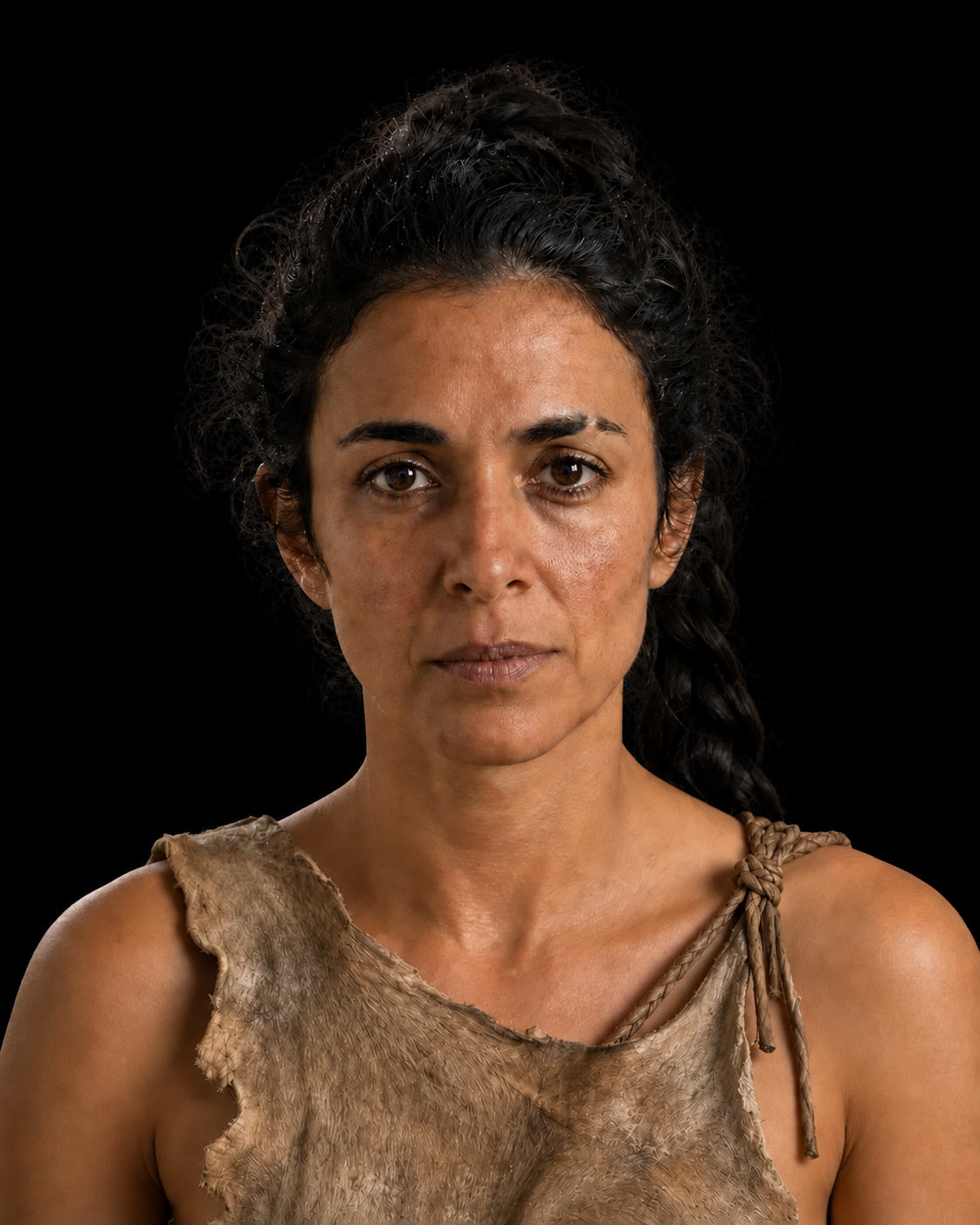
Sira
Sira forages for the group
Compares the plants she finds and separates the samples she does not recognise.
Museum documentation · free public access, no account required.
Generated reconstruction · Declared visual hypothesis
Concept art of a fictional project character. AI edit of the background of the existing portrait, preserving its identity and framing; does not represent an archaeologically documented person or an exact preserved costume.
Tracekeepers
Explore in 3D
Load the model only when you want to explore it. Drag or use the arrow keys to turn it; + and − zoom. Closing it releases its memory.
Digital reconstruction supplied by the project and generated with Tripo. It is not an archaeological scan or a metric replica. The model is displayed at approximately life size: 1.60 m tall, the same height as in the Sarımğara game; this is a design decision for a fictional character, not an archaeological measurement. Sira is a fictional character from Sarımğara, a setting inspired by Çakmaktepe around 9600 BCE. The figure is shown in the technical T-pose in which the model was delivered, without a skeleton or animation; face, clothing and accessories are an interpretation, not an archaeological portrait.
History and context
Sira recognises resources because she has returned many times to the same places. She compares shape, smell, terrain, and season; if a sign does not fit, she keeps the sample separate and does not guess.
When more people arrive than expected, it shows that finding food is not the same as feeding a group: it must be carried, prepared, distributed, and decisions made on what to keep. A modest reserve can be worth more than an abundance too far away.
Evidence and interpretation
The grinding tools from Çakmaktepe support the use of wild plants. The species, quantities, and Sira's decisions are reconstructions; she does not invent agriculture.
Canonical project design; plants, basket, and grinding are presented as documented regional reconstruction.
Catalogue facts
- Narrative date
- c. 9600 BCE
- Narrative setting
- Sarımğara · fictional setting inspired by Çakmaktepe, Anatolia
- Apparent age
- 35 years old
- Function
- Foraging · observation
- Customary object
- Basket of separated samples
- Status
- Fictional character · reconstruction
A closer look
About 1 min to read · 1 section. Further reading and sources · free access. Editorial review recorded: .
Food leaves tools, not a complete menu
At Çakmaktepe there are conical pits cut into the bedrock, interpreted as mortars, as well as grinding surfaces. They are workstations that could not be moved like a bag of seeds. Their presence helps us think about how much food preparation depended on prepared places and repeated effort. The link with Sira is contextual: archaeology documents that equipment, while the game imagines who uses it and decides what to store. We do not know the contents of each mortar or the rations for a single day.
- Heritage · Taş Tepeler · Çakmaktepe, archaeological researchAccess recorded: .
One history, two perspectives
What connects Sira with other people, and how the view changes from the other side. These interpretations are based on sources; they are not quotations or reconstructions of private thoughts.
SAME COMMUNITY · FICTITIOUS NARRATIVE CANON
Sira ↔ Bora
Community companion
Sira and Bora are part of the same group presented by Kael; the canon confirms they know each other, but does not fix a specific private scene here.
From Sira’s perspective
Sira shares a community with Bora. Reading the link from her provisioning work allows us to compare two ways of attending to the landscape, without attributing an expedition or a conversation to them that the canon does not narrate.
Read Bora’s perspective on Sira →COLLABORATION · FICTITIOUS NARRATIVE CANON
Sira ↔ Kael
Forager and companion
Sira contributes observations and reserves to Kael, and discusses with him which need must be attended to first.
From Sira’s perspective
Kael gathers needs competing for the same food and hours. From Sira's provisions, explaining how a reserve is obtained helps ensure distribution does not treat the effort of obtaining it as inexhaustible.
Read Kael’s perspective on Sira →COLLABORATION · FICTITIOUS NARRATIVE CANON
Sira ↔ Lorn
Forager and collaborator
Sira shows Lorn the wear and the food work he must consider when repairing tools.
From Sira’s perspective
For Sira's food work, Lorn intervenes in the time and effort needed to prepare a reserve. The lifespan of a tool changes how much a person can do before exhaustion.
Read Lorn’s perspective on Sira →COLLABORATION · FICTITIOUS NARRATIVE CANON
Sira ↔ Oru
Observer and companion
Sira separates for Oru what she recognises from experience from what the community still does not know.
From Sira’s perspective
Oru can give a memorable form to what Sira observes. From the forager's experience, preserving an observation requires preserving its doubts too: repeating a story does not turn a hypothesis into proof.
Read Oru’s perspective on Sira →COLLABORATION · FICTITIOUS NARRATIVE CANON
Sira ↔ Tala
Provisions manager
Sira explains to Tala what resources exist and what effort is required to turn them into a usable reserve.
From Sira’s perspective
Tala turns Sira's reserves into needs with specific recipients. From the perspective of provisions, it is not enough to count what is stored: it also matters who needs to receive it and who can wait.
Read Tala’s perspective on Sira →Reference images and provenance
No verifiable entrance photograph is preserved for this representation. You may consult its documentation, but we would not present its face as an exact reconstruction.
Additional visual documentation
A cited publication does not establish which image was used to create the character.
Sources and references
Did you enjoy this exhibit?
Your opinion helps us improve the museum. You can change it whenever you like.
Loading your rating…