
 English
 Español
 Français
 Italiano
 Deutsch
 Русский
 Português
 Polski
 Română
 Svenska
 Norsk bokmål
 Suomi
 Türkçe
 العربية
 简体中文
 한국어
 हिन्दी
 Ελληνικά
CHARACTER · TRACKER
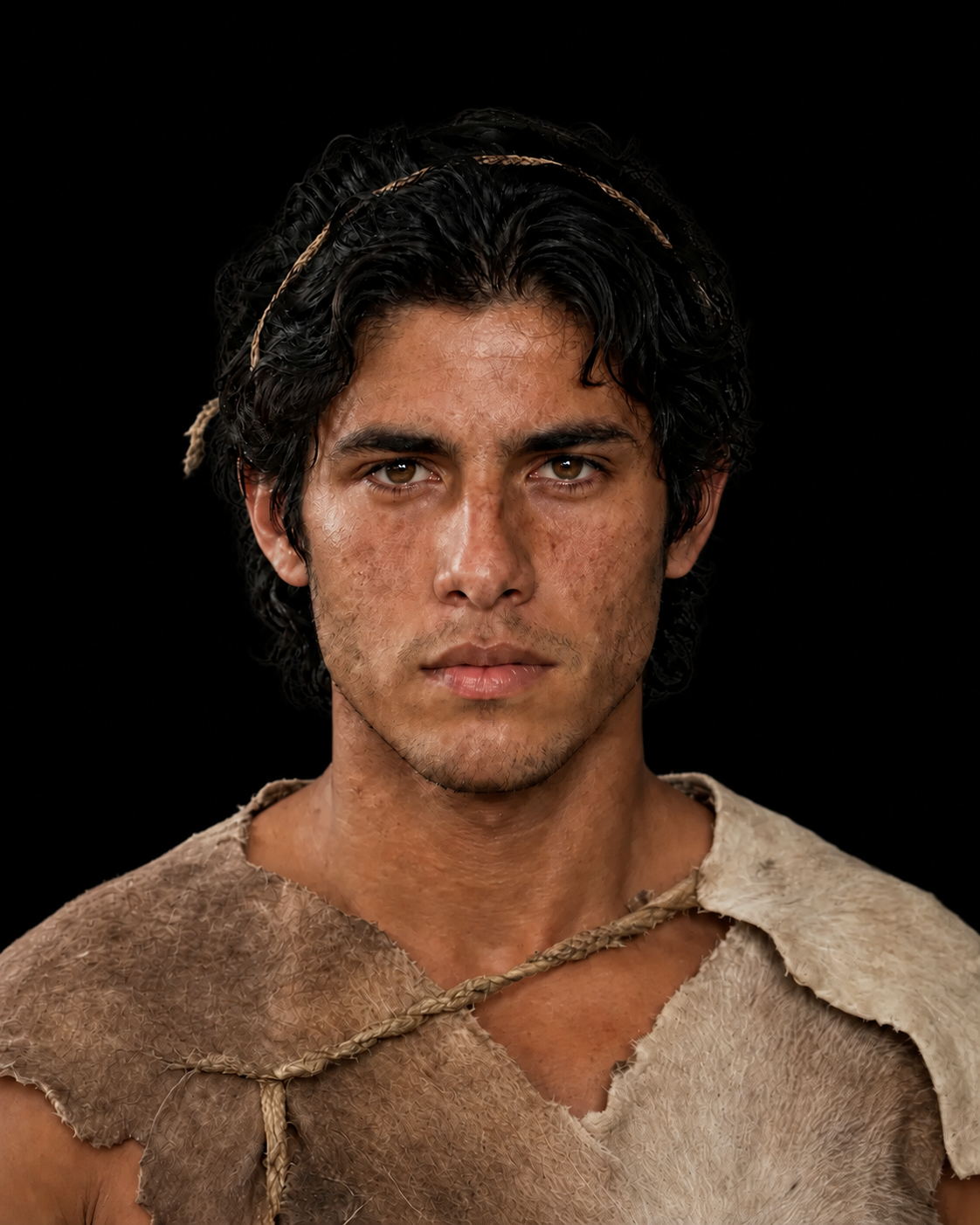
Bora
Bora follows the trail
Observes tracks, wind and terrain before approaching an animal.
Museum documentation · free public access, no account required.
Generated reconstruction · Declared visual hypothesis
Concept art of a fictional project character. AI edit of the background of the existing portrait, preserving its identity and framing; does not represent an archaeologically documented person or an exact preserved costume.
Tracekeepers
Explore in 3D
Load the model only when you want to explore it. Drag or use the arrow keys to turn it; + and − zoom. Closing it releases its memory.
Digital reconstruction supplied by the project and generated with Tripo. It is not an archaeological scan or a metric replica. The model is displayed at approximately life size: 1.70 m tall, the same height as in the Sarımğara game; this is a design decision for a fictional character, not an archaeological measurement. Bora is a fictional character from Sarımğara, a setting inspired by Çakmaktepe around 9600 BCE. The figure is shown in the technical T-pose in which the model was delivered, without a skeleton or animation; face, clothing and accessories are an interpretation, not an archaeological portrait.
History and context
Faced with a huge aurochs, Bora does not need to be ordered to be brave. Fear signals a problem: she can see the track, but not yet a safe way out. She gathers air, terrain, distance and a retreat route before deciding.
Bora explains what marks she has found and what part of the route she still does not know. If she sees no safe exit, she proposes turning back. Her work as a tracker is distinct from the contacts Daro establishes with other groups during his journeys.
Evidence and interpretation
The fauna supports the presence of the aurochs; every encounter and track is fictional. The nocturnal observation avoids Greek constellations and the current Pole Star.
Canonical project design; tracks and fauna sustain the context, never individual identity.
Catalogue facts
- Narrative date
- c. 9600 BCE
- Narrative setting
- Sarımğara · fictional setting inspired by Çakmaktepe, Anatolia
- Apparent age
- 20 years old
- Function
- Tracking · safe routes
- Customary object
- Staff and waymarks
- Status
- Fictional character · reconstruction
A closer look
About 1 min to read · 1 section. Further reading and sources · free access. Editorial review recorded: .
Hunting could also transform the landscape
The Şanlıurfa research combines satellite imagery and fieldwork to recognise stone walls that channelled animals into capture enclosures, known as desert kites. Some structures may date back to the Pre-Pottery Neolithic, though their chronology must be verified case by case. This landscape adds another scale to the tracker's dilemma: hunting could depend on preparing routes and coordinating people, not just on landing a shot. Bora is fictional; the enclosures provide regional context, not evidence of a hunt led by him.
One history, two perspectives
What connects Bora with other people, and how the view changes from the other side. These interpretations are based on sources; they are not quotations or reconstructions of private thoughts.
COLLABORATION · FICTITIOUS NARRATIVE CANON
Bora ↔ Kael
Group tracker
Bora contributes tracks, wind and escape routes to the decisions Kael coordinates.
From Bora’s perspective
Kael transforms Bora's observations into a decision affecting the others. From the perspective of tracking, communicating uncertainty is as important as signalling a track: a conjecture must not become a promise of safety.
Read Kael’s perspective on Bora →COLLABORATION · FICTITIOUS NARRATIVE CANON
Bora ↔ Lorn
Tracker and companion
Bora tests Lorn's material decisions in the field and feeds back information on failures, weight and safety.
From Bora’s perspective
Lorn turns the needs Bora communicates into a tool. From the perspective of tracking, testing it also means feeding back information: the quality of a tool depends on that conversation between making and use.
Read Lorn’s perspective on Bora →SAME COMMUNITY · FICTITIOUS NARRATIVE CANON
Bora ↔ Oru
Community companion
Bora and Oru share community and path; the bond is limited to what is established by the game canon.
From Bora’s perspective
Bora shares community with Oru. From the perspective of tracking, this reading invites us to distinguish the observed from its later account, without attributing a specific collaboration to both that is not narrated.
Read Oru’s perspective on Bora →SAME COMMUNITY · FICTITIOUS NARRATIVE CANON
Bora ↔ Sira
Community companion
Bora and Sira are part of the same group presented by Kael; the bond does not invent dialogue or collaboration outside canonical scenes.
From Bora’s perspective
Bora knows Sira within the group. From her role as tracker, the comparison focuses on how different tasks make different resources and risks visible; it does not suppose a documented private scene between the two.
Read Sira’s perspective on Bora →COLLABORATION · FICTITIOUS NARRATIVE CANON
Bora ↔ Tala
Tracker and companion
Bora provides Tala with information on routes and danger so that care does not ignore the terrain.
From Bora’s perspective
Tala introduces the state of the bodies that must traverse the terrain into Bora's decisions. From the perspective of tracking, a route viable in the landscape may cease to be so for someone tired or frightened.
Read Tala’s perspective on Bora →Reference images and provenance
No verifiable entrance photograph is preserved for this representation. You may consult its documentation, but we would not present its face as an exact reconstruction.
Additional visual documentation
A cited publication does not establish which image was used to create the character.
Sources and references
Did you enjoy this exhibit?
Your opinion helps us improve the museum. You can change it whenever you like.
Loading your rating…