
 English
 Español
 Français
 Italiano
 Deutsch
 Русский
 Português
 Polski
 Română
 Svenska
 Norsk bokmål
 Suomi
 Türkçe
 العربية
 简体中文
 한국어
 हिन्दी
 Ελληνικά
FAUNA · FOOD SOURCE · ASIA AND AFRICA
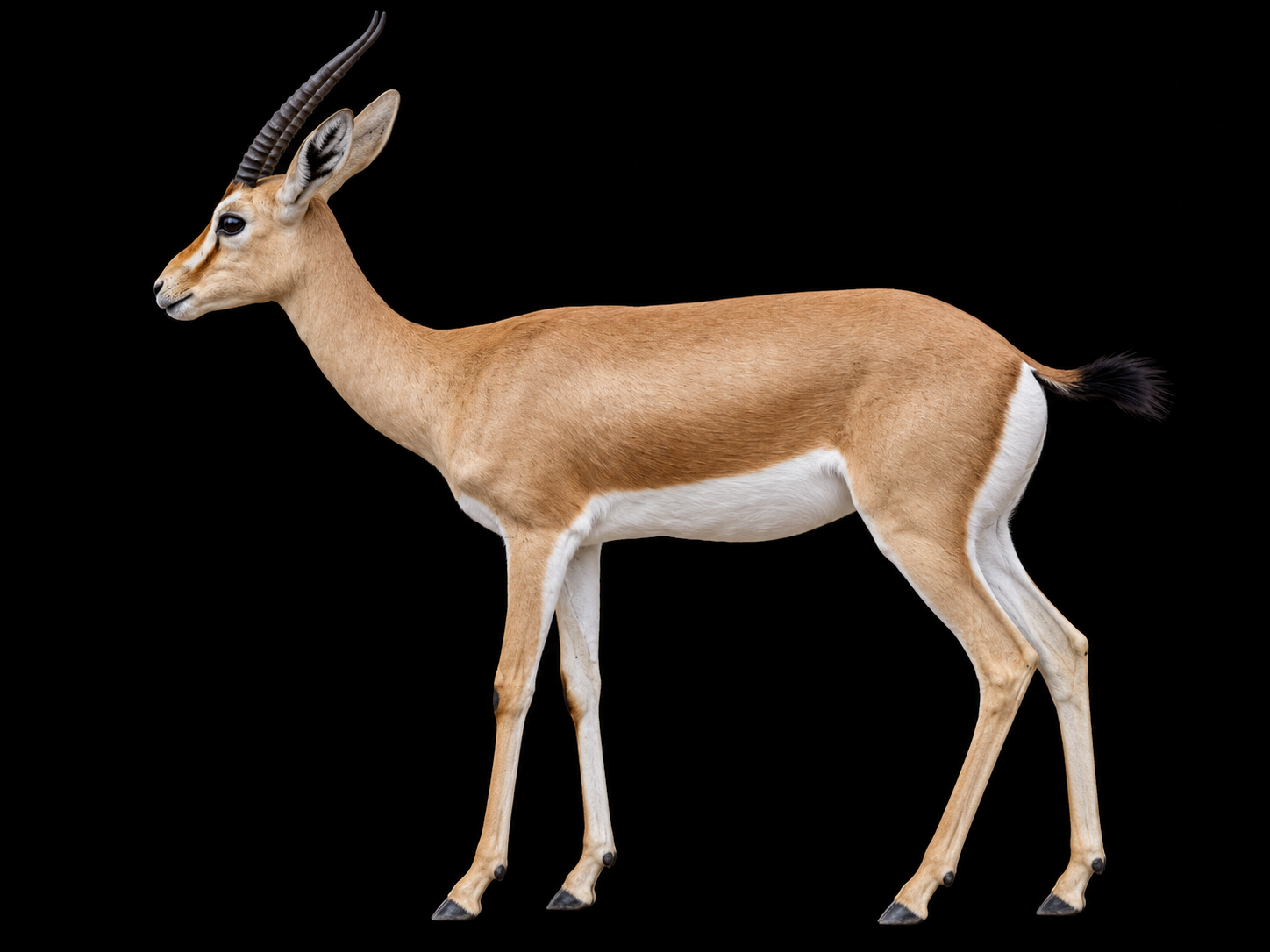
Persian gazelle
Gazelles: the prey that fed hunters for millennia
Fast, gregarious and abundant, gazelles were for millennia one of the most widely eaten meats in southwest Asia.
Museum documentation · free public access, no account required.
Reconstruction · Declared visual hypothesis
Recreation contributed to the project together with the 3D model of the piece. It is not an archaeological photograph or a metric facsimile. Materials, finish, proportions and visible details may differ from the original. The record and its sources distinguish the documented from the interpreted.
Explore in 3D
Load the model only when you want to explore it. Drag or use the arrow keys to turn it; + and − zoom. Closing it releases its memory.
User-supplied digital reconstruction; file metadata declares Tripo. It is not an archaeological scan or a metric replica; the supplied geometry is preserved intact. The model is displayed at approximately life size: about 0.68 m at the withers and 1.05 m to the tips of the horns, the size of an adult male Persian gazelle. Coat, markings, horns and individual proportions are representational choices; it is not an excavated specimen.
History and context
Gazelles live in the steppes and semi-deserts of Asia and Africa. In southwest Asia they were, for tens of thousands of years, one of the most important prey animals for human groups. In the southern Levant, the mountain gazelle was the main prey from the Middle Palaeolithic until the Pre-Pottery Neolithic, about 9,500 years ago.
The Persian gazelle (Gazella subgutturosa), the species in this gallery, roamed the steppes of Upper Mesopotamia. At Göbekli Tepe its bones appear, alongside those of aurochs, among the main hunting remains, and researchers link the gatherings at the site with the passage of the herds between midsummer and autumn. Millennia later, when meat came mainly from domestic livestock, there were mass kills which, according to a 2011 study, contributed to the near disappearance of the species from the Levant.
Evidence and interpretation
Documented fact: gazelle bones dominate many hunted-fauna assemblages in southwest Asia, and at Göbekli Tepe the gazelle ranks, alongside the aurochs, among the most hunted animals. Interpretation: the link between the seasonal passage of the herds and the gatherings at the site is a proposal by the researchers. The model does not reproduce an excavated specimen.
The species and its importance as prey are documented by bone remains. The coat, markings and proportions in the image and the model are an interpretation; they do not reproduce a specific individual. In this species, horns are found mainly in males.
Catalogue facts
- Species
- Gazella subgutturosa · Persian or goitered gazelle
- Habitat
- Steppes and semi-deserts of Asia, from Anatolia and Arabia to Mongolia and China
- Role in prehistory
- One of the main prey animals of southwest Asia before animal husbandry
- At Göbekli Tepe
- Among the most hunted animals, alongside the aurochs · ≈9600–8200 BCE
- Relationship with Sarımğara
- Steppe fauna around Çakmaktepe · appears in the game
- Current status
- Vulnerable according to the IUCN
A closer look
About 2 min to read · 4 sections. Further reading and sources · free access. Editorial review recorded: .
An abundant prey for millennia
In the southern Levant, the mountain gazelle was the main prey from about 200,000 years ago until about 9,500 years ago. A 2022 study proposes that human impact reduced their numbers and allowed gazelles to be larger on average: first through more intensive hunting and later through agriculture, animal management and permanent villages. The Persian gazelle in this gallery is a different species, native to steppes further east and north.
Herds that marked the calendar
At Göbekli Tepe, numerous broken and burnt bones of hunted animals were found, above all aurochs and gazelles. The researchers propose that people gathered there between midsummer and autumn, when the gazelles passed through, and that food was prepared to be eaten straight away, not to be stored.
When hunting stopped being sustainable
At Tell Kuran, in north-eastern Syria, a large deposit of Persian gazelle bones from the fourth millennium BCE shows mass kills at a time when meat already came mainly from livestock. The authors argue that this hunting altered migrations and contributed to the near disappearance of the species in the Levant.
- Research · Bar-Oz, Zeder and Hole (2011) · mass kills of Persian gazelleAccess recorded: .
How to recognise the Persian gazelle
Its name refers to the enlarged larynx, more visible in males. Unlike other gazelles, females usually lack horns. In many parts of its range it has declined sharply, and there it survives mainly in remote places or protected reserves. The IUCN considers it vulnerable.
Location and territory
REGIONAL AREA
Upper Mesopotamia · surroundings of Göbekli TepeIndicative regional marker: it marks the site where the hunted fauna was studied, not the full range of the species or the place where an individual animal was caught.Sources and references
- Munro, Lebenzon and Sapir-Hen (2022) · the gazelle as prey in the Levant
- DAI · feasts at Göbekli Tepe and the seasonal passage of gazelles (2019)
- Peters and Schmidt (2004) · fauna and images of Göbekli Tepe
- Bar-Oz, Zeder and Hole (2011) · mass kills of Persian gazelle
- University of Michigan · Animal Diversity Web entry: Gazella subgutturosa
Did you enjoy this exhibit?
Your opinion helps us improve the museum. You can change it whenever you like.
Loading your rating…