
 English
 Español
 Français
 Italiano
 Deutsch
 Русский
 Português
 Polski
 Română
 Svenska
 Norsk bokmål
 Suomi
 Türkçe
 العربية
 简体中文
 한국어
 हिन्दी
 Ελληνικά
DOOR 01 · AFRICA · CONTACT
Bantu worlds
Living frontiers of southern Africa
Continues in the Bantu Worlds museum
Museum documentation · free public access, no account required.
Generated reconstruction · Declared visual hypothesis
CONTACT, LEARNING AND INEQUALITY; NO NATURAL OPPOSITION BETWEEN HUNTERS AND FARMERS
Why this doorway leads to another museum
San communities and Bantu-speaking societies maintained, over centuries, exchanges, marriages, technical and linguistic adoptions, territorial disputes, and labour relations in different regions of southern Africa.
Why this doorway requires caution: There was no single encounter between two blocs: groups, landscapes and relationships changed, and linguistic expansion does not equate to complete population replacement.
Period of the connection: 1st millennium CE–present
BEFORE YOU ENTER
An introduction to Bantu worlds
Find your place in time, explore the changes and choose where to go next.
- When
- c. 3000 BCE–present · linguistic dispersal and regional trajectories · AFRICA
- Where
- A debated region of origin between south-eastern Nigeria and Cameroon for the proto-Bantu languages; subsequent societies occupied immense territories and never formed a single civilisation.
- What this collection brings together
- Linguistic macrohistory · diverse societies
‘Bantu’ designates above all a large branch of related languages, not a people, a race or an empire. The museum follows the spread of vocabularies, crops, ceramics and technologies while preserving the differences between hundreds of historical societies.
The changing combination of agriculture, river navigation, iron metallurgy, pastoralism and local networks enabled new forms of settlement; no innovation travelled only once or with an identical population.
PLACE MATTERS
Territory and connections
A debated region of origin between south-eastern Nigeria and Cameroon for the proto-Bantu languages; subsequent societies occupied immense territories and never formed a single civilisation. Congo Basin, Great Lakes, Eastern Africa and Southern Africa through displacements, fissions, alliances, marriages, language adoptions and prolonged contacts.
A HISTORY OF CHANGE
The main periods
Dates are approximate. Periods help us navigate the past, but their boundaries were not always the same in every region.
c. 3000–1500 BCE
Proto-Bantu reconstruction
Linguistics places a probable homeland near the south-east of Nigeria and the Grassfields of Cameroon. This is a reconstruction of languages, not a map of a homogeneous people.
c. 1500–500 BCE
Western corridors and equatorial forest
Linguistic branches and communities move along forest edges and rivers. Pottery, crops and words do not in themselves trace a single migratory route.
c. 1000 BCE–500 CE
Great Lakes and East Africa
Several streams reach the Great Lakes and the eastern coast. Iron, livestock and new crops are incorporated at different times and through different contacts.
c. 500–1000 CE
Central-southern and Southern Africa
Agricultural and pastoral settlements consolidate south of the Congo and Zambezi, in contact with San and Khoekhoe communities and with strong regional differences.
Continue the story: 3 more periods
c. 1000–1500 CE
Cities and regional polities
Mapungubwe, Great Zimbabwe, Kongo, Luba and other formations turn routes, livestock, copper, ivory and authority into their own histories. ‘Bantu’ no longer serves as a political unit.
c. 1500–1900 CE
Indian Ocean, Atlantic and colonialisms
Maritime trade, enslavement, weapons, new state formations and colonial conquest change the territories and diasporas of hundreds of Bantu-speaking societies.
Present
Hundreds of living languages and societies
The final map shows the breadth of Bantu languages without presenting it as the surviving territory of a migration or as a single political identity.
BEYOND THE DATES
How people lived and saw the world
How they were organised
Kongo, Ndongo, Matamba, Luba, Kuba, Bamum, Mapungubwe and Great Zimbabwe built authorities with their own institutions and chronologies; they are not phases of a Bantu state.
Letters, royal figures, capitals and performative memory show that governing required negotiating jurisdiction, kinship, ritual, trade and violence.
What daily life was like
The everyday scale appears in clay, music, poetic counsel, learning to write and the maintenance of houses and fields.
These practices are not mere decoration for kings: they transmit knowledge, distribute work and allow for negotiating change.
What they knew how to do
Pottery, iron, dry stone, coral, brass casting and writing changed through learning and local innovation.
A technical form can cross linguistic borders; a language can expand without always carrying the same technology.
What they believed
Kongo Christianity, Swahili Islam, the authority of the mhondoro and Luba memories show specific systems, not a Bantu religion.
Religious adoption and transformation can be creative and at the same time shaped by institutions, coercion and disagreement.
Who they interacted with
Kilwa coins, Ingombe Ilede finds, Mapungubwe objects and Kongo documents connect local scales with the oceans.
Trade produced wealth, mobility and knowledge, but also enslavement, dependency and disputes over sovereignty.
Art, music and storytelling
Timbila, mbira, mvet and Makishi exist in performance, relationship and transmission, not as forms frozen in a display case.
Lydenburg Heads, Zimbabwean birds, ndop figures and crucifixes preserve technique and presence, even when their function is not always recoverable.
PEOPLE AND TESTIMONIES
Meet the people
The records distinguish historical figures, representations and reconstructions. They explain their context, the available sources and their connections with other people.
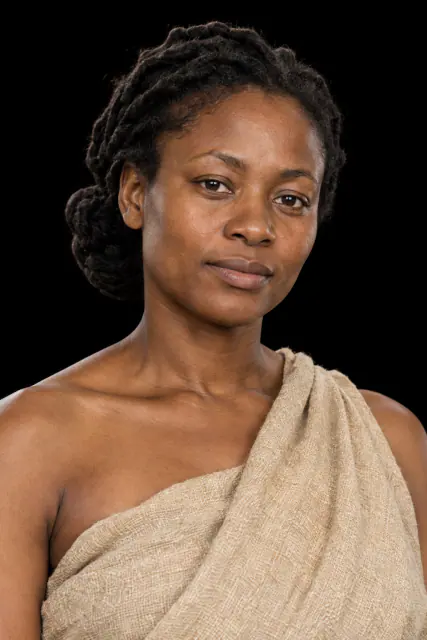
Nia
Nia is a fictional potter created to explain documented techniques; she does not represent an identified historical person.
Read the record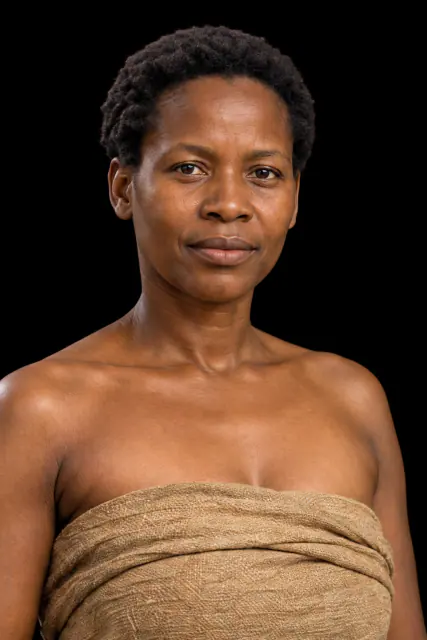
Woman of Lugala A1
A burial by the lake allows us to speak of a life without inventing a name for it.
Read the recordLOOK CLOSER
Objects and places to start with
A selection from the destination museum. Open each record to explore its documentation and images.
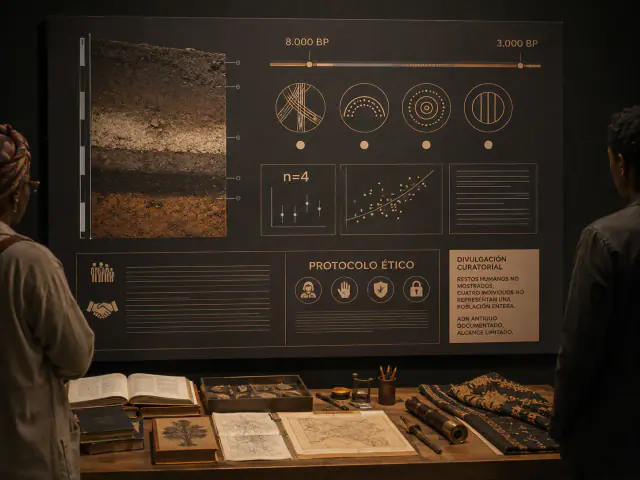
Shum Laka
Their remains allow us to investigate the ancient population of the region without attributing to them a language we do not know.
Read the record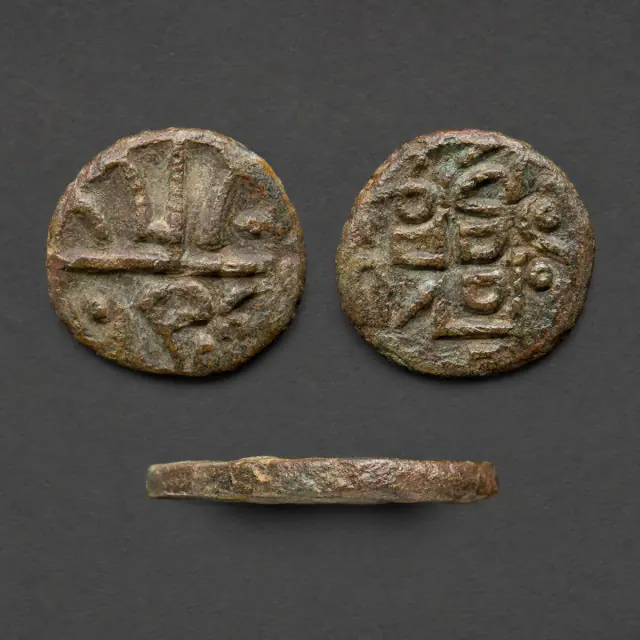
Kilwa coin
This copper coin, probably minted in Kilwa, bears an Arabic inscription with the name of an African coastal authority.
Read the record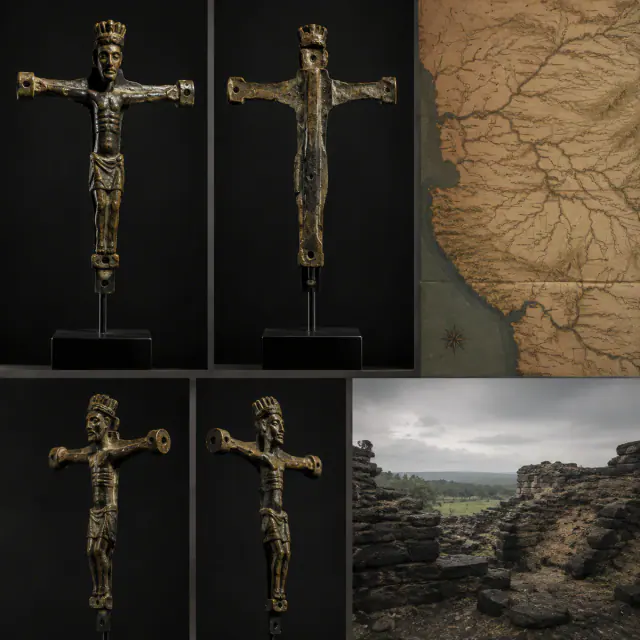
Kongo crucifix
Kongo artists cast brass crucifixes and gave them uses within their own religious and political practices.
Read the record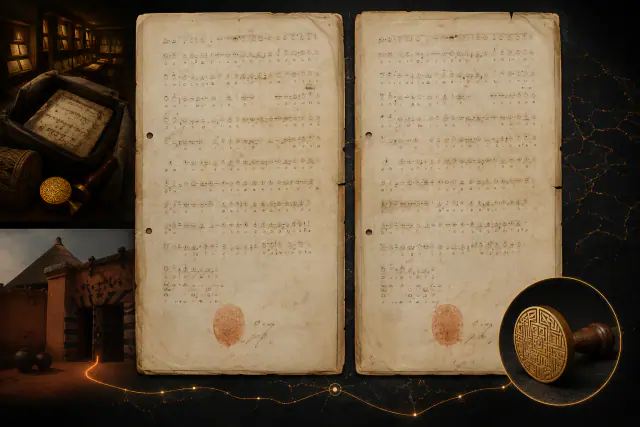
Bamum document
This 1922 document shows an administrative use of Bamum script; the original is preserved in Foumban.
Read the recordWHAT REMAINS
Its legacy and ongoing research
Bantu languages and their societies form a central part of the present-day African landscape. Their history does not end with a migration: it continues in cities, fields, oral archives, arts, religions, states and diasporas.
CHOOSE YOUR NEXT STOP
Inside this museum
Sources for this introduction
Each theme links to its documentation. The full bibliography also brings together sources for the chronology, the people and the connection between the museums.
View all sources and references →Evidence and interpretation
Level of evidence of connection: high. The door describes contact; it does not convert two different cultures into one nor does it presuppose automatic ethnic continuity.
Catalogue facts
- Contact period
- 1st millennium CE–present
- Destination museum
- Bantu expansions and societies of Central, Eastern and Southern Africa
- Link Type
- contact
- Level of evidence
- high
- Destination region
- Africa
A closer look
About 1 min to read · 1 section. Further reading and sources · free access. Editorial review recorded: .
The same mountain range preserves other paintings
The Maloti-Drakensberg heritage record includes paintings from the 19th and 20th centuries attributed to Bantu-speaking communities, alongside the group associated with San artists. This coexistence within one region allows a comparison grounded in context: the makers, periods and uses of the landscape changed. Sharing rock shelters or territories does not automatically turn two graphic traditions into one. The gateway invites visitors to follow the mountain range’s different inhabitants through works and contexts that can be dated, and to consider how rock art continued to form part of histories after the Stone Age.
- Heritage · UNESCO · Maloti-Drakensberg ParkAccess recorded: .
Location and territory
REGIONAL AREA
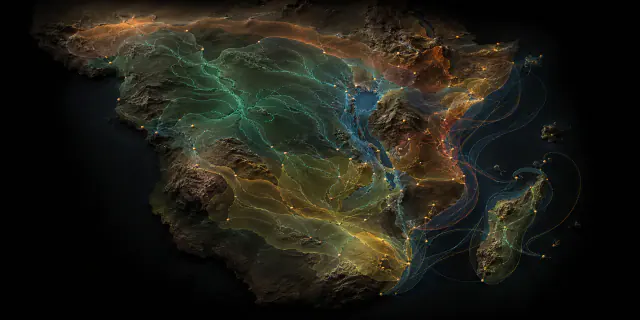
Current linguistic maximum envelope and historical corridors; it was not a single political territory nor simultaneously occupiedCurrent maximum linguistic envelope and historical corridors; it was not a single political territory nor was it occupied simultaneously. The footprint indicates the indicative centre of the sphere, not a border or an exact point.Cultural connections
Sources and references
- PLOS ONE · southern African organic containers database
- Language Dynamics and Change · Bantu-Khoisan contact
- South African History Online · Defining the term Bantu
- UNESCO · Maloti-Drakensberg Park
- UNESCO · General History of Africa
- Journal of African History · Moving Histories
- Annual Review of Linguistics · Historical sociolinguistic configuration
- Ghent University · BantuFirst
- Nature · Medieval Swahili African and Asian roots
- Nature · Genetic legacy of Bantu-speaking expansions
- UNESCO · Great Zimbabwe
- UNESCO · Mbanza Kongo
- UNESCO · Kilwa Kisiwani and Songo Mnara
- World History Commons · Afonso I letter excerpt
- AfricaMuseum · Bantu lexical reconstructions
- British Museum · Ndop Af1909,0513.2
- Smithsonian NMAfA · Inscribing Meaning
- Journal of African History · Nzinga in a New Perspective
- UNESCO ICH · Mbira/Sansi
- UNESCO ICH · Chopi Timbila
- University of Kansas Libraries · Utendi wa Mwana Kupona
- RMCA · Comparative Bantu Pottery Vocabulary
- Met · Lydenburg Heads
- Met · Kongo Crucifix 1999.295.7
- Oxford · Dona Beatriz Kimpa Vita
- Met · Dona Beatriz, Kongo Prophet
- UNESCO ICDH · Nehanda and Kaguvi records
- University of Pretoria · Gold rhinoceros
- Antiquity · Glass beads from Ingombe Ilede
- British Museum · Coin 1938,0210.2
- UNESCO ICH · Makishi
- UNESCO ICH · Mvet Oyeng
- NMMZ · Southern Region, Masvingo
- Grollemund, Schoenbrun and Vansina (2023), Moving Histories, pp. 33–35
- The Met · Kongo Christian Art
- Smithsonian · Images of Bamum
- Ruth Tibesasa (2021), thesis University of Pretoria, pp. 103–109, 197–199; figs. 5.20–5.21; table 5.9
YOUR NEXT VISIT
Explore Bantu worlds
The same collection, two ways to explore. Choose the experience that suits you.
Did you enjoy this exhibit?
Your opinion helps us improve the museum. You can change it whenever you like.
Loading your rating…