
 English
 Español
 Français
 Italiano
 Deutsch
 Русский
 Português
 Polski
 Română
 Svenska
 Norsk bokmål
 Suomi
 Türkçe
 العربية
 简体中文
 한국어
 हिन्दी
 Ελληνικά
04 · OBJECT · STORAGE
Pithos
Storing a harvest in a vessel taller than a child
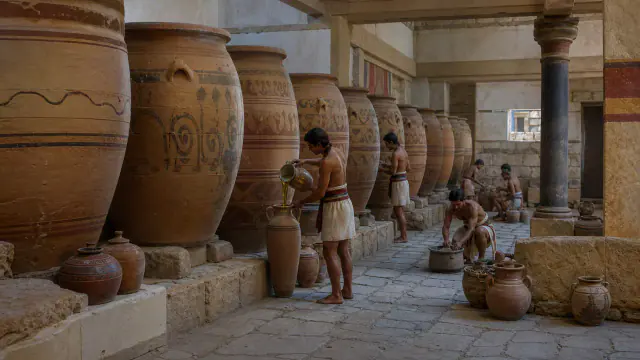
The large vessels called pithoi served to store products in the storerooms of Crete.
Museum documentation · free public access, no account required.
Generated reconstruction · Declared visual hypothesis
Declared visual reconstruction for museographic context; it is not a photograph of the original nor documentary evidence.
History and context
The large pithoi of Crete served to store products in palatial buildings and storerooms. One from Knossos even preserves its findspot in a magazine area.
There is no need to imagine a hidden treasure. Oil, grain or other goods kept in large vessels speak of foresight, labour and control of material flows.
The large pithos in the British Museum comes from a magazine area of Knossos. Its volume and weight show that storage also fixed the product in a building.
Ropes, lids, ladles and records would complete its use, although they do not always survive. Decoration and capacity could coexist in a working vessel.
Evidence and interpretation
Documented fact: The British Museum catalogues a Knossos pithos found in a palace storeroom, dated to Late Minoan II–IIIA1. Interpretation and caution: The concrete content of a vessel or who had authority over it cannot be deduced without analysis and specific context. Expanded documentation: The British Museum preserves a Knossos pithos found in palace storerooms. Expanded interpretation and caution: Without residue analysis, oil, wine or grain must not be assigned to each concrete specimen.
Catalogue facts
- Narrative date
- c. 1450–1375 BCE
- Location
- Knossos, Crete, Greece
- Material
- Incised terracotta
- Context
- Palatial storage
- Curatorial reading
- The documented fact and its interpretation appear separately in the evidence block.
- Context
- Palace magazines of Knossos
- Function
- High-volume storage
- Documentary coverage
- 2 museum, heritage, primary corpus or research sources for this stop.
A SHARED TOPIC, DIFFERENT MOMENTS
Objects connected through time
Follow a topic across the collections. A shared tag is a way to compare objects, not proof that one culture influenced another.
The order uses the midpoint of each approximate date range; ranges can overlap. Spacing does not represent elapsed time. Swipe, scroll or use the arrows. With the sequence focused, use ← / →, Home or End.
Terracotta8 dated objects
 You are viewing
c. 1450–1375 BCE
Pithos
Greek worlds
Approximate dating according to the record.
Current record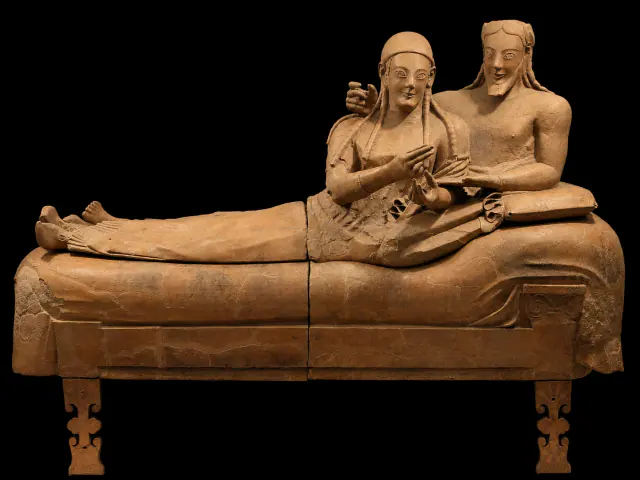
530–520 BCE
Two voices in an urn
Etruscans and Rome
Approximate dating according to the record.
Read the record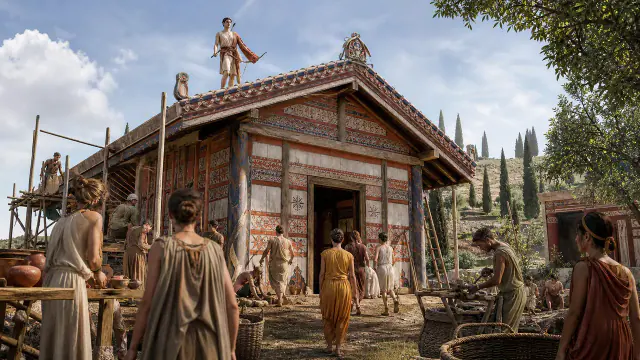
Towards 510–500 BCE
The god on the roof
Etruscans and Rome
Approximate dating according to the record.
Read the record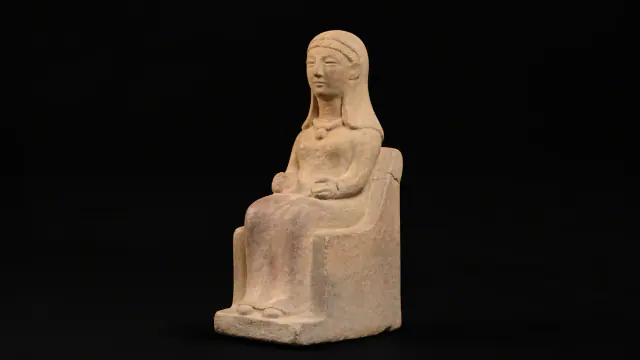
4th–3rd centuries BCE
Lady of Ibiza
Phoenicians
Approximate dating according to the record.
Read the record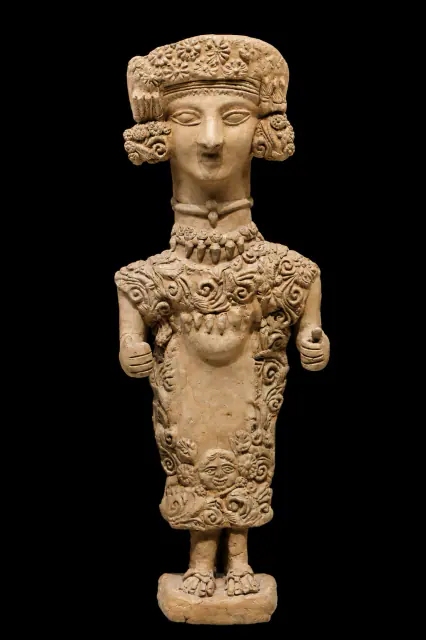
4th–3rd centuries BCE
Lady of Ibiza
Iberians
Approximate dating according to the record.
Read the record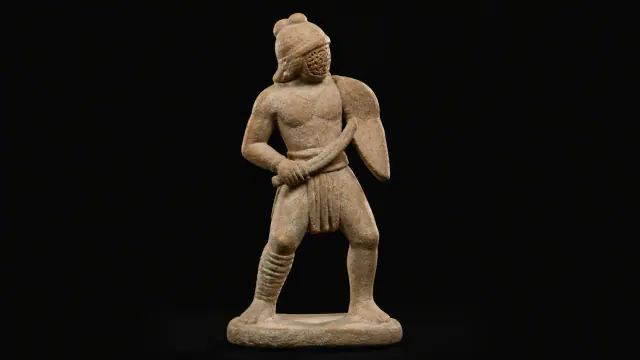
67–100 CE
Thracian Gladiator from Cádiz
Etruscans and Rome
Approximate dating according to the record.
Read the record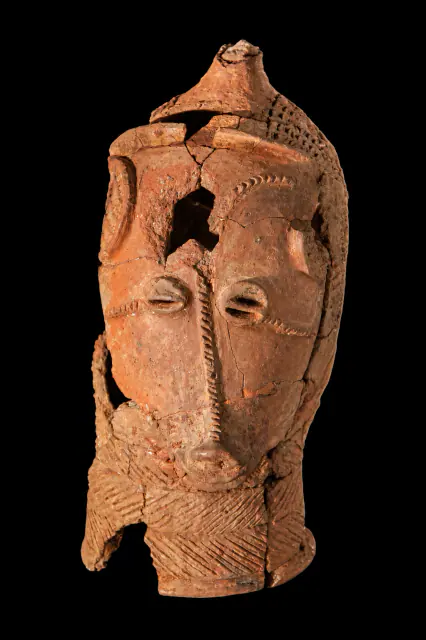
c. 500–700 CE
Seven heads
Bantu-speaking worlds
Dating of the group of seven heads; function debated.
Read the record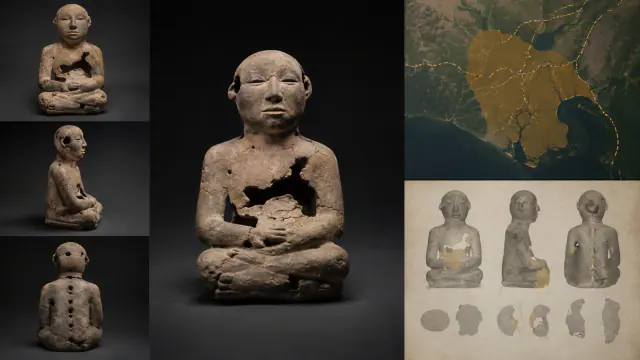
13th century, date attributed by the museum
Seated figure
Mande Worlds
Museum attribution; no demonstrated excavation context.
Read the record
Also connected, without a comparable date (1)
These objects are not placed after the others: an unknown date does not mean a more recent object.
- Rome learns in terracottaEtruscans and Rome · End of the sixth century BCE
A closer look
About 1 min to read · 1 section. Further reading and sources · free access. Editorial review recorded: .
Ropes turned into ceramic decoration
On this pithos, four bands of incised wavy lines produce the appearance of ropes; between them, horizontal reliefs incorporate diagonal strokes. The surface thus transforms a recognisable motif into permanent clay decoration, without the incisions being remains of an actual rope. Its recorded dimensions are 114.3 centimetres high and 69.85 in diameter. Minos Kalokairinos found it in 1878 in the third storeroom of the west wing of Knossos and donated it to the British Museum in 1884. The room number retains greater archaeological precision than a general attribution to the palace.
- Museum · British Museum · Pithos, 1884,0807.1Access recorded: .
Location and territory
LOCATED SITE
Knossos · CreteMarker of the palatial complex.Where it is held
The British Museum
Item or group in the record · Documented collection
The holding institution is documented; public display may change. Check its official record before visiting.
Sources and references
Did you enjoy this exhibit?
Your opinion helps us improve the museum. You can change it whenever you like.
Loading your rating…