
 English
 Español
 Français
 Italiano
 Deutsch
 Русский
 Português
 Polski
 Română
 Svenska
 Norsk bokmål
 Suomi
 Türkçe
 العربية
 简体中文
 한국어
 हिन्दी
 Ελληνικά
WESTERN ASIA · KINGDOM · TERRITORIAL EMPIRE
Persia
Persian / Achaemenid
The Achaemenid Empire brought together peoples with different languages, customs and forms of government.
Museum documentation · free public access, no account required.
Generated reconstruction · Declared visual hypothesis
Declared visual reconstruction; not a photograph of the original nor documentary evidence.
Why this doorway leads to another museum
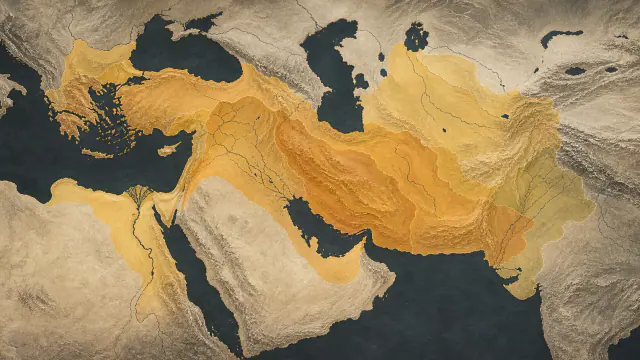
The Achaemenids transformed a Persian kingdom into a continental empire of enormous linguistic, religious and administrative diversity.
Cyrus and his successors combined conquest with agreements, local elites and administrative systems capable of governing very different territories. The empire incorporated peoples and administrations from Mesopotamia, Egypt, Anatolia, Central Asia and India, often preserving local laws and elites.
Period covered by the destination museum: ≈700–550 BCE · empire from ≈550
BEFORE YOU ENTER
An introduction to Persia
Find your place in time, explore the changes and choose where to go next.
- When
- ≈700–550 BCE · empire from ≈550 · WESTERN ASIA
- Where
- Persis/Fars, with Pasargadae and Persepolis on the Iranian plateau.
- What this collection brings together
- Kingdom · territorial empire
The Achaemenids transformed a Persian kingdom into a continental empire of enormous linguistic, religious and administrative diversity.
Cyrus and his successors combined conquest with agreements, local elites and administrative systems capable of governing very different territories.
PLACE MATTERS
Territory and connections
Persis/Fars, with Pasargadae and Persepolis on the Iranian plateau. Anatolia, Mesopotamia, Egypt, Central Asia and Indus Valley.
A HISTORY OF CHANGE
The main periods
Dates are approximate. Periods help us navigate the past, but their boundaries were not always the same in every region.
c. 900–559 BCE
Formation in Persis
Persian lineages consolidated in Fars within Elamite, Median and Mesopotamian networks; no Achaemenid empire yet existed.
559–530 BCE
Conquests of Cyrus II
Cyrus incorporated Media, Lydia and Babylon; each conquest preserved administrations and elites to varying degrees.
530–522 BCE
Conquest of Egypt
Cambyses incorporated Egypt into the empire; the new province preserved local institutions and experienced resistance.
522–486 BCE
Darius I and maximum integration
Darius reorganised satrapies and extended the empire towards the Indus and Thrace; the maximum extent combined controls of uneven intensity.
Continue the story: 3 more periods
486–404 BCE
Rebellions and losses
Rebellions and wars altered provinces and Egypt regained independence in 404 BCE; the empire remained a great power.
404–334 BCE
Late empire and reconquest
Artaxerxes III reconquered Egypt in 343 BCE; the recovery was late and did not restore all previous positions.
334–330 BCE
Macedonian conquest
Alexander defeated Darius III and occupied the capitals; offices, elites and imperial languages did not disappear immediately.
BEYOND THE DATES
How people lived and saw the world
How they were organised
The 'king of kings' ruled by means of satraps, treasurers, commanders, scribes, local dynasts and members of the royal house. Competences varied by region: the label satrapy describes a flexible solution, not an identical organisational chart across the territory.
Bisotun shows the other side of the agreement: Darius legitimised his ascent by labelling his adversaries liars and representing them bound. The administered diversity rested on the capacity to punish rebellions and mobilise resources.
What daily life was like
Behind the ceremonial architecture were kitchens, storerooms, mills, herds, workshops and long journeys. The Persepolis Archive mentions mothers, children, work gangs and travellers, a society much broader than the sculpted elite.
Food, clothing and housing varied from Egypt to Bactria; there was no single Achaemenid way of life. The court adopted regional products and protocols while communities maintained many of their own practices.
What they knew how to do
Large-format stone quarrying, glazed brick, carpentry, drainage and canals combined knowledge from different workshops. Tool marks and materials allow tracing collaboration and transfer of techniques without assuming a single 'national style'.
Cuneiform, seals and travel authorisations were also technologies: they compressed identity, responsibility and provisions into portable media capable of coordinating enormous distances.
What they believed
The kings invoked Ahuramazda in Persian inscriptions, but governed communities with temples, priesthoods and different gods. In Babylon, Cyrus spoke the political language of Marduk; that adaptation was a situated practice of legitimisation.
Altars and winged figures in royal tombs express a privileged relationship between king, truth and order. They are not sufficient to reconstruct an 'Achaemenid Zoroastrianism' identical to much later religious texts.
Who they interacted with
Land and river routes connected the Aegean, the Nile, Mesopotamia, Iran, Central Asia and the Indus. Goods, messengers, specialists and embassies circulated through corridors predating the empire, which the court expanded and supervised.
The daric appears mainly in western circuits and high-value payments; other territories used local coinage or payments in kind. Integration does not equate to a single market.
Art, music and storytelling
Reliefs, glazed bricks and architecture built a grammar of repetition, hierarchy and controlled diversity. The colour, now lost or fragmentary, transformed façades that were never the bare marble of modern imagination.
The processions of the Apadana distinguish hairstyles, textiles, animals and vessels, but order all difference towards the royal centre. They are carefully edited political images, not spontaneous scenes.
PEOPLE AND TESTIMONIES
Meet the people
The records distinguish historical figures, representations and reconstructions. They explain their context, the available sources and their connections with other people.
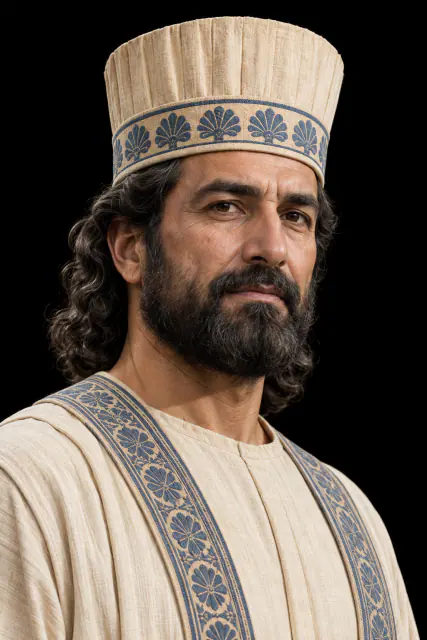
The stone house of Cyrus
A compact chamber on six steps survived when entire palaces became foundations.
Read the record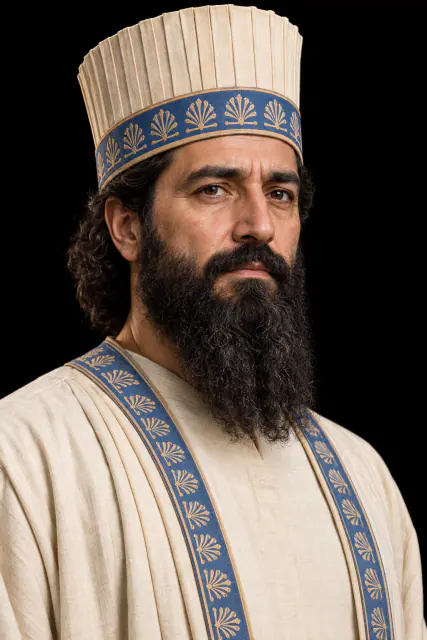
Xerxes I
Xerxes continued Darius's works and left inscriptions identifying his name and lineage.
Read the record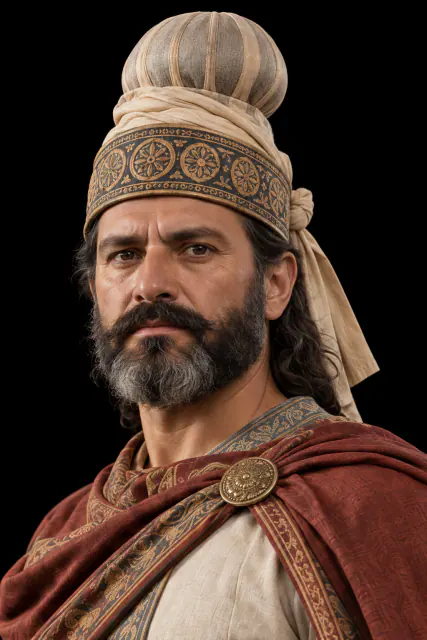
Ardashir I
Centuries after the Achaemenids, Ardashir defeated the Arsacid king and founded a new dynasty.
Read the record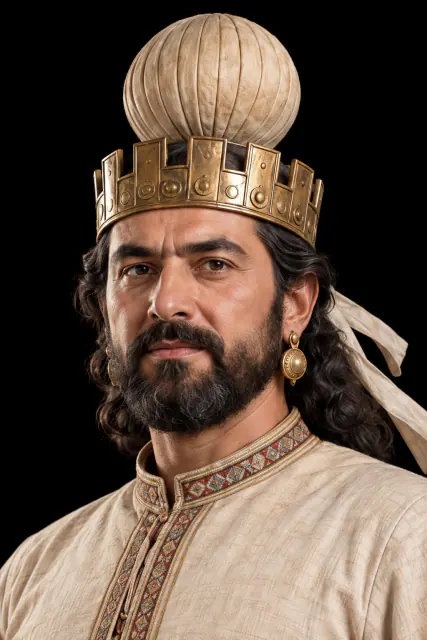
Shapur II
The emblem of a crown allows attribution of the image, without certifying the monarch's face.
Read the recordLOOK CLOSER
Objects and places to start with
A selection from the destination museum. Open each record to explore its documentation and images.
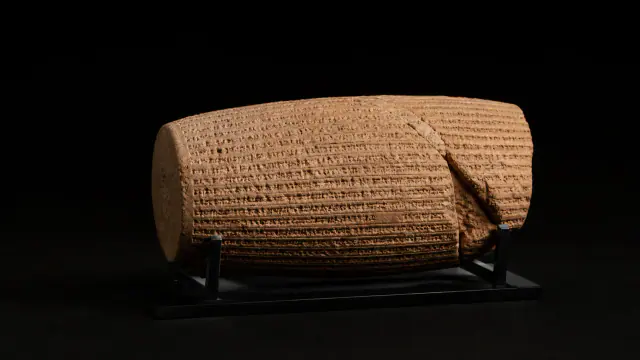
Cyrus speaks as king of Babylon
The conqueror of Babylon presented himself in Babylonian language as chosen by Marduk and restorer of order.
Read the record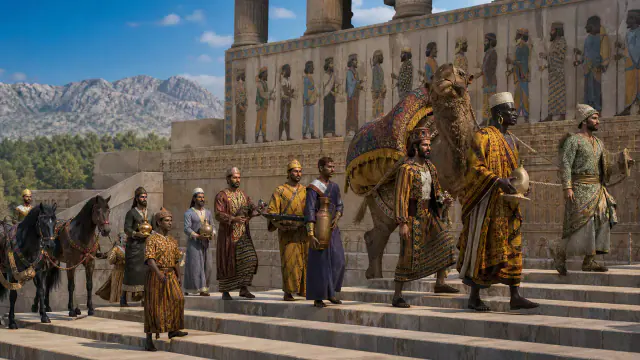
Twenty-three delegations
Peoples from across the empire advance with distinct dress, animals and products towards the king.
Read the record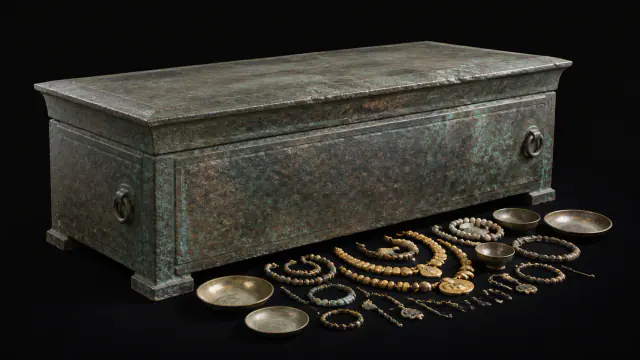
Susa grave goods
A bronze sarcophagus, jewellery and tableware formed the grave goods of a high-ranking person buried in Susa.
Read the record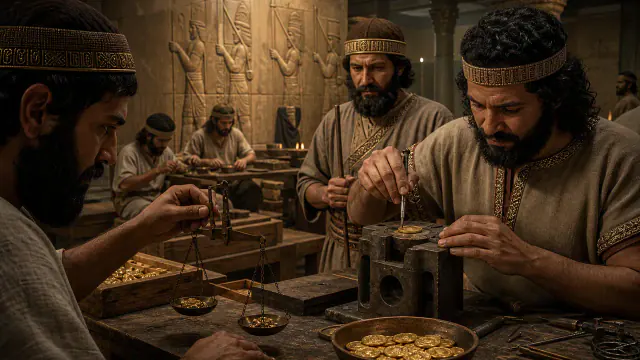
The archer in gold
These gold coins bore a royal figure with weapons and served for high-value payments.
Read the recordWHAT REMAINS
Its legacy and ongoing research
Persian models of administration, infrastructure and imperial representation influenced Hellenistic, Roman and Islamic worlds.
CHOOSE YOUR NEXT STOP
Inside this museum
Sources for this introduction
Each theme links to its documentation. The full bibliography also brings together sources for the chronology, the people and the connection between the museums.
View all sources and references →Evidence and interpretation
This window distinguishes the documented core of its historical reach: Persis/Fars, with Pasargadae and Persepolis on the Iranian plateau. The label 'Persia' summarises a changing trajectory, not an immobile population nor a universal stage of progress.
Catalogue facts
- Narrative date
- ≈700–550 BCE · empire from ≈550
- Location
- Persis/Fars, with Pasargadae and Persepolis on the Iranian plateau.
- Type of entity
- Kingdom · territorial empire
- Scope
- Anatolia, Mesopotamia, Egypt, Central Asia and Indus Valley.
- Key innovation
- Satrapies and multi-level administration
- Legacy
- Persian models of administration, infrastructure and imperial representation influenced Hellenistic, Roman and Islamic worlds.
A closer look
About 1 min to read · 1 section. Further reading and sources · free access. Editorial review recorded: .
An archive functioned in several scripts
The tablets of the Persepolis Fortification, produced around 500 BCE, bring together documents in Elamite, records in Aramaic and numerous seal impressions without text. There are also exceptional cases in other languages. The Chicago project studies them as parts of the same administrative system, not as archives of isolated peoples. The entries and exits of food allow tracking from workers to members of the royal family. This perspective complements the palace reliefs: the empire needed to coordinate everyday supplies as well as visually represent its authority.
Location and territory
LOCATED SITE
Persepolis · IranMarker of the palace terrace.Cultural connections
Sources and references
- UNESCO World Heritage Centre · Pasargadae
- UNESCO World Heritage Centre · Persepolis
- UNESCO World Heritage Centre · Bisotun
- University of Chicago, ISAC · Persepolis Fortification Archive
- The Metropolitan Museum of Art · The Achaemenid Persian Empire (550–330 B.C.)
- Institute for the Study of Ancient Cultures · Persepolis Fortification Tablets (OIP 92)
- Encyclopaedia Iranica · Persepolis Elamite Tablets
- Encyclopaedia Iranica · Women in Pre-Islamic Persia
- Musée du Louvre · Frieze of Archers
- UNESCO World Heritage Centre · Susa nomination dossier
- Encyclopaedia Iranica · Achaemenid Dynasty, Culture
- British Museum · The Cyrus Cylinder
- UNESCO Tentative List · Naqsh-e Rostam and Naqsh-e Rajab
- The Metropolitan Museum of Art · Daric with king
- Institute for the Study of Ancient Cultures · Seals and Archives at Persepolis (SAOC 72)
- ISAC · Religion and Power: Divine Kingship in the Ancient World and Beyond (OIS 4)
- Encyclopaedia Iranica · Pasargadae
- Encyclopaedia Iranica · Clothing II
- British Museum · trilingual inscription with the names of Xerxes
- Encyclopaedia Iranica · rock reliefs of Ardashir I
- The Met · Persian-Style Riding Coat
- The Met · The Sasanian Empire
- British Museum · Ardashir I · coin 1850,0412.90
- British Museum · Ardashir I · coin 1848,0803.242
- Smithsonian · dish of Shapur II, 4th century, F1934.23
- Smithsonian · crown, attire and identification of Shapur II
- The Met · historical context of the Sasanian Empire
YOUR NEXT VISIT
Explore Persia
The same collection, two ways to explore. Choose the experience that suits you.
Did you enjoy this exhibit?
Your opinion helps us improve the museum. You can change it whenever you like.
Loading your rating…