
 English
 Español
 Français
 Italiano
 Deutsch
 Русский
 Português
 Polski
 Română
 Svenska
 Norsk bokmål
 Suomi
 Türkçe
 العربية
 简体中文
 한국어
 हिन्दी
 Ελληνικά
EUROASIAN STEPPE · HORSE PEOPLES · MOBILE CONFEDERATIONS
Scythians and Saka
Scythian / Saka
The horse facilitated movement, exchange, and warfare among the peoples of the steppe.
Museum documentation · free public access, no account required.
Generated reconstruction · Declared visual hypothesis
Declared visual reconstruction, created for museographic contextualisation; not a photograph of the original nor does it constitute documentary evidence.
Why this doorway leads to another museum
Nomadic Iranian peoples organised power, exchange, and warfare through equine mobility. They did not form a single city-state or a stable empire.
Mastery of the horse and the composite bow turned vast distances into political, military, and commercial routes. Scythian and Saka are broad names used by different observers. These societies connected Persia, Central Asia, the Caucasus, and Greek colonies on the Black Sea.
Period covered by the destination museum: c. 800–700 BCE
BEFORE YOU ENTER
An introduction to Scythians and Saka
Find your place in time, explore the changes and choose where to go next.
- When
- c. 800–700 BCE · EUROASIAN STEPPE
- Where
- Steppe corridors between Central Asia, the Caucasus, and the Black Sea.
- What this collection brings together
- Horse peoples · mobile confederations
Nomadic Iranian peoples organised power, exchange, and warfare through equine mobility. They did not form a single city-state or a stable empire.
Mastery of the horse and the composite bow turned vast distances into political, military, and commercial routes.
PLACE MATTERS
Territory and connections
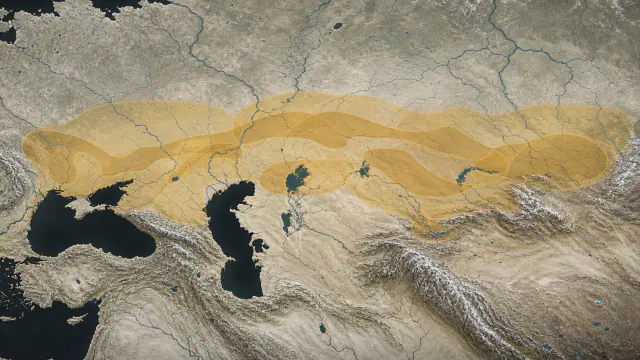
Steppe corridors between Central Asia, the Caucasus, and the Black Sea. Pontic steppes and wide areas of Eurasia connected through seasonal mobility and political networks.
A HISTORY OF CHANGE
The main periods
Dates are approximate. Periods help us navigate the past, but their boundaries were not always the same in every region.
c. 900–700 BCE
Early Scythian horizons
Kurgans, horses, and animal art appear in several steppe foci; a single origin and a linear migration remain debated.
c. 700–500 BCE
Pontic confederations
Groups called Scythians dominate corridors north of the Black Sea and contact the Caucasus and the Near East; mobility does not produce a fixed border.
c. 550–330 BCE
Plural Scythians and Sakas
Persian and Greek sources name different groups from the Pontus to Central Asia; sharing repertoires does not imply common sovereignty.
c. 500–300 BCE
Regional apogee
Steppe kingdoms and confederations sustain networks with Greek colonies and Persia; the total area is not a Euro-Asiatic empire.
Continue the story: 2 more periods
c. 300 BCE–200 CE
Sarmatian advance in the west
New Sarmatian confederations transform the Pontic steppe; this is not an instantaneous replacement of the entire population.
c. 200 BCE–300 CE
Eastern transformations
Yuezhi, Kushans, and other powers reorder Central Asia; Saka populations continue in diverse forms.
BEYOND THE DATES
How people lived and saw the world
How they were organised
Arzhan-2, Issyk, and the great kurgans of the Dnieper show people capable of mobilising metals, animals, artisans, and funerary labour. That concentration demonstrates hierarchy, but titles of king, prince, or priest derive from analogies and external sources.
Confederations could gather and fragment around lineages, herds, and campaigns. Bisotun records Darius's attempt to represent Skunkha and his group as a subdued province, an Achaemenid political claim that does not equate to continuous administrative control.
What daily life was like
Permafrost preserved boots, clothing, bowls, cheese, felts, and textile supports that rarely survive. These materials allow the reconstruction of techniques for warmth, transport, and service far beyond gold.
Images from Kul-Oba show a drawn bow, a tended leg, and conversations between men wearing trousers and caps. They are valuable visual observations, though filtered through a workshop of the Bosporan Kingdom and the programme of a funerary object.
What they knew how to do
The gorytus gathered bow and arrows in a portable case, and stirrup-less saddles distributed weight on the horse. Balance, training, and flexible equipment made mounted archery effective centuries before the arrival of the stirrup.
Knotted carpets, appliquéd felts, and carved harnesses show textile and leather engineering comparable in complexity to metallurgy. Ice alters our perception by preserving technologies normally invisible.
What they believed
Log chambers, prepared bodies, sacrificed horses, and broken or disassembled objects built funerals with memory and transit. Regional repetition allows the recognition of practices, but not the recovery of a complete doctrine.
Crouching deer, griffins, and animal combat appear on clothing, harnesses, and vessels. They may relate to status and cosmology; assigning each figure to a named god or myth often goes beyond the evidence.
Who they interacted with
Silks and Chinese manufactures, shells from the Indian Ocean, carpets linked to the Near East, and Greek objects appear far from their likely places of manufacture. The networks could have included exchange, gift, tribute, marriage, and booty.
On the Black Sea, Greek workshops worked for Scythian clients and observed local clothing and equipment. The Greco-Scythian result is neither copy nor purity: it is a material relationship between coastal cities and steppe elites.
Art, music and storytelling
The so-called animal style compressed deer, felids, and birds of prey into silhouettes suitable for clothing, weapons, and harnesses. Scale, repetition, and shine turned the dressed body and the horse into mobile surfaces of communication.
Combs and vessels from the Black Sea mixed Greek techniques with Scythian clients, themes, and observation. Their naturalism is not ethnic photography, and identifications of historical characters based on Herodotus remain hypotheses.
PEOPLE AND TESTIMONIES
Meet the people
The records distinguish historical figures, representations and reconstructions. They explain their context, the available sources and their connections with other people.
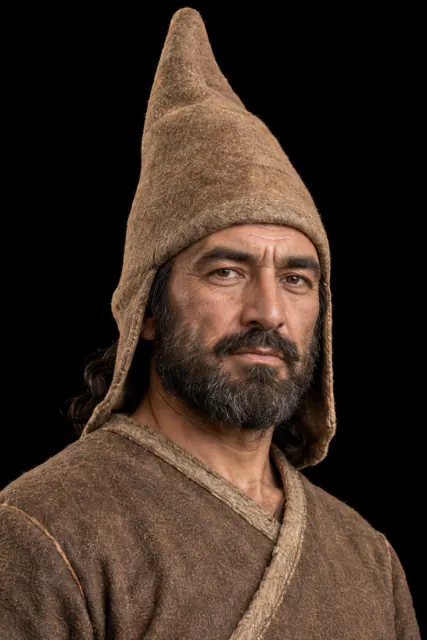
The captive in the pointed cap
Darius incorporated a Saka chief into his row of defeated rebels and distinguished him by his headdress.
Read the record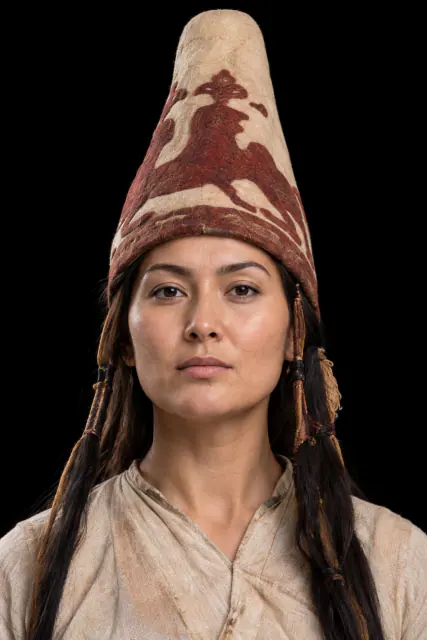
The tattooed woman of Ukok
An adult woman wore animal tattoos and an imported silk blouse into a frozen tomb.
Read the record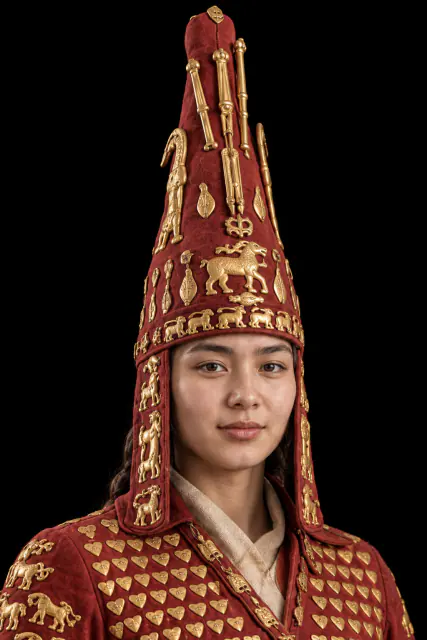
Four thousand pieces of gold
A young person was buried with thousands of gold ornaments; their reconstruction is today known as the Golden Man.
Read the recordLOOK CLOSER
Objects and places to start with
A selection from the destination museum. Open each record to explore its documentation and images.
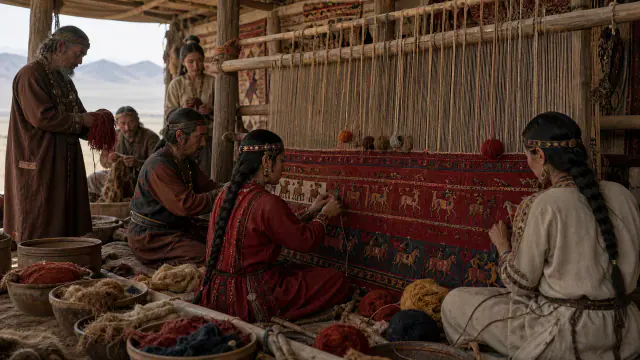
The oldest knotted carpet
Over a million knots depicted horsemen, deer and griffins before being trapped in ice.
Read the record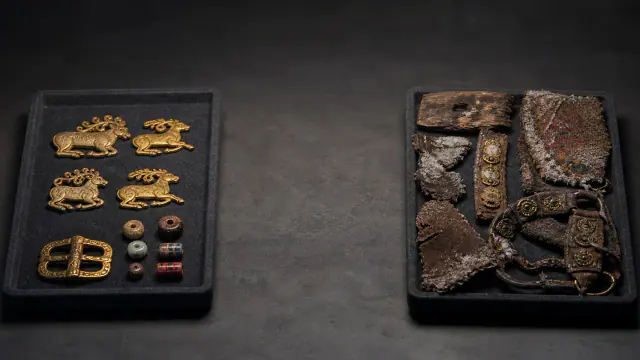
Steppe kurgans
These burials preserved gold ornaments, weapons and materials uncommon in other graves, such as clothing, felt and leather.
Read the record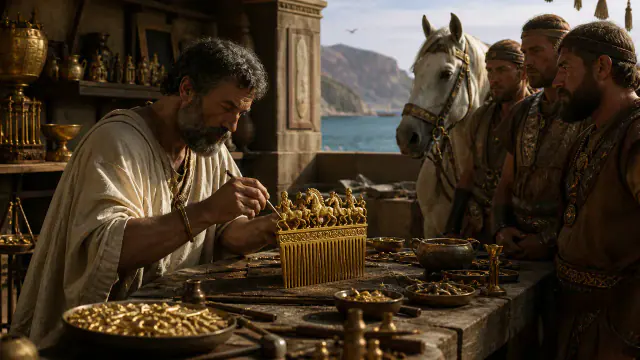
A battle on a comb
Three combatants face each other on gold teeth in a work made for a steppe tomb.
Read the record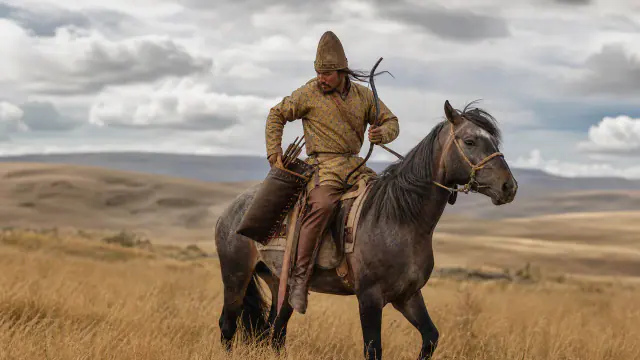
Bow and arrows in a case
A single case protected a composite bow and arrows, ready for use from the side.
Read the recordWHAT REMAINS
Its legacy and ongoing research
Their goldwork, funerary practices, and equine technologies show how mobility could sustain continental power networks.
CHOOSE YOUR NEXT STOP
Inside this museum
Sources for this introduction
Each theme links to its documentation. The full bibliography also brings together sources for the chronology, the people and the connection between the museums.
View all sources and references →Evidence and interpretation
This window distinguishes the documented core of their historical reach: Steppe corridors between Central Asia, the Caucasus, and the Black Sea. The label 'Scythians and Sakas' summarises a changing trajectory, not a static population or a universal stage of progress.
Catalogue facts
- Narrative date
- c. 800–700 BCE
- Location
- Steppe corridors between Central Asia, the Caucasus, and the Black Sea.
- Type of entity
- Horse peoples · mobile confederations
- Scope
- Pontic steppes and wide areas of Eurasia connected through seasonal mobility and political networks.
- Key innovation
- Composite bow adapted for riding
- Legacy
- Their goldwork, funerary practices, and equine technologies show how mobility could sustain continental power networks.
A closer look
About 1 min to read · 1 section. Further reading and sources · free access. Editorial review recorded: .
Colour begins before dyeing the wool
A 2021 study examined fibres from the Pazyryk carpet using X-ray fluorescence microscopy and compared them with experimentally prepared wools. The distribution of pigment components proved compatible with fermentation prior to dyeing. The conclusion shifts attention from the carpet's motifs to the knowledge of those who transformed its raw material. It is not an ancient written recipe: it is a technical reconstruction verified in fibres. Steppe societies are also investigated through specialised crafts that do not fit the image of the mounted warrior.
Location and territory
REGIONAL AREA
Steppe corridors between Central Asia, the Caucasus, and the Black Sea.Steppe corridors; mobility and confederations, not a permanent border. The marker indicates the indicative centre of the area, not a border or an exact point.Cultural connections
Sources and references
- UNESCO · Pazyryk kurgans
- Hermitage · Pazyryk Burial Mounds
- The Metropolitan Museum of Art · Gold, Griffins, and Greeks: Scythian Art and Cultural Interactions
- Scientific Reports · X-ray microscopy reveals the outstanding craftsmanship of Siberian Iron Age textile dyers, 2021
- British Museum · Scythians
- State Hermitage Museum · Early Nomads of the Sayan-Altai
- State Hermitage Museum · Arzhan-2 funerary and memorial complex, monograph 2024
- Government of Kazakhstan · Procession of the Golden Man continues in India
- UNESCO World Heritage Centre · Bisotun
- UNESCO — Preservation of the Frozen Tombs of the Altai Mountains
- Antiquity · Review and archaeological assessment of Scythians: warriors of ancient Siberia
- State Hermitage Museum · Gold vessel with Scythians from Kul-Oba
- UNESCO World Heritage Centre · Treasures of the Pazyryk Culture
- State Hermitage Museum · Pazyryk pile carpet
- British Museum · Gold gorytus fitting from the Oxus Treasure
- State Hermitage Museum · Silver-gilt amphora from Chertomlyk
- State Hermitage Museum · Scythians collection
- State Hermitage Museum · The Wonderful Scythian Gold Comb, monograph 2024
- UNESCO · Bisotun nomination file
- TITUS · Old Persian corpus, DBk: identification of Skunkha
- Encyclopaedia Iranica · Clothing II
- British Museum · Persepolis 500 BC
- Institute of Archaeology and Ethnography SB RAS · MRI of the mummy from Ak-Alakha-3
- HAU: Journal of Ethnographic Theory · Repatriation and social values of the Ukok human remains
- State Historical-Cultural Museum-Reserve Issyk · Official museum site
- Government of Kazakhstan — The Golden Warrior of the Kazakh Steppe
- Archaeology of Kazakhstan · Archival study of the discovery and reconstructions of the Issyk Golden Man
YOUR NEXT VISIT
Explore Scythians and Saka
The same collection, two ways to explore. Choose the experience that suits you.
Did you enjoy this exhibit?
Your opinion helps us improve the museum. You can change it whenever you like.
Loading your rating…