
 English
 Español
 Français
 Italiano
 Deutsch
 Русский
 Português
 Polski
 Română
 Svenska
 Norsk bokmål
 Suomi
 Türkçe
 العربية
 简体中文
 한국어
 हिन्दी
 Ελληνικά
LIVING AND DOCUMENTED CULTURE · 03
Mvet Oyeng: story, instrument and audience
The mvet brings together a string instrument, narratives and knowledge shared with audience participation.
Museum documentation · free public access, no account required.
Reconstruction · Declared visual hypothesis
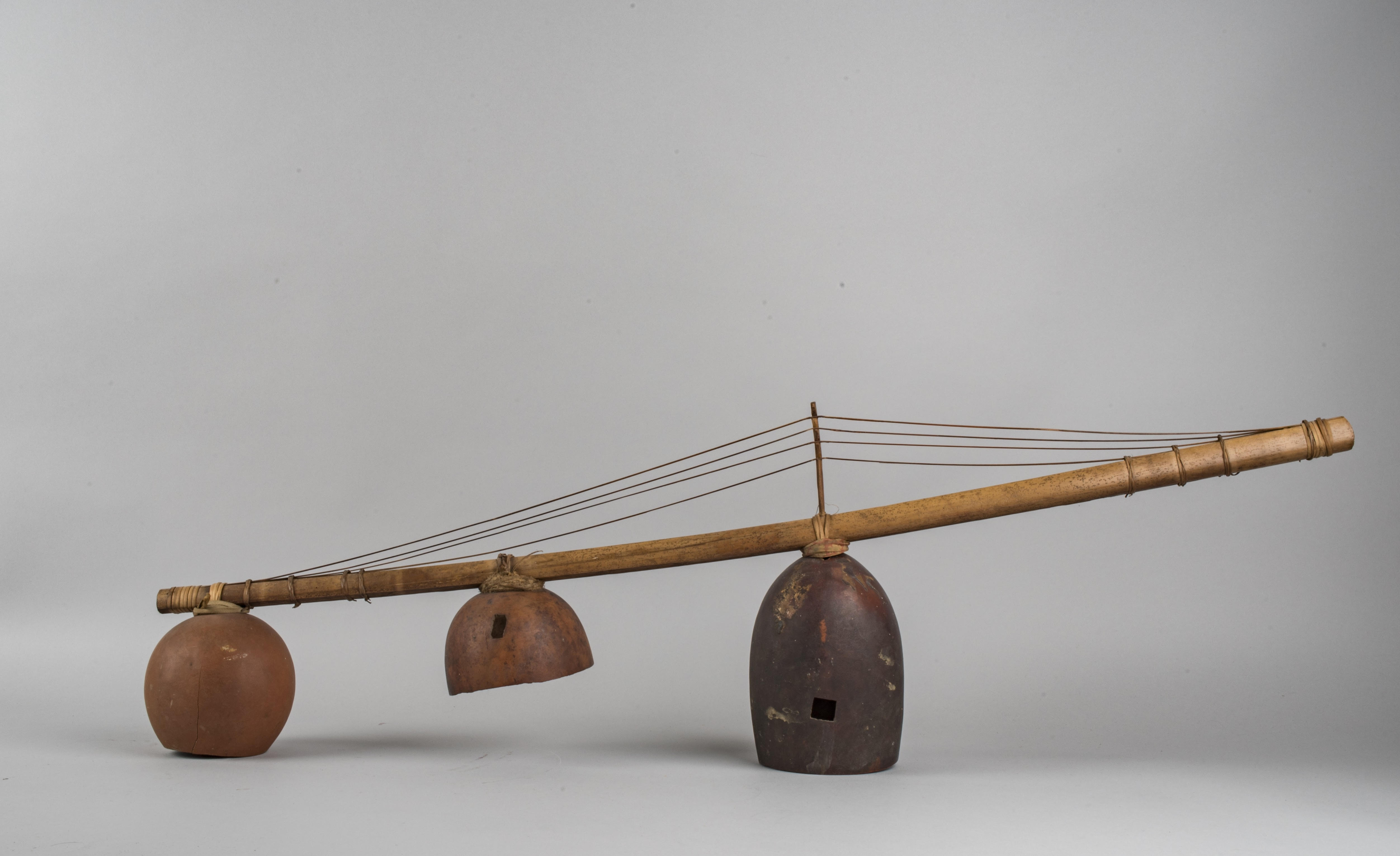
Fang mvet · MDMB 679. Documented specimen from the 20th century used to approach a living tradition, without representing a ceremony or reducing it to a remote past. Interpretive material reconstruction from the photograph of Sguastevi. It is not an archaeological photograph nor a certified restitution. Microdetails, finish and colour are interpretive approximations.
Tracekeepers / OpenAI ImageGen; source photograph: Sguastevi · Museu de la Música de Barcelona · Inventory: MDMB 679 · CC BY-SA 4.0
History and context
The term brings together string instrument, performer, epic, knowledge and audience participation in sacred and popular forms. UNESCO records learning, manufacture, narratives and transborder community function.
Museographic proposal: Annotated performance screen where the audience can hear responses and pauses, without fragmenting the instrument from its narration.
Evidence and interpretation
Documented fact: UNESCO records learning, manufacture, narratives and transborder community function. Caution: The recent inscription does not fix an eternal version; update with communities and distinguish open from restricted uses.
Catalogue facts
- Place and period
- Ekang communities of Cameroon, Gabon and Republic of the Congo; living heritage inscribed in 2025
- Approach
- The term brings together string instrument, performer, epic, knowledge and audience participation in sacred and popular forms.
- Caution
- The recent inscription does not fix an eternal version; update with communities and distinguish open from restricted uses.
A closer look
About 1 min to read · 1 section. Further reading and sources · free access. Editorial review recorded: .
There are also organisers and makers behind the story
The Mvet Oyeng inscription distinguishes performers, sponsors who organise gatherings, and artisans who craft instruments. The audience participates with clapping, singing, and stick percussion, as well as responding to the narrator. UNESCO notes that women can narrate, especially in the popular mode, although they do not usually craft or play the instrument. These roles show a concrete and variable distribution of cultural labour. The performance does not depend solely on an exceptional voice: it requires organisation, craftsmanship, learning, and participation, and the possibilities for intervention differ between its sacred and open forms.
- Heritage · UNESCO · Mvet Oyeng, nomination file 02253Access recorded: .
Reference images and provenance
 View full-size photograph ⛶
Original photograph of specimen MDMB 679; material example to contextualise a wider living practice. It does not represent a complete ceremony.
Documentary original · Contextual correspondence
Sguastevi · Museu de la Música de Barcelona · Inventory: MDMB 679

Sources and references
Did you enjoy this exhibit?
Your opinion helps us improve the museum. You can change it whenever you like.
Loading your rating…