
 English
 Español
 Français
 Italiano
 Deutsch
 Русский
 Português
 Polski
 Română
 Svenska
 Norsk bokmål
 Suomi
 Türkçe
 العربية
 简体中文
 한국어
 हिन्दी
 Ελληνικά
LYSIMACHUS SUCCESSOR OF ALEXANDER
Lysimachus
Lysimachus: ruling Thrace with the image of Alexander
He received Thrace after Alexander's death, but had to confront local rulers to control the territory.
Museum documentation · free public access, no account required.
Reconstruction · Declared visual hypothesis
AI-recreated portrait of Lysimachus. The clothing is supported by the historical context of the card; the face, age depicted, coloration, and unpreserved details are interpretive. It is neither an authentic photograph nor a scientific facial reconstruction.
Tracekeepers
History and context
After the death of Alexander, the distribution of power assigned Thrace to Lysimachus. He was a Macedonian leader in a territory where local kings continued to operate. Diodorus recounts his confrontation with Seutes: receiving a region on paper was not equivalent to controlling it without resistance.
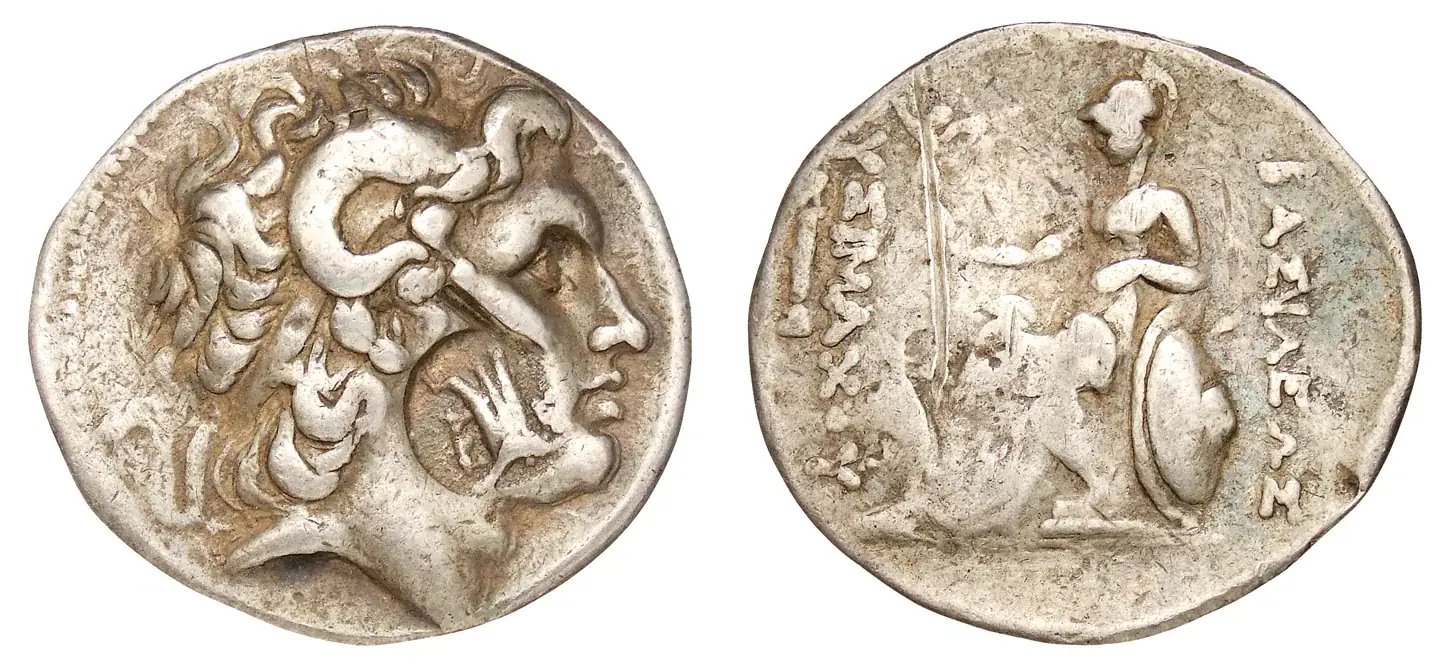
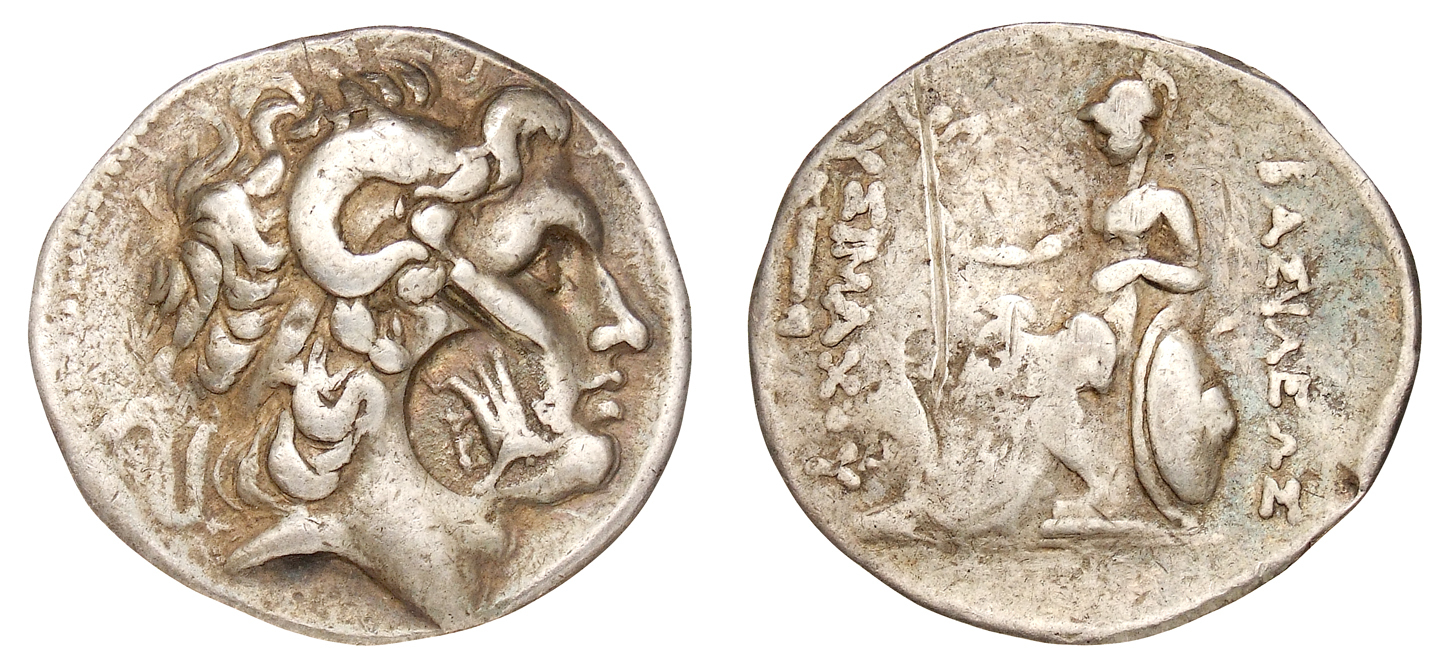
Coins minted in his name show Alexander with a diadem and horn of Amun. On the reverse, the inscription names Lysimachus and Athena holds a Victory. The image of the deceased conqueror thus accompanied the authority of one of his successors.
Evidence and interpretation
Macedonian ruler of Thrace, not Odrysian or Thracian king by identity. On the proposed coin the sitter is Alexander and the issuer is Lysimachus. Minting and governing dates should be kept separate.
AI-recreated portrait of Lysimachus. The clothing is supported by the historical context of the card; the face, age depicted, coloration, and unpreserved details are interpretive. It is neither an authentic photograph nor a scientific facial reconstruction.
Catalogue facts
- Chronology
- 323–281 BCE · power in Thrace after Alexander
- Location
- Lysimachia · Thracian Chersonesus, current Gallipoli Peninsula
A closer look
About 1 min to read · 3 sections. Further reading and sources · free access. Editorial review recorded: .
The sitter and the issuer
As a comparison, Corpus Nummorum dates the stater type 21721 to 297–281 BCE and attributes it to Lysimachia. The head is that of deified Alexander. The legend ΒΑΣΙΛΕΩΣ ΛΥΣΙΜΑΧΟΥ identifies the issuer. The photograph in this record shows another specimen of the coin in the name of Lysimachus, identified in its image credit.
- Research · Corpus Nummorum · type 21721, Lysimachian stateterAccess recorded: .
A successor between local powers
Diodorus places the clash with Seutes when Lysimachus arrived at his assigned territory. The story allows us to present the tensions of the distribution of 323 BCE without coloring all of Thrace as a politically homogeneous space or considering the Odrysian monarchy extinct.
The Danubian boundary
The expedition against the Getae ended with Lysimachus held captive by Dromichaetes. Diodorus recounts his release after a territorial agreement. The episode links both rulers and reminds us that Alexander's successors also suffered defeats and had to negotiate.
One history, two perspectives
What connects Lysimachus with other people, and how the view changes from the other side. These interpretations are based on sources; they are not quotations or reconstructions of private thoughts.
SUCCESSION · DOCUMENTED RELATIONSHIP
Lysimachus ↔ Alexander the Great
Alejandro, previous authority and monetary image
Lysimachus ruled part of the space conquered by Alexander and issued coins with his deified head. The image on the obverse is not a portrait of Lysimachus himself.
From Lysimachus’s perspective
Since the monarchy of Lysimachus, Alexander is a personal antecedent and a public image capable of accompanying the authority of the new king. The coin brings together memory and power without being confused with a portrait of the issuer or a conversation between the two.
Read Alexander the Great’s perspective on Lysimachus →CONFLICT · DOCUMENTED RELATIONSHIP
Lysimachus ↔ Dromichaetes
Captive released after agreement
Lysimachus was captured by the Getae and freed by Dromichetes. Diodorus and Strabo preserve the episode, although they do not equally credit the moral details of the narrated banquet.
From Lysimachus’s perspective
From the campaign of Lysimachus, Dromichaetes turns an expedition into an experience of dependency. Liberation by agreement reminds us that expanding could end up forcing the conqueror to accept conditions from a neighboring power.
Read Dromichaetes’s perspective on Lysimachus →CONFLICT · DOCUMENTED RELATIONSHIP
Lysimachus ↔ Seuthes III
Local rival in Thrace
For Lysimachus, Seuthes represented effective resistance within the region that had been assigned to him. The story distinguishes a political concession from actual control on the ground.
From Lysimachus’s perspective
From the position of Lysimachus, Seuthes shows the distance between receiving Thrace in an agreement and ruling it. Victory or pact depended on specific adversaries, not only on the legitimacy that a successor of Alexander could claim.
Read Seuthes III’s perspective on Lysimachus →Reference images and provenance
You can enlarge the documentary photograph of the piece related to this figure. It is not listed as an input of a generated portrait. The identification of the figure, when discussed, is explained in the file.
 View full-size photograph ⛶
Coin in the name of Lysimachus in the Münzkabinett in Berlin: the obverse represents Alexander deified, not the issuer. It is not the comparative specimen of Corpus Nummorum type 21721. The monetary portrait is Alexander with the horn of Amun, not a portrait of Lysimachus.
Contextual image · Contextual correspondence
Reinhard Saczewski

 View full-size reference ⛶
Documentary photograph of the reference object
This photograph is the registered source of the documentary image currently displayed; it is not presented as an input photograph for another generated portrait.
This photograph is the registered source of the documentary image currently displayed; it is not presented as an input photograph for another generated portrait.
Documentary original · Contextual correspondence
Reinhard Saczewski
Additional visual documentation
A cited publication does not establish which image was used to create the character.
- Diodorus XVIII · conflict with Seutes; historical translation by George Booth (1814)
- Corpus Nummorum · type 21721, Lysimachian stateter
- Diodorus XXI.12 · captivity of Lysimachus, Loeb edition
- Bundesbank · Ancient Gold Coins, Lysimachus and Alexander
- Diodorus XVIII.3 · distribution of power, George Booth (1814)
- Diodorus XXI · capture and banquet; translation by George Booth (1814)
- Diodorus XXI · the two tables; George Booth (1814)
Location and territory
REGIONAL AREA
Lysimachia · Thracian Chersonesus, current Gallipoli PeninsulaApproximate area of Lysimachia; confirm the ancient city point before using site precision.Sources and references
- Diodorus XVIII · conflict with Seutes; historical translation by George Booth (1814)
- Corpus Nummorum · type 21721, Lysimachian stateter
- Diodorus XXI.12 · captivity of Lysimachus, Loeb edition
- Bundesbank · Ancient Gold Coins, Lysimachus and Alexander
- Diodorus XVIII.3 · distribution of power, George Booth (1814)
- Diodorus XXI · capture and banquet; translation by George Booth (1814)
- Diodorus XXI · the two tables; George Booth (1814)
- The Met · Chiton, Peplos, Himation
- The Met · Marble statue of a woman
- Arrian Anabasis of Alexander, translation E. J. Chinnock
- Strabo VII.3.14 · Dromichaetes and Lysimachus
Did you enjoy this exhibit?
Your opinion helps us improve the museum. You can change it whenever you like.
Loading your rating…