
ARCHAEOLOGICAL INDIVIDUAL · COPPER AGE · VARNA
The Important Man of Varna
His grave, full of gold objects, suggests a leader who lived about 6,500 years ago.
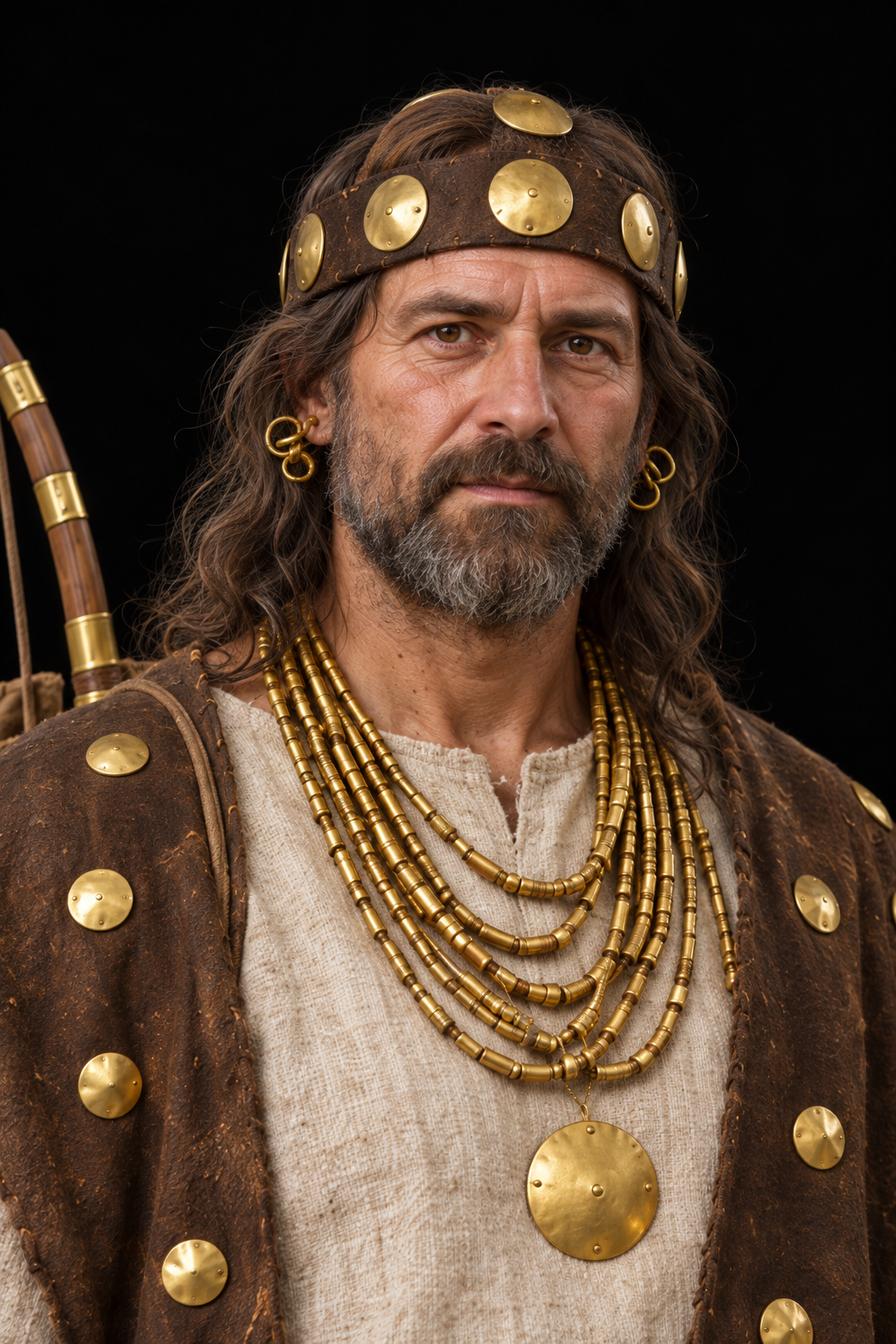
Reconstruction · Declared visual hypothesis
An artistic recreation, made with AI, of a real person whose name and face we do not know. The ornaments and the sceptre are inspired by the objects from grave 43. The face, hair, skin colour and clothing are imagined, and nothing suggests that he dressed like this every day. It is not a scientific facial reconstruction, and it does not reproduce every piece to scale.
Tracekeepers
Real person · recreated from their remains
How it was recreated
- What it is based on
- The skeleton of an adult man and the grave goods from grave 43 in the Varna necropolis (around 4500 BCE): a sceptre with a limestone head and a gold-covered handle, bracelets, hundreds of beads, appliqués, pieces from a bow and a Spondylus bracelet. His height comes from the study of his bones, and the outfit follows the interpretation of the archaeologist Vladimir Slavchev.
- What is imagined
- The face, hair, skin colour, clothing, pose in life and the way the jewellery is worn on the body.
- Why it matters
- It gives a face to someone known only from a skeleton and a handful of gold, and helps us picture how these pieces might have been worn in life. It shows that behind one of the oldest known collections of worked gold there was a real person.
History and context
Around 4500 BCE, a man was buried in the Varna necropolis, beside the Black Sea, in present-day Bulgaria. His grave, number 43, held more than a kilo and a half of gold objects, as well as shells, copper axes and flint tools. We do not know his name.
The sceptre, the ornaments and the wealth of the grave suggest that he held a prominent position. He has been called a chief or a priest, but we do not know what office he held or how he exercised his authority. He was buried lying on his back, like many others in the necropolis.
The recreation shows him alive, in ceremonial dress inspired by the objects from his grave. The gold pieces help us imagine how he might have adorned himself, but the face, the clothing and the way each piece was worn are one possible version.
Evidence and interpretation
The skeleton and the grave goods, that is, the objects buried with him, come from grave 43. A review of the bones published in 2017 changed the estimates of his age and height. The gold shows wealth, but it does not tell us what title he held or what he died of.
The man and the objects come from a real grave. That he was a chief or a priest is an interpretation. His physical appearance and the shape of his clothing have not survived.
Catalogue facts
- Chronology
- Around 4500 BCE · Copper Age
- Context
- Varna I necropolis · in use around 4600–4340 BCE
- Provenance
- Grave 43 · Varna, Bulgaria
- Identity
- Man with no known name · possible leader or ritual authority
- Age at death
- 45–50 years according to the Varna Museum; 50–65 according to the 2017 review of the bones
- Estimated stature
- About 1.70 m, calculated from the skeleton
- Grave assemblage
- Sceptre with limestone head and gold coverings; bracelets, beads, appliqués and Spondylus shell
- Reconstruction
- Face, hair, skin colour, clothing and the arrangement of the pieces are interpretations
Explore in 3D
Load the model only when you want to explore it. Drag or use the arrow keys to turn it; + and − zoom. Closing it releases its memory.
A 3D reconstruction created for the project; it is not an archaeological scan or a scientific facial reconstruction. The web version keeps all of the geometry and adjusts the textures so that they look good in a browser. The face, the clothing and the placement of the jewellery are imagined. It is shown at roughly life size, at about 1.70 m, the height estimated from his skeleton.
A closer look
About 3 min to read · 6 sections
Placing him in time
The grave belongs to Varna I, a Copper Age cemetery. A radiocarbon study published in 2018 calculates that it came into use between 4596 and 4516 BCE and went out of use between 4427 and 4341 BCE, with a probability of 95.4%. These are dates for the cemetery, not for this man's birth or death. That is why his burial is dated only approximately, to around 4500 BCE.
A prominent position, an unknown office
The Varna Museum describes him as a very wealthy man, probably a chief or a priest. The sceptre and the valuable objects show that he had a special place in his community, but they do not say what title he held or whom he ruled. The person existed; what the recreation imagines is his appearance and one possible way he may have presented himself at a ceremony.
What the bones tell us
The estimates do not agree. The museum puts his age at between 45 and 50. The review of the bones published in 2017 by Leusch and colleagues suggests an age of between 50 and 65 and a height of about 1.70 m, with a robust skeleton and signs of physical activity. None of these figures is an exact measurement, and age alone is not enough to tell whether he was an unusually old man in his community.
Reading the gold inventory
The list of pieces from an exhibition held in Tokyo in 2015, with loans from the Varna museum, details objects from the grave. It records a sceptre with a limestone head and a gold-covered handle, four gold bracelets, a bracelet made from the shell of a sea mollusc, Spondylus, covered with two gold plates, and six gold pieces that covered a bow. It also lists ten round appliqués, two discs with raised dots, 42 domed appliqués and ten pendants. And it separates two strings of beads: one of 277 at the neck and another of 406 at the neck and chest. Some popular descriptions do not match these counts; for example, the list does not mention an eight-strand necklace. The recreation does not try to reproduce every piece.
How his outfit was imagined
Vladimir Slavchev, an archaeologist at the Varna Regional Museum of History, proposes that the man wore a ritual outfit with ornaments, a cap covered with appliqués, and a bow with its quiver, the case that holds the arrows. The recreation follows that proposal. But the leather or cloth, the cut of the garments and the way each piece was sewn have not survived. Nor do the gold discs force us to picture a crown like those of later periods. The face, the hairstyle and the skin colour are artistic decisions.
A sceptre for display
The sceptre from grave 43 has an axe head made of limestone and a handle covered in gold. A review of the grave goods doubts that it was ever a real weapon or tool: limestone is a soft stone, and the head does not seem designed for cutting or striking. It may have been an object for display at ceremonies or during the burial.
Reference images and provenance
The record for this portrait does not retain verified photographs used as reference. We cannot present their face as an exact reconstruction. Written sources can be consulted at the end of the entry.
Location and territory
APPROXIMATE LOCATION
Varna I Necropolis · BulgariaThe marker shows the approximate area of the necropolis, west of Varna. It does not show the exact spot of grave 43 or the museum where the pieces are kept today.Where it is held
Varna Archaeological Museum · Varna Regional Museum of History
Item or group in the record · Documented collection
Holds the objects from the grave. The list of items for an exhibition held in Tokyo in 2015 records them as a loan from this museum.
The holding institution is documented; public display may change. Check its official record before visiting.
Sources and references
- Varna Archaeological Museum · Prehistory
- National Museum of Western Art (2015) · The Golden Legend, items 6–26 from grave 43
- Leusch et al. (2017) · Rich metallurgists’ (?) graves from the Varna I cemetery, pp. 101–124
- Higham et al. (2018) · AMS Dating of the Late Copper Age Varna Cemetery, Bulgaria
- Vladimir Slavchev (2025) · Varna Necropolis, BTA/UNESCO publication
Sources consulted on 29 September 2026.
Did you enjoy this exhibit?
Your opinion helps us improve the museum. You can change it whenever you like.
Loading your rating…