
REAL PERSON · COPPER AGE · ALPS
Ötzi
A life preserved in ice
His body, clothes and tools let us study how someone lived about 5,300 years ago.
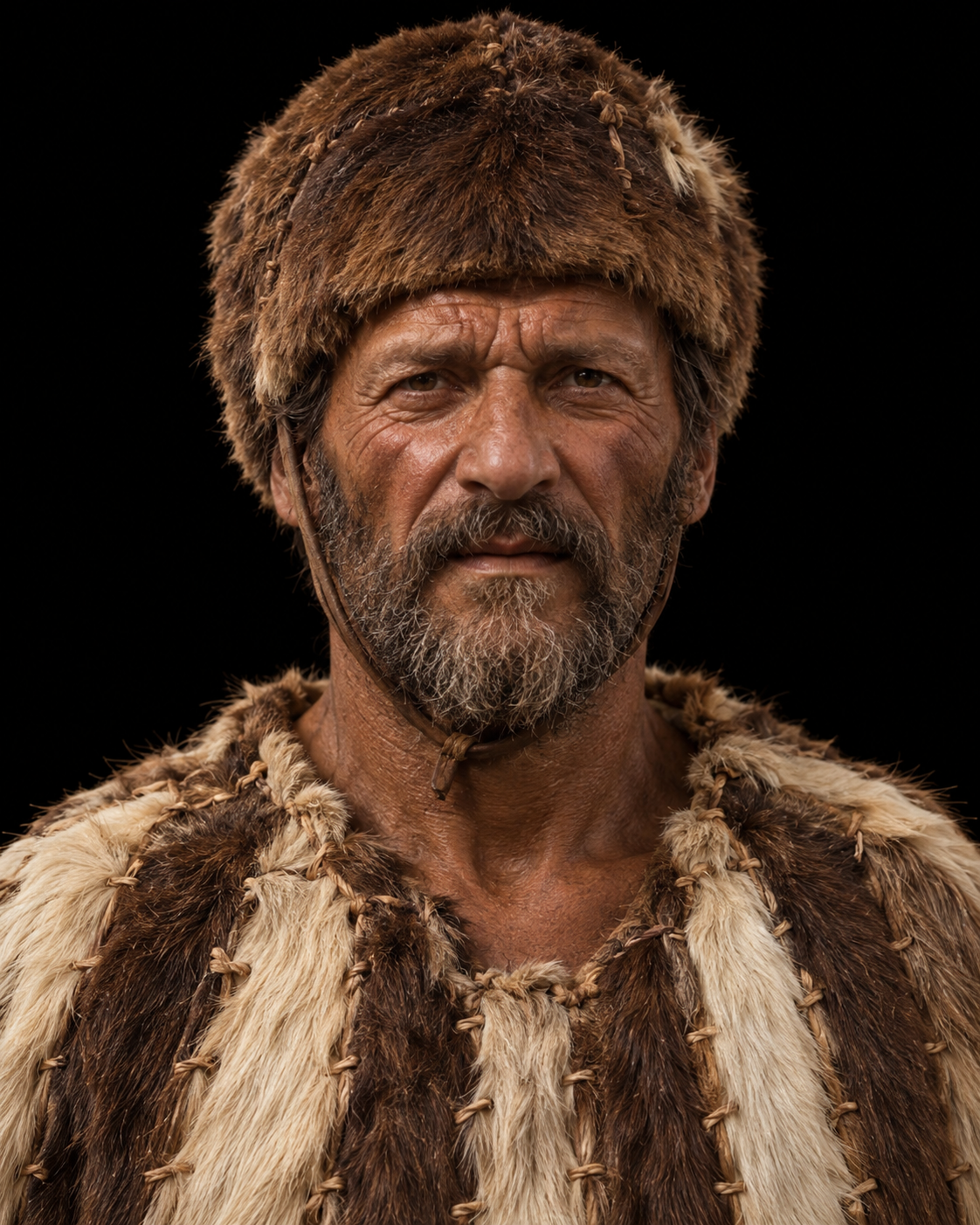
Reconstruction · Declared visual hypothesis
Portrait recreated with AI from the project’s image. The goat- and sheepskin coat and the bearskin cap are based on finds; the face, the beard and the exact way the garments are worn are interpretations. The skin colour and the lack of long hair follow the 2023 genetic study. It is not a photograph of the mummy, nor a scientific facial reconstruction.
Tracekeepers
Real individual · recreated from their remains
How it was recreated
- What it is based on
- The natural mummy found in 1991 with its clothing and equipment, which are kept in the South Tyrol Museum of Archaeology in Bolzano; the genome published in 2023, which points to dark skin and a tendency to baldness; and a height of about 1.60 m, estimated from the body.
- What is imagined
- The features of the face, the beard, the amount of hair, the expression and the exact way the garments are worn; in the 3D model, also the long hair and the mat worn as a cloak.
- Why it matters
- Ötzi shows how an image changes when the evidence changes: for decades he was drawn with pale skin and long hair, and DNA forced a correction. Seeing him wearing his real clothes and carrying his real kit helps us understand how someone crossing the Alps 5,300 years ago protected himself from the cold.
History and context
Ötzi lived in the Alps during the Copper Age, around 3300 BCE. His name is modern: we do not know what he was called. The ice preserved his body and part of his equipment until two hikers found him in 1991.
He wore clothes made of animal skins and carried flint tools and a copper axe, a highly valuable object in his day. His belongings show that he knew how to choose materials and mend what broke. People have called him a chief, a herder or a shaman, but we do not know what he did for a living.
The portrait is a recreation made with AI. It takes account of a 2023 DNA study, which suggests that Ötzi probably had darker skin than older reconstructions show, and a tendency to go bald. The clothing is based on the garments that were found; the face and beard are imagined. He is not shown wearing a grass cloak, because researchers now doubt that the mat found with him was a cloak.
Evidence and interpretation
We know Ötzi from his own body and from the objects he carried. The arrow wound is certain; we do not know who fired the arrow, why, or how long he took to die. The 61 tattoos are well documented, but what they meant is debated.
The clothing and equipment are based on objects that were found; the face, the hair and the way the garments are worn are interpretations. The 2023 DNA study suggests that Ötzi had darker skin than many earlier recreations show.
Catalogue facts
- Chronology
- 3350–3120 BCE · c. 3300 BCE
- Period
- Alpine Copper Age
- Provenance
- Tisenjoch / Giogo di Tisa · Ötztal Alps, Italy
- Discovery
- 19 September 1991 · approx. 3,210 m altitude
- Age at death
- Approximately 45–46 years
- Estimated stature
- Around 1.60 m in life
- Tattoos
- 61 marks distributed in 19 groups
- Relationship to campaign
- He lived about 6,300 years after the fictional Sarımğara community, and far from it
Explore in 3D
Load the model only when you want to explore it. Drag or use the arrow keys to turn it; + and − zoom. Closing it releases its memory.
A 3D recreation supplied to the project; it is not a scan of the mummy. It is shown at roughly life size, about 1.60 m tall, which is the height estimated for Ötzi in life; the bow rises above the head. The long hair, the beard and the use of the mat as a cloak are not proven.
A closer look
About 5 min to read · 12 sections
A person of the Copper Age
Ötzi belongs to European prehistory. He lived in the Alps around 3300 BCE, some 6,300 years after the fictional Sarımğara community. The date of his death is worked out by radiocarbon dating: living things contain carbon-14, which disappears at a known rate after death. The result is not an exact year but a range, 3350–3120 BCE, which places his death; it is not the length of his life.
The find and the name
Erika and Helmut Simon found the body on 19 September 1991, at an altitude of about 3,210 metres, close to the Tisenjoch pass. At first it was thought to be a mountaineer who had died only a short time before. ‘Ötzi’ is a modern nickname, taken from the Ötztal Alps, where he was found. We do not know his real name, his language or his family.
A body, many questions
He was about 45 or 46 years old and stood around 1.60 metres tall. His body shows worn joints, dental problems and hardened arteries. These are estimates, with some margin of error. No wound, tool or mark on the skin is enough to tell us what he did for a living or what place he held in his community.
Skin, hair and reconstructions
According to the 2023 genetic study, Ötzi probably had darker skin than many older recreations show, and a tendency to go bald. But DNA is not a photograph. In both the portrait and the 3D model, the face and beard are imagined, and the long hair appears only in the 3D model. A 2025 study of 47 prehistoric individuals from the eastern Italian Alps showed that Ötzi’s ancestry, which came mainly from the first farmers who arrived from Anatolia (modern Turkey), had been common in the region since the Neolithic.
Skins from different animals
DNA analysis of the garments identified sheep and goat in the coat, goat in the leggings and sheep in the loincloth. The cap was made of brown bear and the quiver of roe deer. Ötzi combined the skins of domestic and wild animals. We do not know whether he hunted the bear and the roe deer himself or got those skins from other people.
Shoes stuffed with grass, and a mat
The shoes had uppers of deer hide, leather soles and a padding of dry grass that kept the feet warm. The museum in Bolzano points out that they gave little protection against damp. Remains of a mat of plaited grass were also found at the site. For years it was reconstructed as a large cloak, but this is now disputed: it may have been a mat to shelter from the rain, or part of a rucksack. The cloak on the 3D model shows one of those possibilities; the portrait does not include it.
Stone, wood and copper
His kit included a copper axe, a flint dagger, an unfinished yew bow, and a quiver holding two finished arrows and twelve unfinished shafts. He also carried a retoucher, a small tool for sharpening stone edges again. Copper had not replaced flint: both materials were in use at the same time. Because the bow and almost all the arrows were half-made, he may have been remaking his equipment, but we cannot know.
The copper's journey
Analysis of the axe’s metal links it to copper ores from southern Tuscany. This is a clue that metal travelled hundreds of kilometres. We do not know whether raw copper or the finished axe made the journey, or how many hands it passed through before it reached Ötzi’s.
What he had eaten
His last meal was still in his stomach: fat and meat from wild animals, such as ibex and red deer, and einkorn, an ancient kind of wheat. There were also traces of fern; we do not know whether he ate it on purpose or it got there by accident. It is a window onto his final hours, not onto everything he ate over a lifetime.
Sixty-one tattoos
Photographs taken in different kinds of light made it possible to record 61 tattoos in 19 groups. They are lines and crosses. Many lie over joints and on the lower back, areas that show wear, and for that reason it has been suggested that they were connected with easing pain; this is not proven. A 2024 experiment concluded that they were probably made by pricking the skin many times with a fine point, not by cutting. That explains how they were made, but not what they meant to him.
A violent death still under investigation
A flint arrowhead is lodged in his left shoulder; X-rays revealed it in 2001. The wound damaged an artery. For years it was thought that he bled to death very quickly, but research from 2025 casts doubt on whether the loss of blood killed him straight away. We do not know who fired the arrow, or why.
Looking after the mummy, and still learning
The mummy is kept in Bolzano at −6 °C and a relative humidity of nearly 99%. Researchers also study what happened to the body inside the ice, where it may have been exposed and thawed more than once. A study published in 2026 distinguished ancient microbes, from his gut and from the glacier, from others that arrived later, while the mummy was being conserved. Knowing this helps to look after the mummy and to separate what belongs to his life from what happened afterwards.
Reference images and provenance
No verifiable entrance photograph is preserved for this representation. You may consult its documentation, but we would not present its face as an exact reconstruction.
Additional visual documentation
A cited publication does not establish which image was used to create the character.
- South Tyrol Museum of Archaeology · Ötzi
- South Tyrol Museum of Archaeology · find
- South Tyrol Museum of Archaeology · body and conservation
- Wang et al. (2023) · genome and limits of the portrait
- Samadelli et al. (2015) · 61 tattoos in 19 groups
- Villa et al. (2025) · forensic review of the wound
- South Tyrol Museum of Archaeology · clothing and plant-fibre mat
- South Tyrol Museum of Archaeology · identity and interpretations
- Croze et al. (2025) · genetic diversity of the Alps
- O’Sullivan et al. (2016) · DNA of the skins
- South Tyrol Museum of Archaeology · equipment
- Wierer et al. (2018) · flint tools
- Artioli et al. (2017) · copper provenance
- Maixner et al. (2018) · last meal
- Deter-Wolf et al. (2024) · tattooing techniques
- Pernter et al. (2007) · radiological study of the wound
- New insights on Ötzi’s injuries from a clinical perspective (2025)
- Pilø et al. (2022, 2023 volume) · conservation history in the ice
- Sarhan et al. (2026) · microorganisms and conservation
Location and territory
APPROXIMATE LOCATION
Tisenjoch / Giogo di Tisa · findspotApproximate marker of the find in the Alps, in Italian territory near the border with Austria. It does not mark a dwelling or the place of birth.Where it is held
South Tyrol Museum of Archaeology · Bolzano
Item or group in the record · Permanent exhibition
Preserves and exhibits the mummy and its associated finds since 1998.
The holding institution is documented; public display may change. Check its official record before visiting.
Sources and references
- South Tyrol Museum of Archaeology · Ötzi
- South Tyrol Museum of Archaeology · find
- South Tyrol Museum of Archaeology · body and conservation
- Wang et al. (2023) · genome and limits of the portrait
- Samadelli et al. (2015) · 61 tattoos in 19 groups
- Villa et al. (2025) · forensic review of the wound
- South Tyrol Museum of Archaeology · clothing and plant-fibre mat
- South Tyrol Museum of Archaeology · identity and interpretations
- Croze et al. (2025) · genetic diversity of the Alps
- O’Sullivan et al. (2016) · DNA of the skins
- South Tyrol Museum of Archaeology · equipment
- Wierer et al. (2018) · flint tools
- Artioli et al. (2017) · copper provenance
- Maixner et al. (2018) · last meal
- Deter-Wolf et al. (2024) · tattooing techniques
- Pernter et al. (2007) · radiological study of the wound
- New insights on Ötzi’s injuries from a clinical perspective (2025)
- Pilø et al. (2022, 2023 volume) · conservation history in the ice
- Sarhan et al. (2026) · microorganisms and conservation
Sources consulted on 21 September 2026.
Did you enjoy this exhibit?
Your opinion helps us improve the museum. You can change it whenever you like.
Loading your rating…