
 English
 Español
 Français
 Italiano
 Deutsch
 Русский
 Português
 Polski
 Română
 Svenska
 Norsk bokmål
 Suomi
 Türkçe
 العربية
 简体中文
 한국어
 हिन्दी
 Ελληνικά
FAUNA · BOS PRIMIGENIUS
Aurochs
The wild ancestor of domestic cattle
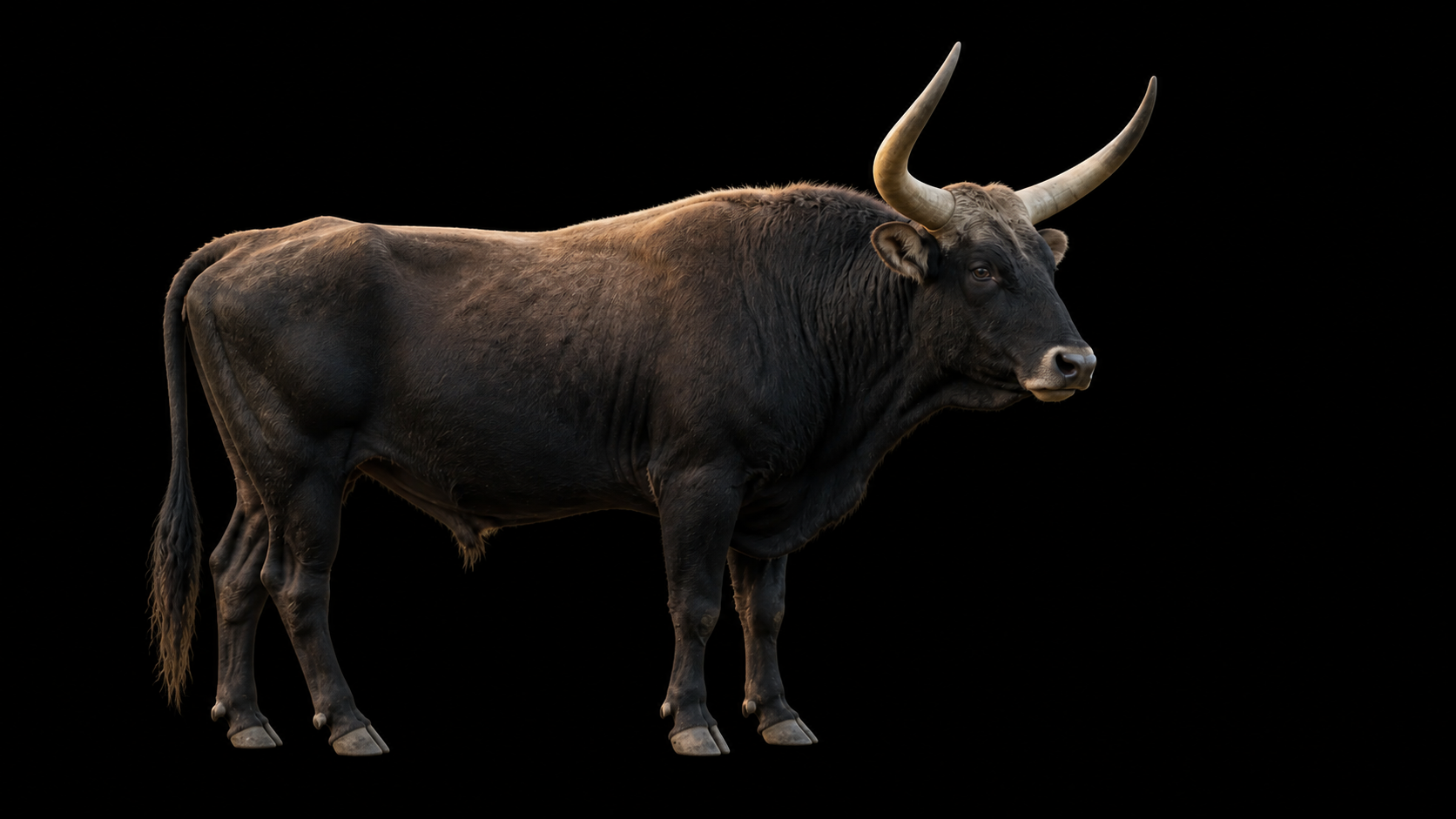
The aurochs was a large wild bovine. It became extinct after coexisting for thousands of years with people.
Museum documentation · free public access, no account required.
Generated reconstruction · Declared visual hypothesis
AI-edited project recreation: black background and full silhouette. Fur, soft tissues and individual appearance are interpretive; not a documentary photograph of the extinct animal.
Tracekeepers
Explore in 3D
Load the model only when you want to explore it. Drag or use the arrow keys to turn it; + and − zoom. Closing it releases its memory.
Interpretative 3D reconstruction supplied for the museum, not an archaeological scan. Display size is not a measurement of the original.
History and context
The aurochs roamed Europe, Asia and North Africa. Its large horns appear in Palaeolithic art and males could approach two metres in height and one tonne in weight.
Its end was surprisingly recent: in 1627 the last known female died in Jaktorów. A species painted by prehistoric artists survived into the Modern Age and disappeared after habitat loss and overexploitation.
Evidence and interpretation
The final date comes from historical records. Habitat loss and overexploitation explain its decline; it was not simply an oversized domestic bull.
Catalogue facts
- Chronology
- Record from ≈700,000 years · extinction in 1627
- Extinction
- Jaktorów, Poland · 1627
- Species
- Bos primigenius
- Relationship
- Ancestor of domestic cattle
A closer look
About 1 min to read · 1 section. Further reading and sources · free access. Editorial review recorded: .
Domestication did not close the frontier with the wild
Ancient DNA allows us to investigate a history that horns do not tell. A 2024 genomic study identifies the initial capture of a small number of aurochs from southwestern Asia and subsequent interbreeding, especially mediated by males, between cattle and wild populations as herds spread. Domestication was not an instantaneous and definitive separation. That exchange helps explain why cattle ancestry retains a complex geography, even though the aurochs disappeared as a recognisable wild population.
- Research · Nature · The genomic natural history of the aurochs, 2024Access recorded: .
Sources and references
Did you enjoy this exhibit?
Your opinion helps us improve the museum. You can change it whenever you like.
Loading your rating…