
 English
 Español
 Français
 Italiano
 Deutsch
 Русский
 Português
 Polski
 Română
 Svenska
 Norsk bokmål
 Suomi
 Türkçe
 العربية
 简体中文
 한국어
 हिन्दी
 Ελληνικά
FAUNA · PLEISTOCENE
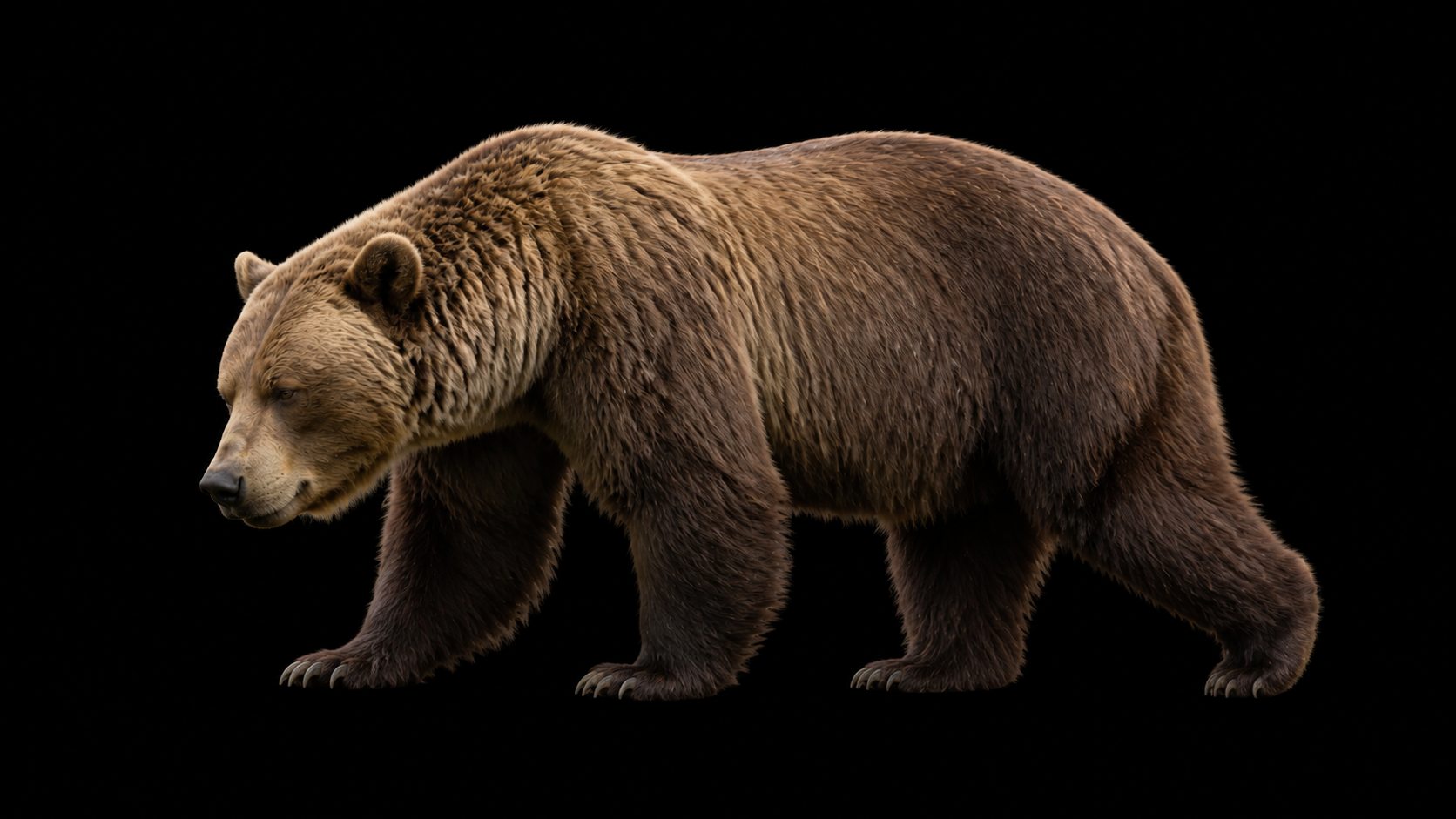
Cave bear
A large bear that ate mostly plants
Although it belongs to the carnivore family, its diet was mainly vegetarian.
Museum documentation · free public access, no account required.
Generated reconstruction · Declared visual hypothesis
AI-edited project recreation: black background and full silhouette. Fur, soft tissues and individual appearance are interpretive; not a documentary photograph of the extinct animal.
Tracekeepers
Explore in 3D
Load the model only when you want to explore it. Drag or use the arrow keys to turn it; + and − zoom. Closing it releases its memory.
Digital reconstruction supplied by the project and generated with Tripo. It is not an archaeological scan or a metric replica; the model is displayed at approximately life size: standing on its hind legs, as in the model, it measures about 3 m, the height of an upright adult male; on all fours it would be around 1.5–1.7 m at the withers. Representation of a Pleistocene cave bear, not fauna living at Çakmaktepe around 9600 BCE.
History and context
European caves preserve thousands of cave bear bones because these animals used them for hibernation and giving birth. They could reach about 3.5 metres in length, but their size does not tell the whole story.
Amino acids in their collagen reveal a strongly plant-based diet. Their specialisation may have become vulnerable when the cold reduced landscape productivity until their disappearance.
Evidence and interpretation
Amino acid isotopes support a plant diet. Climate and vegetation loss are consistent explanations for their extinction, not the only possible cause.
Catalogue facts
- Date
- ≈100,000–25,000 years BP
- Range
- Europe
- Species
- Ursus spelaeus
- Length
- Up to ≈3.5 m
A closer look
About 1 min to read · 1 section. Further reading and sources · free access. Editorial review recorded: .
A diet can change depending on the scale of observation
Toll's analyses, in Catalonia, introduce an important nuance to the plant-diet predominance. Collagen isotopes integrate long periods, while dental microwear reflects meals from the last days or weeks. In those specimens, the dental signals also approach omnivorous diets. It does not invalidate all herbivorous results: it indicates that a single label can hide seasonal and regional variation. It is worth imagining populations that responded to specific resources, not animals obliged to always eat exactly the same thing.
- Research · Scientific Reports · study of the Toll bears' diet, 2019Access recorded: .
Sources and references
Did you enjoy this exhibit?
Your opinion helps us improve the museum. You can change it whenever you like.
Loading your rating…