
 English
 Español
 Français
 Italiano
 Deutsch
 Русский
 Português
 Polski
 Română
 Svenska
 Norsk bokmål
 Suomi
 Türkçe
 العربية
 简体中文
 한국어
 हिन्दी
 Ελληνικά
FAUNA · PANTHERA SPELAEA
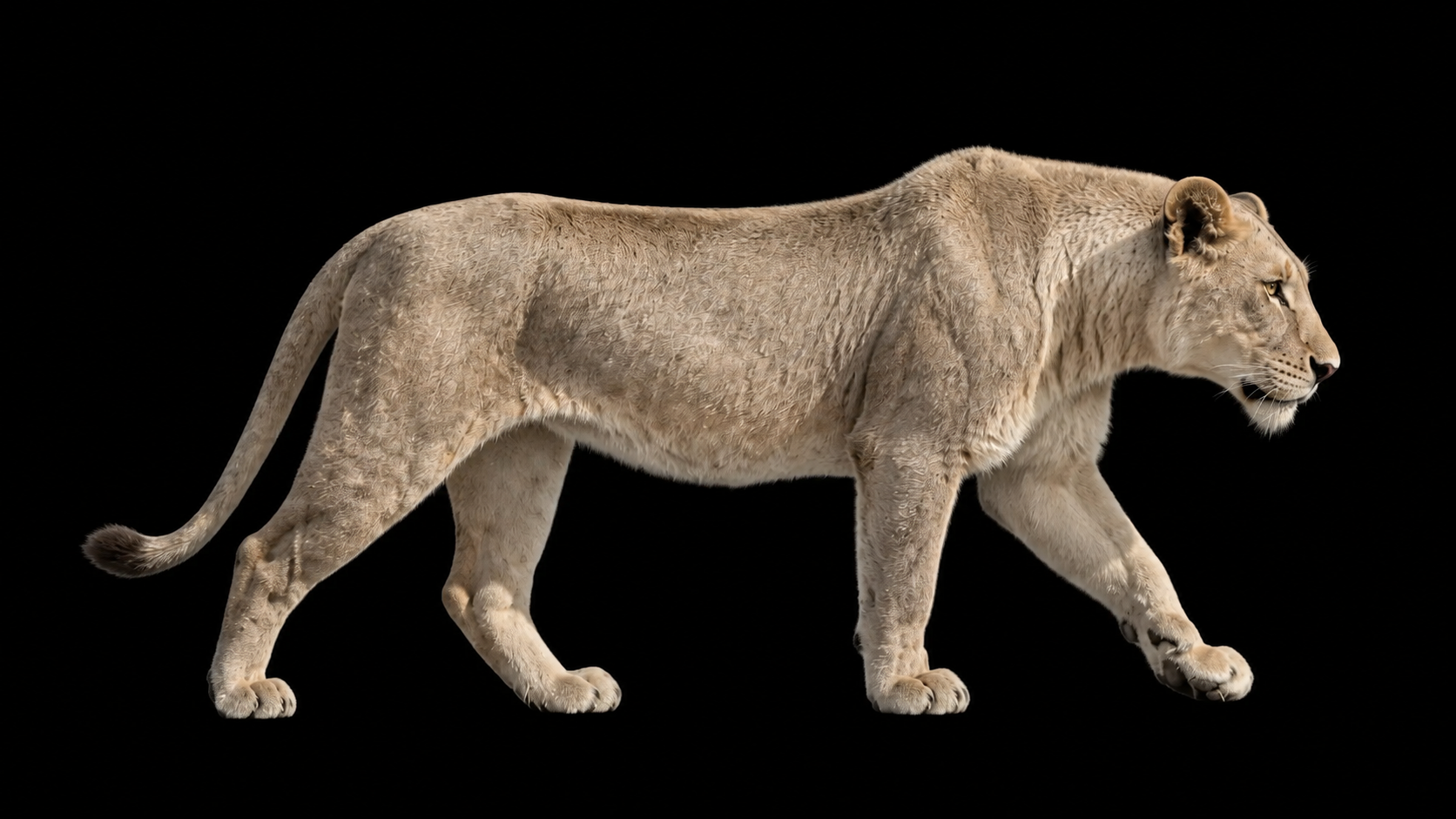
Cave lion
A large Pleistocene lion
This feline lived in cold regions. Palaeolithic depictions do not usually show a mane like that of many modern lions.
Museum documentation · free public access, no account required.
Generated reconstruction · Declared visual hypothesis
AI-edited project recreation: black background and full silhouette. Fur, soft tissues and individual appearance are interpretive; not a documentary photograph of the extinct animal.
Tracekeepers
Explore in 3D
Load the model only when you want to explore it. Drag or use the arrow keys to turn it; + and − zoom. Closing it releases its memory.
Digital reconstruction supplied by the project and generated with Tripo. It is not an archaeological scan or a metric replica; the model is displayed at approximately life size: about 1.25 m at the withers, within published estimates for the species. Fur and soft-tissue anatomy are interpretative; the cave lion belongs to the Pleistocene, not the Neolithic settlement.
History and context
The cave lion occupied steppes and open landscapes from western Europe to Beringia. It did not live exclusively in caves: that name derives from the places where many of its bones were preserved.
Ancient DNA distinguishes a lineage spread across western Eurasia and a Beringian one. Palaeolithic images usually show rounded ears, a tail tuft, and no large mane; artists who coexisted with the animal recorded details that the skeleton would never have told.
Evidence and interpretation
Mitochondrial genomes support that Panthera spelaea was a distinct species from the modern lion and that it harboured deep regional lineages. The absence of a mane is inferred from palaeolithic art: it is a consistent observation, not a direct preservation of the entire coat.
Catalogue facts
- Date
- Middle Pleistocene–≈14,200 cal BP
- Range
- Eurasia and Beringia
- Species
- Panthera spelaea
- Living relative
- Sister lineage of Panthera leo
A closer look
About 1 min to read · 1 section. Further reading and sources · free access. Editorial review recorded: .
A kinship needing several clocks
The 2020 study compared thirty-one mitochondrial genomes and combined radiocarbon dates with fossil calibrations. Estimating the divergence between lineages is not equivalent to directly dating their first encounter: the result depends on the model and is expressed with a wide interval. Mitochondria also follow a single line of inheritance, not the whole genome's history. These limitations do not detract from the finding; they explain how we moved from discussing similarities between bones to comparing ancient populations distributed across a vast territory.
Sources and references
Did you enjoy this exhibit?
Your opinion helps us improve the museum. You can change it whenever you like.
Loading your rating…