
 English
 Español
 Français
 Italiano
 Deutsch
 Русский
 Português
 Polski
 Română
 Svenska
 Norsk bokmål
 Suomi
 Türkçe
 العربية
 简体中文
 한국어
 हिन्दी
 Ελληνικά
DOOR 03 · EUROPE · INFLUENCE
Greeks
A Transformed Alphabet
Continues in the Greek museum
Museum documentation · free public access, no account required.
Generated reconstruction · Declared visual hypothesis
Declared visual reconstruction, created for museographic contextualisation; not a photograph of the original nor does it constitute documentary evidence.
Why this doorway leads to another museum
The Greek alphabet adapted Phoenician signs in a Mediterranean of traders, artisans and bilingual communities.
Why this door requires caution: The Greek innovation of representing vowels was an adaptation, not a simple copy, and occurred after the Mycenaean world.
Period of the connection: 9th–8th centuries BCE
BEFORE YOU ENTER
An introduction to Greeks
Find your place in time, explore the changes and choose where to go next.
- When
- From the Minoan phase ≈3100 BCE · EUROPE AND AEGEAN
- Where
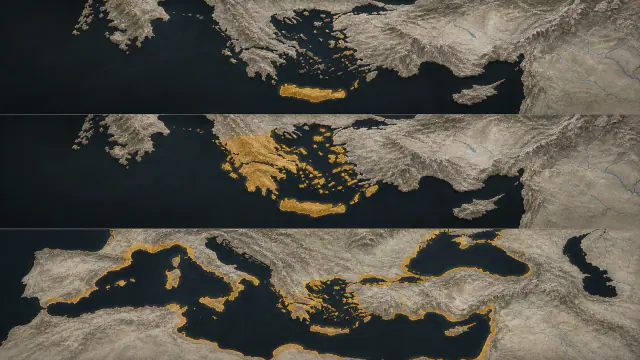
- Crete, mainland Greece, Aegean islands and Mediterranean-connected communities
- What this collection brings together
- Aegean cultures, city-states and kingdoms of different periods
This route brings together distinct societies that lived around the Aegean: Minoan Crete, the Mycenaean kingdoms and, centuries later, the Greek city-states. The palaces of Knossos and Mycenae do not belong to the same moment as Periclean Athens. Between them there were population changes, crises and new ways of organising common life.
History does not end in Athens either. Greek communities extended along Mediterranean and Black Sea coasts; Alexander's conquests and the Hellenistic kingdoms opened another stage of contacts. Following a tablet, a vessel, a statue or a coin allows understanding what changed and what was conserved. Sharing language, gods or customs did not mean living under a single government.
PLACE MATTERS
Territory and connections
The Minoan and Mycenaean centres, the Greek cities and the Hellenistic kingdoms had different areas. A map of Alexander's expansion does not serve to situate the world of Knossos nor all the Greek cities.
A HISTORY OF CHANGE
The main periods
Dates are approximate. Periods help us navigate the past, but their boundaries were not always the same in every region.
ca. 3100–1900 BCE
Prepalatial Crete
Prepalatial Cretan villages, tombs and workshops are connected by the Aegean; this phase cannot yet be called a Minoan state.
ca. 1900–1700 BCE
First Minoan palaces
Knossos, Phaistos and other centres organise storage and ritual; no unique capital demonstrated for all of Crete exists.
ca. 1700–1450 BCE
Neopalatial network
Cretan material influence reaches Aegean islands and coasts; the map shows a maritime network, not a thalassocracy with proven frontiers.
ca. 1450–1200 BCE
Mycenaean administration
Mainland Greek-speaking centres and Knossos use Linear B; Mycenaean influence and control do not turn Minoans and Mycenaeans into a single identity.
Continue the story: 4 more periods
c. 1200–800 BCE
Postpalatial world
Palatial archives disappear and populations reorganise settlements and networks; there is no human or cultural vacuum.
ca. 800–480 BCE
Archaic poleis and colonisation
Greek communities founded settlements across the Mediterranean and the Black Sea; each polis was autonomous and the routes did not form a national territory.
ca. 480–323 BCE
Leagues, wars and Macedonia
Athens, Sparta, Thebes and Macedonia articulated successive spheres; none represented all Greek communities.
323–30 BCE
Hellenistic kingdoms
Alexander’s successors ruled distinct territories; Greek language and culture circulated without creating a single Hellenic state.
BEYOND THE DATES
How people lived and saw the world
From palaces to cities and kingdoms
Minoan and Mycenaean centres combined power, storage and administration. Much later, Greek cities had different governments: Athenian democracy was one of them, with political participation reserved for male citizens. After Alexander, his successors established large kingdoms, while some cities sought autonomy through alliances. There is no single form of government that explains the entire trajectory.
What happened in the houses
Cooking, storing food, spinning and weaving were necessary tasks even where there were great palaces and temples. Images of classical Greece show domestic labour, visits to springs and participation in celebrations. Social position, gender and place conditioned this life: an Athenian scene does not equally describe a family from Crete, Sparta or a Hellenistic city.
Building, making and keeping accounts
Aegean artisans worked clay, stone and metals. The Mycenaeans raised fortifications and drainage systems, and their scribes recorded goods on Linear B tablets, a script that represents ancient Greek. Centuries later, temples combined planning, masonry and decoration. Comparing these works helps understand the knowledge and labour they required, beyond their monumental appearance.
Places and festivals for meeting the gods
In Minoan Crete there was ritual activity in palaces, caves and summits. In the later Greek world, temples, altars and sanctuaries formed part of cities and countryside. Festivals at places such as Olympia or Delphi brought together visitors from different communities. Offerings allow recognition of petitions and thanks; accounts of gods and heroes help understand images, but do not substitute the history of each place.
The sea united ports, people and ideas
Goods travelled across the Aegean long before classical Greece. Mycenaean vessels appear in places distant from their workshops. In later periods, Greek settlements in Italy, Sicily, Asia Minor and other coasts expanded the networks. Encounters with local populations involved exchanges and also conflicts. Finding a Greek vase does not suffice to affirm that the place was governed by Greeks.
Music and theatre before an audience
Music accompanied festivals, weddings, funerals and banquets. Images of instruments, inscriptions and some fragments of notation allow its study. In Athens, theatrical performances were linked to Dionysian celebrations: tragedies and comedies presented stories and problems before a gathered community. In the Hellenistic world, audiences, commissions and forms of representing people also changed.
PEOPLE AND TESTIMONIES
Meet the people
The records distinguish historical figures, representations and reconstructions. They explain their context, the available sources and their connections with other people.
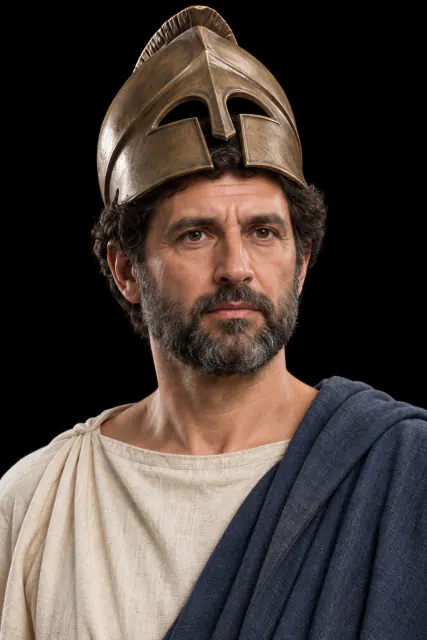
Pericles
Pericles was a central figure in Athens during a period of major public works and conflicts.
Read the record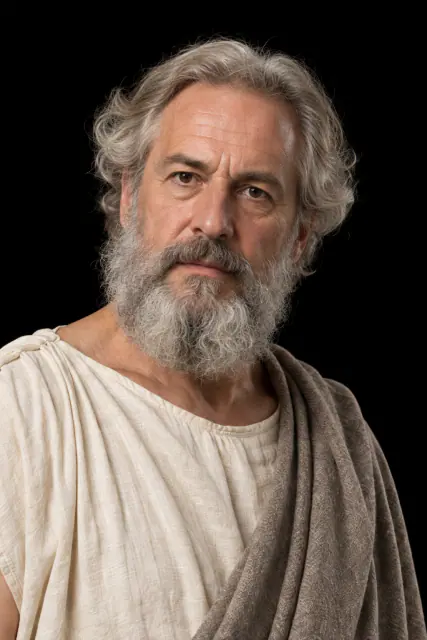
Plato
Plato expounded his philosophical questions and ideas through dialogues between characters.
Read the record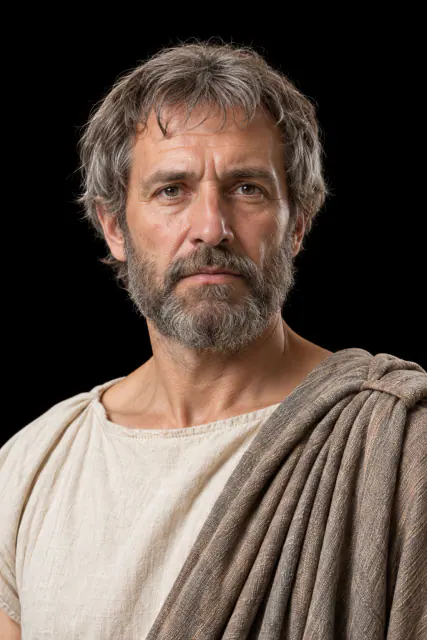
Aristotle
Aristotle founded the Lyceum; his works have come down to us through later copies and editions.
Read the record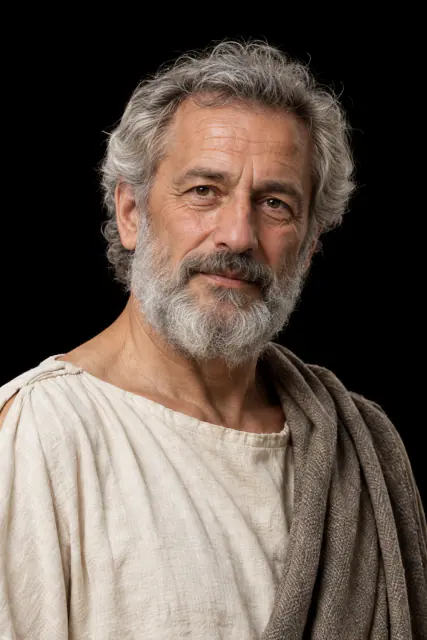
Strabo
Strabo described places he visited and others he knew through others’ accounts, including Iberia.
Read the recordLOOK CLOSER
Objects and places to start with
A selection from the destination museum. Open each record to explore its documentation and images.
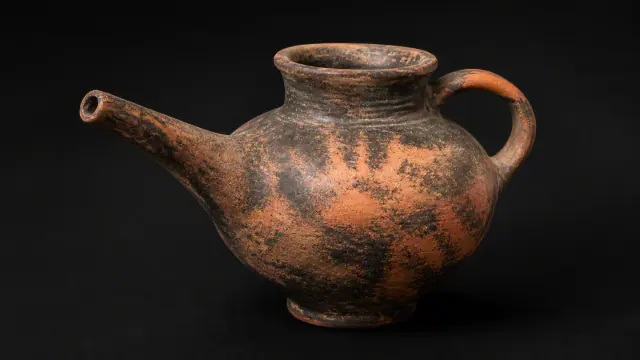
Vasiliki
The firing method of these vessels produced their characteristic red and black spots.
Read the record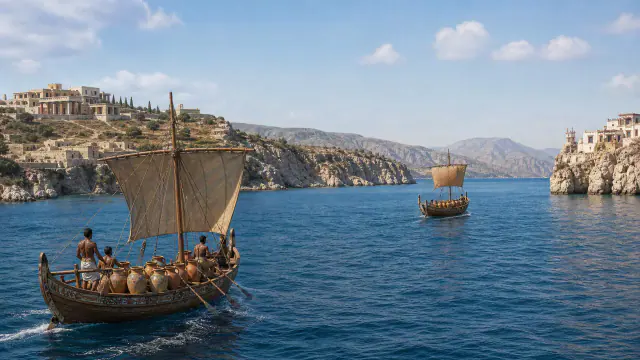
Akrotiri
The paintings and ceramics of Thera show contacts between Crete and other Aegean islands.
Read the record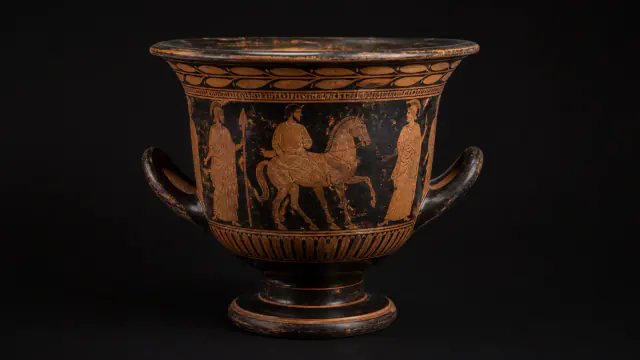
The Attic krater that took on a new life in Cástulo
A vessel made in Attica reached Cástulo and was used in an Iberian burial.
Read the record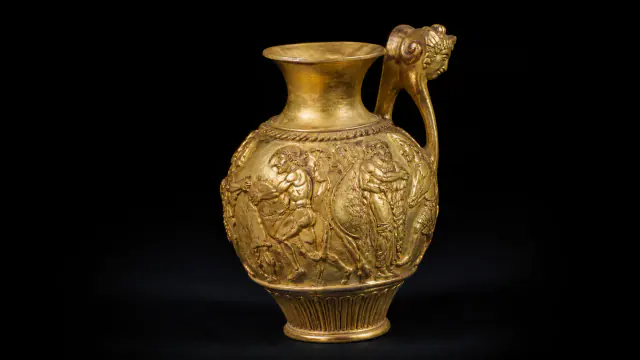
The Kul-Oba vase
A workshop of Greek tradition represented Scythian figures on a vase destined for a Scythian tomb.
Read the recordWHAT REMAINS
Its legacy and ongoing research
Theatre, images of gods and heroes and many ways of building and representing the body transformed when passing to other societies. Rome was one of its great receivers. Continuity was not a changeless copy: artists, rulers and spectators gave them new uses.
CHOOSE YOUR NEXT STOP
Inside this museum
Sources for this introduction
Each theme links to its documentation. The full bibliography also brings together sources for the chronology, the people and the connection between the museums.
View all sources and references →Evidence and interpretation
Level of evidence of connection: high. The door describes influence; it does not convert two different cultures into one nor does it presuppose automatic ethnic continuity.
Catalogue facts
- Contact period
- 9th–8th centuries BCE
- Destination museum
- Greeks: from Minoan Crete to the Hellenic world
- Link Type
- influence
- Level of evidence
- high
- Destination region
- Europe and the Aegean
A closer look
About 1 min to read · 1 section. Further reading and sources · free access. Editorial review recorded: .
Translating a Request Between Gods
The bilingual dedication of Baalrom in Idalion does not merely juxtapose scripts: it relates the Phoenician Reshef Mikal to Apollo Amyklos. The offerer appears with the Phoenician title ’dn and its Greek equivalent wanax. According to the study by Cannavò and Le Meaux, the Greek version follows exceptionally closely the Phoenician formula that thanks the deity for having heard the voice of the donor, expressing it as fulfilment of their vows. This choice allows us to observe a deliberate religious translation in fourth-century BCE Cyprus, distinct from the alphabet adaptation that occurred centuries earlier.
Location and territory
REGIONAL AREA
Crete, Aegean and mainland Greece; the museum begins in the Minoan phaseCrete, Aegean and mainland Greece; the museum begins in the Minoan phase. The footprint marks the orientative centre of the scope, not a boundary nor an exact point.Cultural connections
Sources and references
- British Museum · bilingual Phoenician-Greek base
- Ashmolean Museum — Aegean World gallery
- The Met · The Phoenicians (1500–300 B.C.)
- Anna Cannavò and Hélène Le Meaux · Inscriptions, oreilles et yeux votifs : les dieux de Chypre écoutent et regardent-ils ?
- UNESCO · Mycenae and Tiryns
- The Met · Athens, its institutions and the figure of Theseus
- The Met · Hellenistic world and its traditions
- The Met · Minoan Crete
- The Met · women and daily life in classical Greece
- The Met · Mycenaean civilisation
- The Met · architecture of ancient Greece
- The Met · Greek gods and religious practices
- The Met · Greek colonisation and exchanges
- The Met · music in ancient Greece
- The Met · theatre in ancient Greece
- British Museum · inscribed bust of Pericles, 1805,0703.91
- The Met · Chiton, Peplos, Himation
- The Met · Marble statue of a woman
- The Met · study of Greco-Roman portrait types
- British Museum · biographical register and visual corpus of Aristotle
- Cambridge · introduction to Strabo’s Cultural Geography (2005)
- Strabo · Geography XVII.1.38 and XVII.1.46, Jones, Loeb
- Provenance and image license

YOUR NEXT VISIT
Explore Greeks
The same collection, two ways to explore. Choose the experience that suits you.
Did you enjoy this exhibit?
Your opinion helps us improve the museum. You can change it whenever you like.
Loading your rating…