
 English
 Español
 Français
 Italiano
 Deutsch
 Русский
 Português
 Polski
 Română
 Svenska
 Norsk bokmål
 Suomi
 Türkçe
 العربية
 简体中文
 한국어
 हिन्दी
 Ελληνικά
HISTORICAL FIGURE · WHO WROTE THESE HISTORIES
Strabo
Strabo · Greek geographer and historian
Strabo described places he visited and others he knew through others’ accounts, including Iberia.
Museum documentation · free public access, no account required.
Reconstruction · Declared visual hypothesis
AI-recreated portrait of Strabo. The clothing is based on the historical context of the label; the face, the age represented, the colouring and the details not preserved are interpretive. It is not an authentic photograph nor a scientific facial reconstruction.
Tracekeepers
History and context
Strabo was born in Amasia and wrote in Greek in a Mediterranean dominated by Rome. He gathered places he visited and reports from other authors. He did not travel through all the regions he describes, and that difference matters when we read his observations on Iberia.
His entry belongs to the Greek museum, although his work also accompanies us among Iberians, Egyptians and other peoples. Before the Geography he had written a history, now almost lost, that continued that of Polybius.
Evidence and interpretation
His Greek cultural belonging does not require having been born in present-day Greece. The categories of civilisation and barbarism in his work express ancient hierarchies, not a classification adopted by the museum.
AI-recreated portrait of Strabo. The clothing is based on the historical context of the label; the face, the age represented, the colouring and the details not preserved are interpretive. It is not an authentic photograph nor a scientific facial reconstruction.
Catalogue facts
- Chronology
- c. 64 BCE–after 23 CE
- Place and trajectory
- Amasia, Pontus
- Work
- Geography · seventeen books
- Context
- Greek geographer and historian
A closer look
About 2 min to read · 3 sections. Further reading and sources · free access. Editorial review recorded: .
A Greek in the Roman world
His education and language were Greek, while Rome organised much of the political space he described. The academic introduction to Strabo’s Cultural Geography situates this dual relationship and his earlier historical project. It is important not to confuse the writer’s identity with the power under which he lived, nor a specific journey with personal knowledge of an entire territory.
Hearing something and not taking it as explained
In Geography XVII.1.46 he recounts that, during a journey with Aelius Gallus, he heard a sound beside one of the colossi near Thebes. He did not assert that it came from the statue: he also considered the pedestal and nearby people. The interest of the scene lies in that he makes his doubt visible, rather than resolving it with an indisputable marvel.
- Ancient text · Strabo · Geography XVII.1.38 and XVII.1.46, Jones, LoebAccess recorded: .
A visit, not an entire country
In XVII.1.38 he narrates a visit to the crocodile venerated at Arsinoe. According to his account, the priests gave him food brought by visitors. It is a localised observation, with host and concrete circumstances. It serves to bring us close to a practice he describes, but does not authorise claiming that all inhabitants of Egypt acted in the same way.
- Ancient text · Strabo · Geography XVII.1.38 and XVII.1.46, Jones, LoebAccess recorded: .
Reference images and provenance
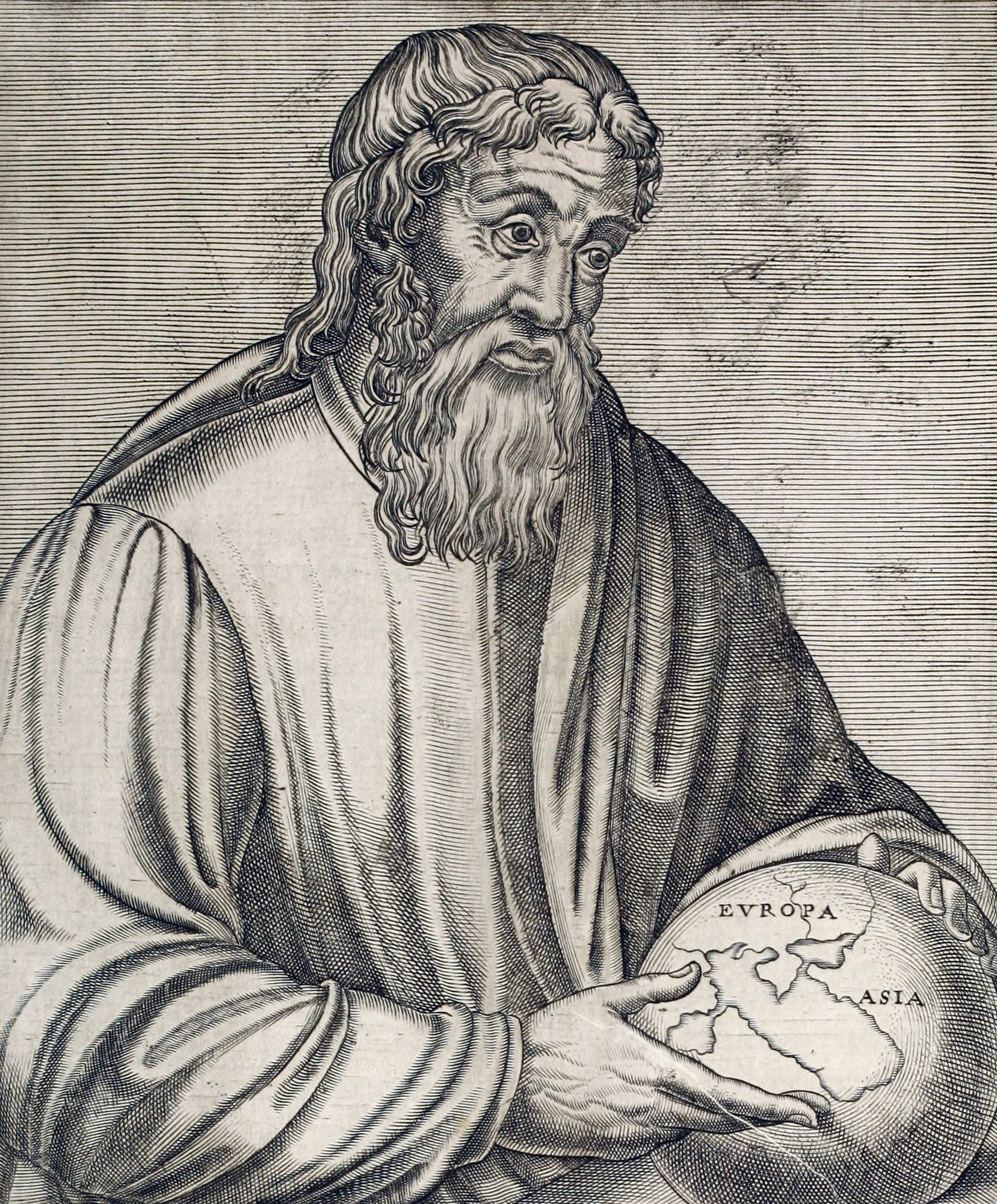
This image documents how the author's work was represented or transmitted. It is not presented as an exact portrait, autograph, or reference for a generated face. The caption distinguishes the date of the author from the date of the image.
 View full-size reference ⛶
Documentary comparison · not recorded as an image used to create the portrait
1584 representation, not a portrait made during his life nor proof of the clothing he wore.
1584 representation, not a portrait made during his life nor proof of the clothing he wore.
Contextual image · Contextual correspondence
Editorial work by André Thévet · engraver not identified on the label

Additional visual documentation
A cited publication does not establish which image was used to create the character.
Sources and references
Did you enjoy this exhibit?
Your opinion helps us improve the museum. You can change it whenever you like.
Loading your rating…