
 English
 Español
 Français
 Italiano
 Deutsch
 Русский
 Português
 Polski
 Română
 Svenska
 Norsk bokmål
 Suomi
 Türkçe
 العربية
 简体中文
 한국어
 हिन्दी
 Ελληνικά
HISTORICAL FIGURE · WHO WROTE THESE HISTORIES
Diodorus Siculus
Diodorus Siculus · Greek historian
Diodorus compiled histories of many peoples and preserved accounts by authors whose works were lost.
Museum documentation · free public access, no account required.
Reconstruction · Declared visual hypothesis
AI-recreated portrait of Diodorus Siculus. The clothing is based on the historical context of the label; the face, the age represented, the colouring and the details not preserved are interpretive. It is not an authentic photograph nor a scientific facial reconstruction.
Tracekeepers
History and context
Diodorus wished to gather dispersed histories into a work that a reader could consult without having to pursue many different books. His Historical Library preserves news of authors whose writings have been lost.
He was born in Sicily and wrote in Greek. He is not an Egyptian character for having described Egypt, nor Iberian for transmitting news about Iberia. Reading him presupposes distinguishing his work of compilation from the episodes he claims to have witnessed.
Evidence and interpretation
His sources have different qualities and perspectives. Preserving a lost report does not prove that every detail is true nor that he personally verified it.
AI-recreated portrait of Diodorus Siculus. The clothing is based on the historical context of the label; the face, the age represented, the colouring and the details not preserved are interpretive. It is not an authentic photograph nor a scientific facial reconstruction.
Catalogue facts
- Chronology
- 1st century BCE · birth and death uncertain
- Place and trajectory
- Agirio, Sicily
- Work
- Historical Library · project of forty books
- Context
- Greek historian
A closer look
About 1 min to read · 3 sections. Further reading and sources · free access. Editorial review recorded: .
Preserving is not copying without changes
The Historical Library is important because it transmits reports of works that we can no longer read complete. The study of Ernst Badian shows the need to value that information attending to the sources and their transmission. Diodorus selected and ordered materials: not all proceed from his own observations nor have the same reliability.
- Research · Ernst Badian · Diodorus Siculus, Encyclopaedia IranicaAccess recorded: .
The work he describes in his prologue
In I.4 he says that he devoted thirty years to the work and that residing in Rome facilitated materials. He also mentions his knowledge of Latin, related to his dealings with Romans in Sicily. These are useful statements about his method, although not an independent record that allows checking each consultation and each displacement.
- Ancient text · Diodorus · Historical Library I.4, Oldfather, LoebAccess recorded: .
An episode he says he witnessed
In I.83.8–9 he narrates the attack of a mob against a Roman who had accidentally killed a cat. Diodorus insists that he was an eyewitness. The museum maintains that attribution: we know what he claims to have seen. A violent episode does not describe the behaviour of all Egyptians nor turn a stereotype into a historical explanation.
- Ancient text · Diodorus · Historical Library I.83.8–9, Oldfather, LoebAccess recorded: .
Reference images and provenance
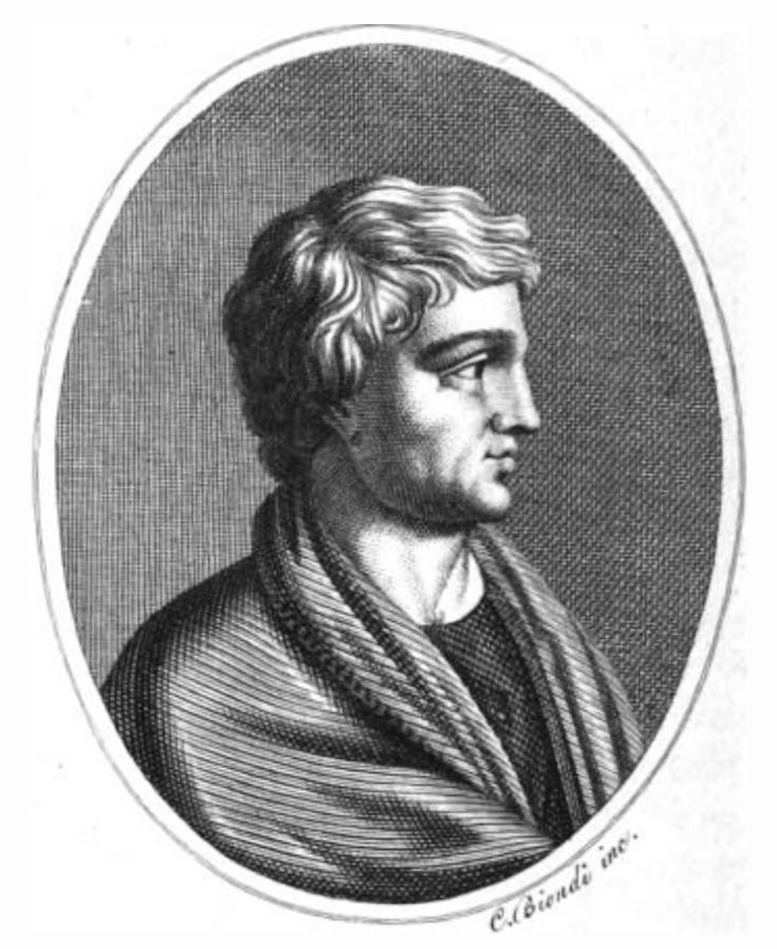
This image documents how the author's work was represented or transmitted. It is not presented as an exact portrait, autograph, or reference for a generated face. The caption distinguishes the date of the author from the date of the image.
 View full-size reference ⛶
Documentary comparison · not recorded as an image used to create the portrait
19th-century engraving, dated 1817 by the label. It is not known as a portrait taken from life of the ancient historian.
19th-century engraving, dated 1817 by the label. It is not known as a portrait taken from life of the ancient historian.
Contextual image · Contextual correspondence
Carlo Biondi, engraver · editorial work of Giuseppe Emanuele Ortolani

Additional visual documentation
A cited publication does not establish which image was used to create the character.
Sources and references
Did you enjoy this exhibit?
Your opinion helps us improve the museum. You can change it whenever you like.
Loading your rating…