
 English
 Español
 Français
 Italiano
 Deutsch
 Русский
 Português
 Polski
 Română
 Svenska
 Norsk bokmål
 Suomi
 Türkçe
 العربية
 简体中文
 한국어
 हिन्दी
 Ελληνικά
GATEWAY 03 · EUROPE · CONTACT
Etruscans and Rome
Neighbours before conquest
Continues in the Etruscans and Rome museum
Museum documentation · free public access, no account required.
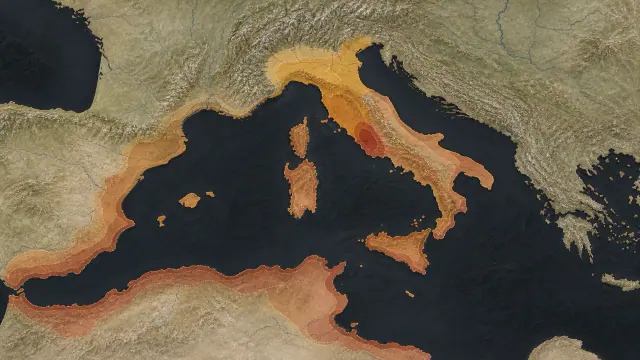
Generated reconstruction · Declared visual hypothesis
Declared visual reconstruction, created for museographic contextualisation; not a photograph of the original nor does it constitute documentary evidence.
Why this doorway leads to another museum
Elites and communities of central Europe exchanged wine and manufactures with Italy before wars, migrations and Roman incorporation.
Why this gateway requires caution: Roman sources group distinct peoples and describe conquest from the victor's point of view.
Period of the connection: 6th century BCE–1st century CE
BEFORE YOU ENTER
An introduction to Etruscans and Rome
Find your place in time, explore the changes and choose where to go next.
- When
- ≈900–700 BCE → Rome from ≈750 · EUROPE AND AEGEAN
- Where
- Central Italy as starting point; afterwards, the Mediterranean and the Roman provinces
- What this collection brings together
- Etruscan cities and Roman trajectory: monarchy, republic and empire
Etruria and Rome shared part of the Italian peninsula, but were not the same society. Etruscan cities such as Cerveteri, Tarquinia and Veii developed their own workshops, sanctuaries and forms of power. Rome grew among neighbouring peoples with whom it traded, learned, negotiated and fought.
The trajectory continues after Roman expansion: from a city ruled by kings to a republic and, finally, to an empire. The provinces of North Africa, Europe and Asia did not lose all their differences upon incorporation into Rome. Alongside emperors and armies, houses, workshops and places of worship allow us to know those who sustained and transformed that world.
PLACE MATTERS
Territory and connections
Etruria had its core between the Arno and Tiber rivers and presence in other regions of Italy. Rome came to govern extensive territories in Europe, Africa and Asia. The extent and control of borders changed over time.
A HISTORY OF CHANGE
The main periods
Dates are approximate. Periods help us navigate the past, but their boundaries were not always the same in every region.
c. 900–700 BCE
Villanovan and Latin communities
Cores of Etruria and Latium grow in parallel; material culture does not allow drawing two homogeneous peoples.
c. 700–500 BCE
Etruscan cities
Etruscan cities project networks towards the Po valley and Campania without forming a centralised empire.
509–343 BCE
Early Republican Rome
Rome consolidated Latium while several Etruscan cities lost autonomy; cultural influence does not equal ethnic succession.
343–264 BCE
Conquest and integration of Italy
Rome imposed treaties, colonies and citizenships of different ranks; conquest did not imply the replacement of all communities.
Continue the story: 4 more periods
264–27 BCE
Mediterranean Republic
Wars and provinces extended Roman authority across the Mediterranean; allies, provinces and client kingdoms were not equivalent.
27 BCE–117 CE
Roman Empire
The empire reached its greatest extent under Trajan only briefly; the map should not freeze that maximum for five centuries.
117–284 CE
Retreats and reorganisation
Some conquests were abandoned and the frontiers reorganised; territorial loss was not a uniform decline of the whole society.
284–476 CE
Late Empire and division
The western and eastern administrations diverged; 476 marks the end of the western empire, not the disappearance of the Eastern Roman Empire.
BEYOND THE DATES
How people lived and saw the world
How a city came to govern so many territories
Rome’s expansion combined conquest and agreements. During the Republic, disputes over land, wealth and political participation accompanied territorial growth. Civil wars led to the power of Augustus, who preserved republican institutions under a new distribution of power. Thereafter followed dynasties, crises and reforms; imperial government was not the same throughout its centuries of existence.
Housing and objects for a diverse society
A lamp, a tableware set or a pipe reveal aspects of life that do not appear in an imperial statue. Excavated houses and their objects allow the study of lighting, food, water and decoration. But the better-known rich houses do not represent all inhabitants. Nor was life the same in Italy, Britain, North Africa or the cities of the eastern Mediterranean.
From Etruscan workshops to Roman production
Etruscan workshops excelled in bronze, jewellery and pottery; bucchero is recognised by its black surface. They also used terracotta to decorate and protect buildings. In Roman times, glass and pottery manufacture achieved wide distribution. Objects show manual skill and work organisation: a simple piece produced in quantity can explain as much as a luxury commission.
Cults that coexisted and transformed
The gold sheets of Pyrgi bring together Etruscan and Phoenician inscriptions in a sanctuary, a concrete example of religious contact. Rome incorporated traditions of its neighbours and developed public and domestic cults. In its provinces local practices persisted: in Dendur, for example, Augustus is represented as a pharaoh before Egyptian divinities. Political unity did not produce an identical religion everywhere.
Supplying cities and crossing the Mediterranean
The Etruscans exported metal objects and imported materials and pieces from other regions. Later, ports, roads and maritime routes sustained Roman supply. Amphorae transported wine and oil, while workshops in different provinces produced goods for distant markets. Following these containers allows us to know who produced and where goods circulated, not only where the capital was.
What the images wanted to show
Etruscan tombs preserve paintings that bring us close to ceremonies, banquets and ways of remembering the dead. Roman portraits, mosaics and monuments had other audiences and functions: they could decorate a house, honour a person or make imperial authority visible. In the provinces, these resources were combined with local ways of dressing and representing oneself. The same authority could be shown with different images.
PEOPLE AND TESTIMONIES
Meet the people
The records distinguish historical figures, representations and reconstructions. They explain their context, the available sources and their connections with other people.
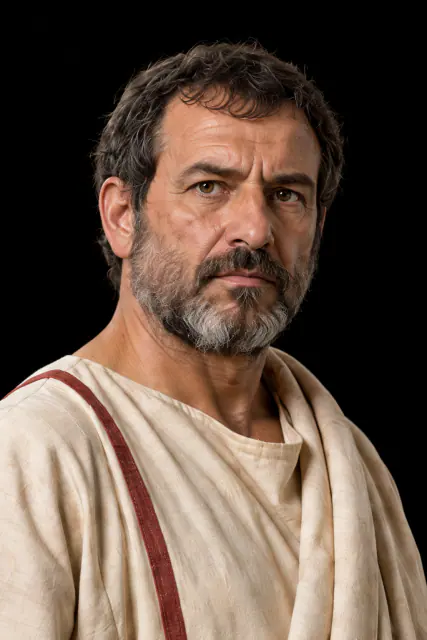
Sixteen kilometres of frontier
Rome’s great rival was a day’s journey away, not in a remote world.
Read the record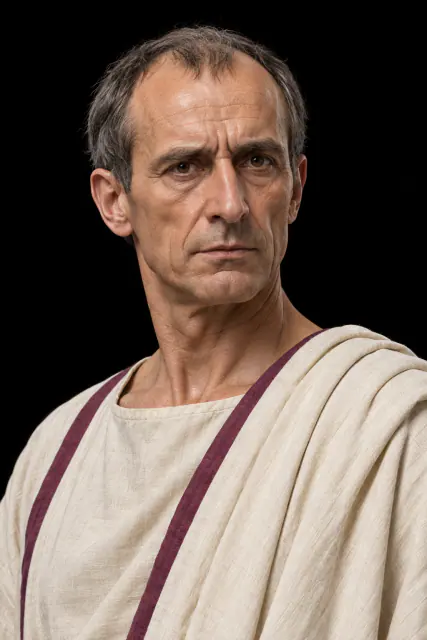
Julius Caesar
Shortly before his death, Julius Caesar authorised coins bearing his portrait and titles.
Read the record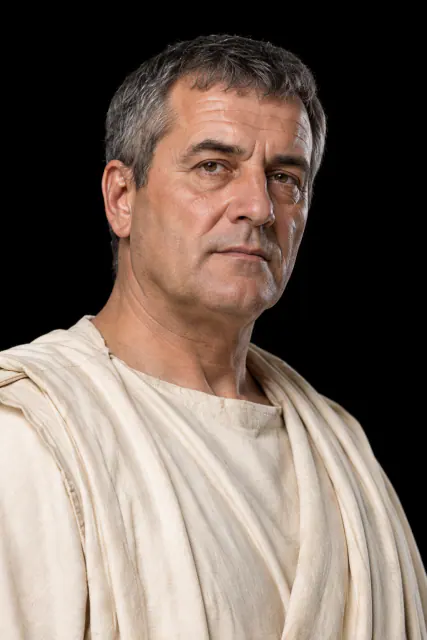
Tacitus
Tacitus wrote about imperial power from his experience as a senator, choosing which conflicts and behaviours to highlight.
Read the record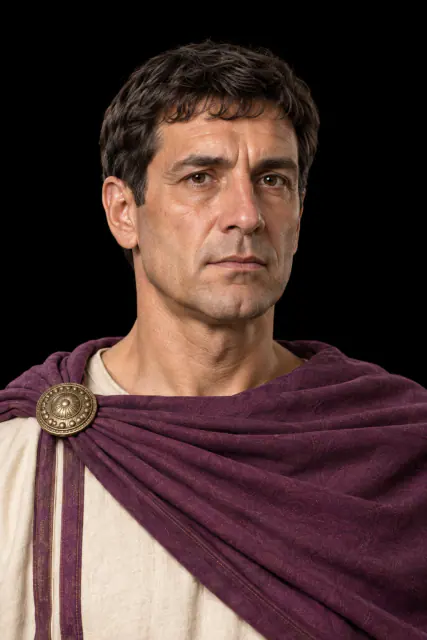
Constantine
Constantine defeated his rivals, favoured Christianity and founded Constantinople.
Read the recordLOOK CLOSER
Objects and places to start with
A selection from the destination museum. Open each record to explore its documentation and images.
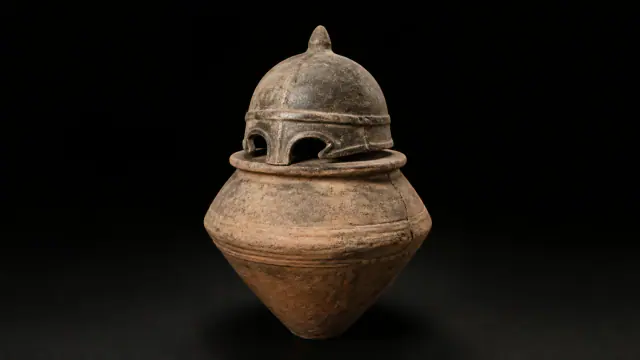
The urn under the helmet
A closed vessel with a helmet-shaped lid held the cremated remains of a person.
Read the record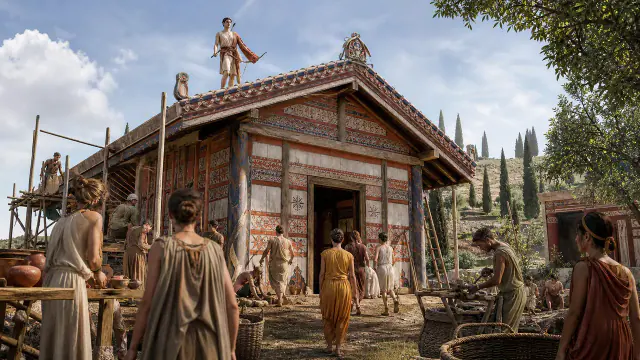
The god on the roof
The statue of Apollo formed part of a group placed on the roof of the temple.
Read the record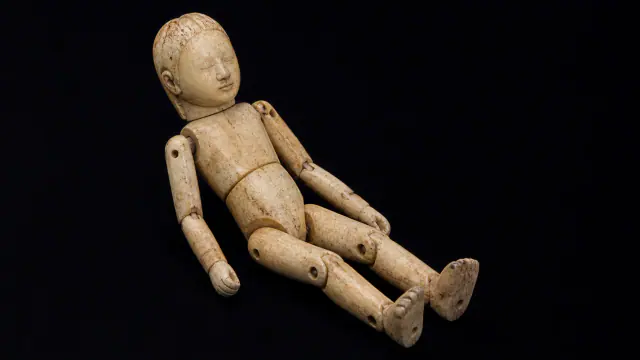
Articulated doll from Tarragona
The doll has movable arms and legs and appeared in the tomb of a girl.
Read the record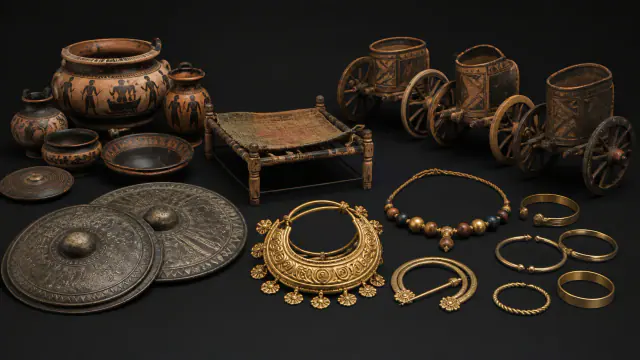
Regolini-Galassi tomb
The Regolini-Galassi tomb brought together jewellery, tableware, shields and chariots alongside two people buried in different ways.
Read the recordWHAT REMAINS
Its legacy and ongoing research
Cities, inscriptions and objects preserve both shared practices and local differences. Latin, institutions and Roman artistic forms had long continuity, but did not erase all preceding languages or traditions. Studying Etruria separately allows recognition of contributions often hidden under the name of Rome.
CHOOSE YOUR NEXT STOP
Inside this museum
Sources for this introduction
Each theme links to its documentation. The full bibliography also brings together sources for the chronology, the people and the connection between the museums.
View all sources and references →Evidence and interpretation
Level of evidence of connection: high. The door describes contact; it does not convert two different cultures into one nor does it presuppose automatic ethnic continuity.
Catalogue facts
- Contact period
- 6th century BCE–1st century CE
- Destination museum
- Etruscan → Roman
- Link Type
- contact
- Level of evidence
- high
- Destination region
- Europe and the Aegean
A closer look
About 1 min to read · 1 section. Further reading and sources · free access. Editorial review recorded: .
Domestic tableware also points to residents
In certain houses of Lattara, the ceramic assemblage was almost entirely Etruscan: it included wine amphorae, cooking vessels and tableware, with some graffiti written in Etruscan letters. The combination of everyday utensils and inscriptions supports the presence of people from that sphere, beyond an isolated luxury import. The same harbour preserves evidence of Massaliot participation, such as Greek inscriptions on lead. This gateway can be read from the coexistence and commercial activity of a concrete settlement, where local and foreign inhabitants converged before the Roman conquest.
Location and territory
REGIONAL AREA
Etruria and formative Italy; the later Roman expansion was much greaterEtruria and formative Italy; the later Roman expansion was much greater. The footprint indicates the orientative centre of the area, not a boundary nor an exact point.Cultural connections
Enter the Etruscans and Rome museum and follow this connection →
Sources and references
- Lugdunum Museum and Roman Theatres · Visitor booklet
- The Metropolitan Museum of Art · Etruscan Art in the Metropolitan Museum
- British Museum · Collection term: Etruscan
- Ministère de la Culture · Lattes in Languedoc: Gauls and foreigners
- UNESCO · necropolis of Cerveteri and Tarquinia
- The Met · the Roman Republic
- The Met · the Roman Empire
- Penn Museum · houses and objects of the Roman world
- Penn Museum · the Roman world
- The Met · Etruscan art and society
- Penn Museum · journey through Etruria and Rome
- National Etruscan Museum of Villa Giulia · Pyrgi sheets
- The Met · art and life of the Roman provinces
- British Museum — Etruscan world
- The Metropolitan Museum — Etruscan Art
- Livy · History of Rome, Book 5, Chapter 21 (Perseus Digital Library)
- The Met · Togatus
- British Museum · Roman leather shoe
- British Museum · denarius of 44 BCE with portrait of Julius Caesar
- Owen and Gildenhard · life and career of Tacitus, Dickinson
- Tacitus · Agricola 45, annotated edition by Cynthia Damon
- Open University · Pliny, Letters VI.16, Tacitus’ request
- Provenance and image license
- British Museum · solidus with portrait of Constantine
- The Met · Textiles of Late Antiquity

YOUR NEXT VISIT
Explore Etruscans and Rome
The same collection, two ways to explore. Choose the experience that suits you.
Did you enjoy this exhibit?
Your opinion helps us improve the museum. You can change it whenever you like.
Loading your rating…