
 English
 Español
 Français
 Italiano
 Deutsch
 Русский
 Português
 Polski
 Română
 Svenska
 Norsk bokmål
 Suomi
 Türkçe
 العربية
 简体中文
 한국어
 हिन्दी
 Ελληνικά
HISTORICAL FIGURE · WHO WROTE THESE HISTORIES
Tacitus
Tacitus · Roman senator and historian
Tacitus wrote about imperial power from his experience as a senator, choosing which conflicts and behaviours to highlight.
Museum documentation · free public access, no account required.
Reconstruction · Declared visual hypothesis
AI-recreated portrait of Tacitus. The clothing is based on the historical context of the entry; the face, the age represented, the colouring and the details not preserved are interpretative. It is not an authentic photograph nor a scientific facial reconstruction.
Tracekeepers
History and context
Tacitus wrote on imperial power from within the senatorial class. He was consul in 97 and governor of Asia in 112/113. His political portraits are not neutral: the writer selects conflicts and behaviours so that the reader may judge them.
He also sought information from people close to the events. Pliny the Younger wrote to him about the death of his uncle during the eruption of Vesuvius. Knowing that correspondence helps us understand how he prepared a historical account.
Evidence and interpretation
His exact origin is debated. Do not confuse the historian with the emperor Tacitus of the third century. The words he attributes to Britons are not an independent Briton source.
AI-recreated portrait of Tacitus. The clothing is based on the historical context of the entry; the face, the age represented, the colouring and the details not preserved are interpretative. It is not an authentic photograph nor a scientific facial reconstruction.
Catalogue facts
- Chronology
- c. 56/58–c. 118/120 CE
- Place and trajectory
- Career in Rome and in the province of Asia · disputed birth
- Work
- Agricola · Germania · Histories · Annals
- Context
- Roman senator and historian
A closer look
About 1 min to read · 3 sections. Further reading and sources · free access. Editorial review recorded: .
A critic with a public career
His access to the Senate and provincial government made him knowledgeable about institutions. However, biographical data do not allow us to determine with certainty his birthplace or all his kinship ties. Dickinson’s introduction reminds us that his claimed critical distance coexists with a highly committed style of writing. One must not confuse a declaration of impartiality with the absence of perspective.
- Research · Owen and Gildenhard · life and career of Tacitus, DickinsonAccess recorded: .
Agricola was also family
At the end of Agricola he laments that he and his wife could not accompany him during his final illness. The general was his father-in-law. This relationship makes the loss personal and must be taken into account when assessing the favourable portrait offered by the work. The passage is preserved with Latin text and commentary in the edition by Cynthia Damon.
- Ancient text · Tacitus · Agricola 45, annotated edition by Cynthia DamonAccess recorded: .
A request to Pliny
Pliny the Younger’s letter VI.16 responds to a request from Tacitus concerning the death of Pliny the Elder during the eruption of 79. It allows us to observe a search for information through a nearby witness. It does not mean that Tacitus was at Vesuvius, nor does it preserve the account he would have written afterward based on that response.
- Research · Open University · Pliny, Letters VI.16, Tacitus’ requestAccess recorded: .
Reference images and provenance
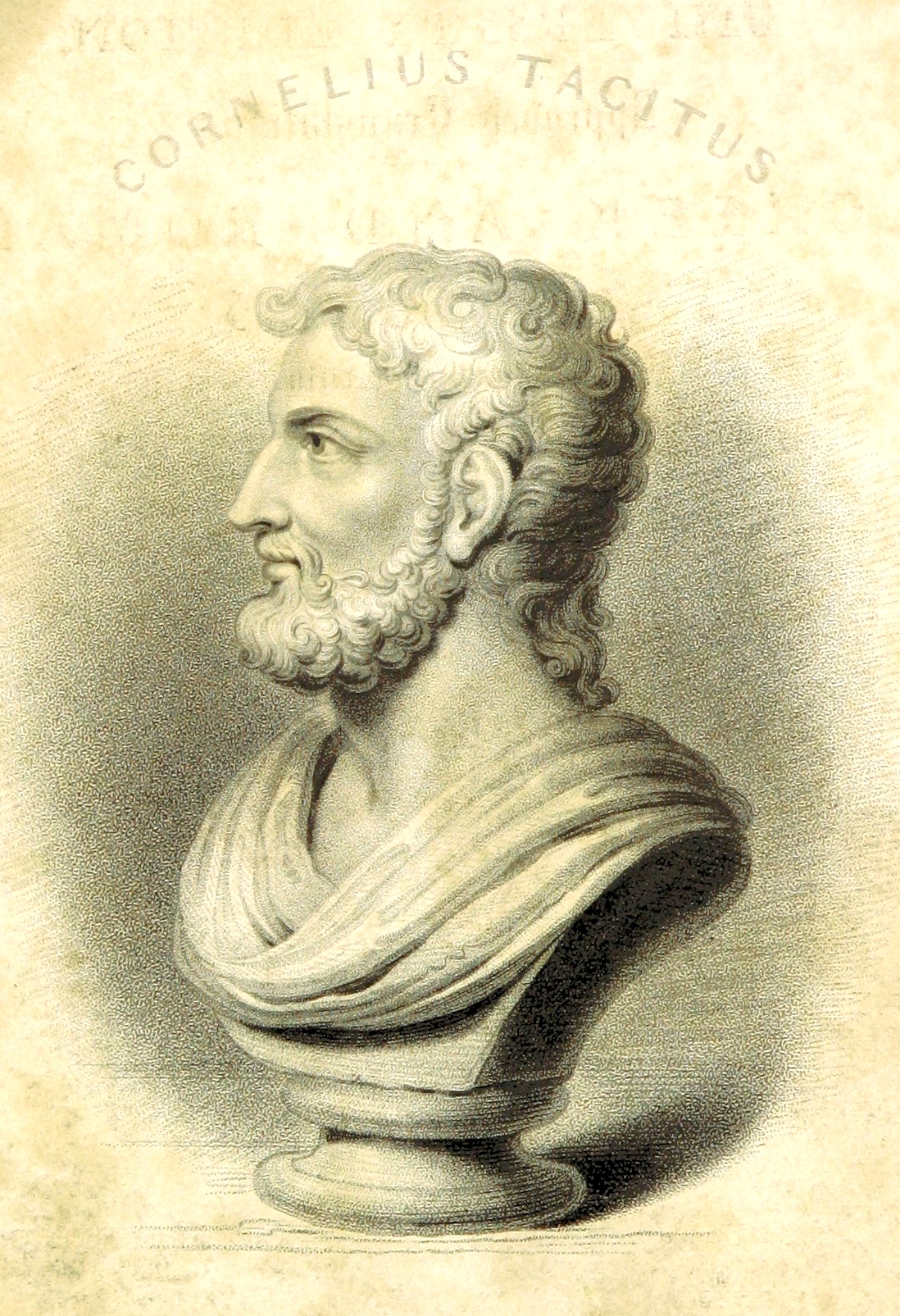
This image documents how the author's work was represented or transmitted. It is not presented as an exact portrait, autograph, or reference for a generated face. The caption distinguishes the date of the author from the date of the image.
 View full-size reference ⛶
Documentary comparison · not recorded as an image used to create the portrait
Engraving from an 1829 edition, not a contemporary portrait. It depicts the historian Cornelius Tacitus, not the homonymous emperor of the third century.
Engraving from an 1829 edition, not a contemporary portrait. It depicts the historian Cornelius Tacitus, not the homonymous emperor of the third century.
Contextual image · Contextual correspondence
S. Freeman according to a drawing by Brooke · translated edition by Arthur Murphy · British Library · Inventory: 9041.c.44 · página digital 8

Additional visual documentation
A cited publication does not establish which image was used to create the character.
Where it is held
British Library
Reference material evidence · Documented collection
Preserves the visual reference, not personal remains of the author. Public display may change.
The holding institution is documented; public display may change. Check its official record before visiting.
Sources and references
Did you enjoy this exhibit?
Your opinion helps us improve the museum. You can change it whenever you like.
Loading your rating…