
 English
 Español
 Français
 Italiano
 Deutsch
 Русский
 Português
 Polski
 Română
 Svenska
 Norsk bokmål
 Suomi
 Türkçe
 العربية
 简体中文
 한국어
 हिन्दी
 Ελληνικά
27 · CURIOSITY · CONTACT LINGUISTICS
Clicks and contact
How clicks entered some Bantu languages
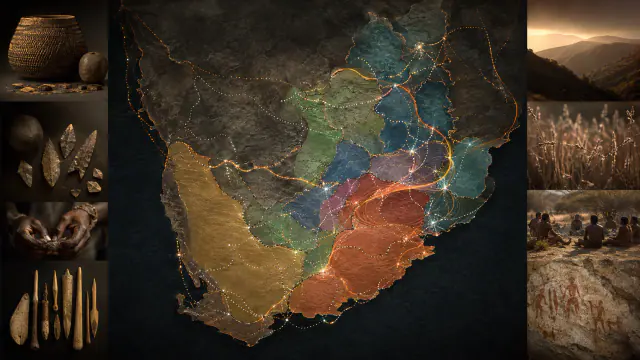
Some languages of southern Africa incorporated these sounds through contact with other communities.
Museum documentation · free public access, no account required.
Editorial visualisation · Contextual correspondence
Declared editorial visualisation, based on the cartography and sources of the fact sheet; it is not an exact historical frontier.
History and context
Several southern Bantu languages incorporated clicks through contact with Khoe, Kx’a and Tuu languages.
Studies combine linguistics and marriage patterns, but each language has a distinct history.
Evidence and interpretation
Linguistic contact is firmly supported; the exact social mechanisms remain regional inferences.
Catalogue facts
- Narrative date
- precolonial contacts with varying chronologies and subsequent continuity
- Location
- Southern Africa and the Kavango–Zambezi region
- Material
- Recordings, phonemes, vocabulary and historical/genetic data
- Context
- Borrowing, prestige and marriage
- Curatorial reading
- The documented fact and its interpretation appear separately in the evidence block.
- Dossier axis
- beliefs
- Research record
- BANTU · bantu-belief-clicks
- Documentary coverage
- 2 museum, heritage, primary corpus or research sources for this stop.
A SHARED TOPIC, DIFFERENT MOMENTS
Objects connected through time
Follow a topic across the collections. A shared tag is a way to compare objects, not proof that one culture influenced another.
The order uses the midpoint of each approximate date range; ranges can overlap. Spacing does not represent elapsed time. Swipe, scroll or use the arrows. With the sequence focused, use ← / →, Home or End.
THE CURRENT OBJECT
Its date is not sufficiently established to place it on the timeline. We keep it here, separate from the dated objects.
 You are viewing
precolonial contacts with varying chronologies and subsequent continuity
Clicks and contact
Bantu-speaking worlds
Contacts with varying chronologies; not the date of an individual object.
Current recordLanguages1 dated object
Also connected, without a comparable date (5)
These objects are not placed after the others: an unknown date does not mean a more recent object.
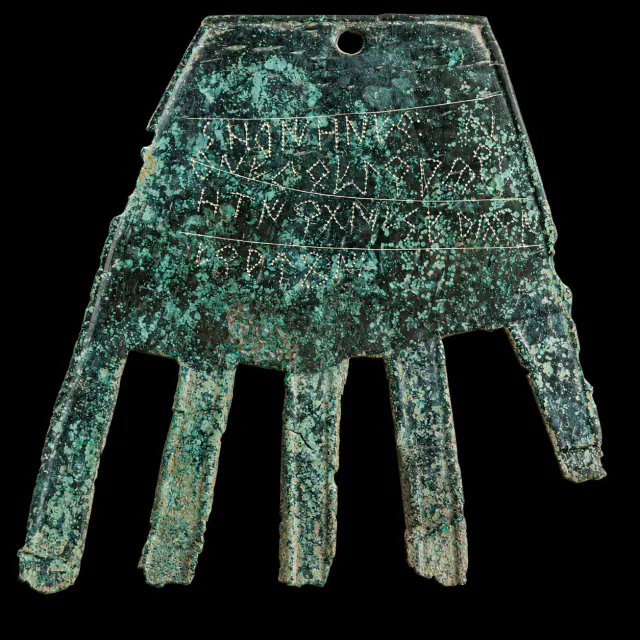
- 49 Classical VoicesIberians · Authors and traditions between the 6th century BCE and 4th century CE
- Ba-ntuBantu-speaking worlds · A long linguistic history; an academic term since the 19th century
- Before Bantu WorldsBantu-speaking worlds · Modern linguistic reconstruction on historical and living languages
- Indian Ocean KiswahiliBantu-speaking worlds · from the first millennium CE; major development in medieval and modern times
- Voices from outsideGaramantes · Fifth century BCE–Late Antiquity
A closer look
About 1 min to read · 1 section. Further reading and sources · free access. Editorial review recorded: .
Clicks can also be lost
The study by Pakendorf and colleagues compares northern and southern varieties of fwe. In the north, certain velar consonants systematically correspond to clicks conserved in the south. Since these velars do not always reproduce the consonants prior to the incorporation of clicks, the authors infer a later loss, not an original absence of contact. The example adds a direction to linguistic change: adopting a sound does not guarantee retaining it indefinitely. The current distribution is the result of incorporation, transmission and substitution, and needs to be reconstructed before being used as historical evidence.
Location and territory
REGIONAL AREA
Southern Africa and the Kavango–Zambezi regionCurrent maximum linguistic envelope and historical corridors; it was not a single political territory nor was it occupied simultaneously. The footprint indicates the indicative centre of the sphere, not a border or an exact point.Sources and references
Did you enjoy this exhibit?
Your opinion helps us improve the museum. You can change it whenever you like.
Loading your rating…