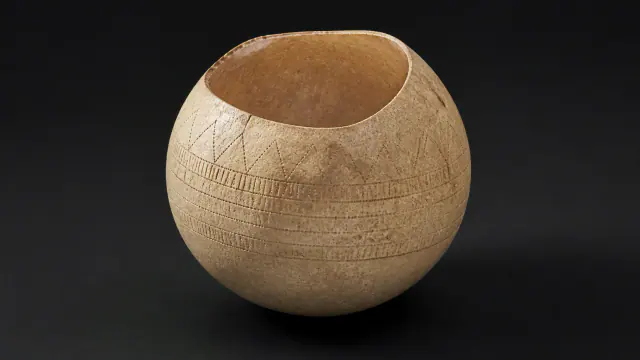
Declared visual reconstruction; not a photograph of the original nor documentary evidence.
History and context
A decorated ostrich-eggshell was transformed into a vessel for transporting or storing water.
The historical piece has a San attribution. Archaeologically similar vessels document technology, but do not suffice to identify a millennia-long ethnic continuity.
The British Museum record places the collection of the piece between 1816 and 1826 and identifies it as a San water vessel from South Africa. The shell offers volume with very little weight.
The incised decoration belongs to this specific historical object. Similar archaeological fragments may document technology, but do not automatically transfer their ethnic name to the remote past.
Evidence and interpretation
Material, collection chronology, attribution and inventory are documented; the relation to archaeological objects is comparative.
Documented expansion: Material, collection chronology, attribution and inventory are documented.
Expanded interpretation and caution: The relation to archaeological objects is comparative.
Catalogue facts
Narrative date
1816–1826
Location
South Africa
Material
Ostrich eggshell
Context
Historically identified vessel
Curatorial reading
The documented fact and its interpretation appear separately in the evidence block.
Inventory
British Museum Af1910,-.363
Collection
1816–1826
Documentary coverage
2 museum, heritage, primary corpus or research sources for this stop.
A SHARED TOPIC, DIFFERENT MOMENTS
Objects connected through time
Follow a topic across the collections. A shared tag is a way to compare objects, not proof that one culture influenced another.
The order uses the midpoint of each approximate date range; ranges can overlap. Spacing does not represent elapsed time. Swipe, scroll or use the arrows. With the sequence focused, use ← / →, Home or End.
About 1 min to read · 1 section. Further reading and sources · free access. Editorial review recorded: .
Incisions that became visible
The Af1910,-.363 vessel bears incised geometric designs highlighted with a black substance identified in the catalogue as ash or charcoal. The description measures a height of fifteen centimetres and records a fine crack beside the opening. The curatorial comment further notes a plug made of putty, a detail comparable to other old examples from the Griquatown area. Thus, recognising the egg alone is not enough: opening, addition and decoration show different operations that transformed a shell into a manageable and recognisable utensil.

 English
 Español
 Français
 Italiano
 Deutsch
 Русский
 Português
 Polski
 Română
 Svenska
 Norsk bokmål
 Suomi
 Türkçe
 العربية
 简体中文
 한국어
 हिन्दी
 Ελληνικά