
 English
 Español
 Français
 Italiano
 Deutsch
 Русский
 Português
 Polski
 Română
 Svenska
 Norsk bokmål
 Suomi
 Türkçe
 العربية
 简体中文
 한국어
 हिन्दी
 Ελληνικά
AFRICA · LINGUISTIC FAMILY · CULTURAL AND POLITICAL NETWORKS
Mande Worlds
Mandé worlds of the Upper Niger and West Africa
Mande oral traditions transmit stories of people, journeys and kingdoms of West Africa.
Museum documentation · free public access, no account required.
Generated reconstruction · Declared visual hypothesis
THRESHOLD BETWEEN PERIODS; NOT DIRECT ETHNIC GENEALOGY
Why this doorway leads to another museum
Mande brings together related languages and societies, not an eternal political identity. The museum connects the archaeology of early cities, gold and iron, the expansion of Mali, manuscripts, epics and memory keepers without forcing a uniform continuity.
Control of corridors between southern gold, Saharan salt and the Niger allowed power to be concentrated, but markets, villages, specialists and memories survived each specific capital. Mande societies participated in Sahelian and trans-Saharan networks with Amazigh communities, Islamic cities, Akan and forest peoples, Songhai states and, later, Atlantic traders. This circulation did not turn that diversity into a single block.
Period covered by the destination museum: 1st millennium BCE–present · cities, empires and oral memory
BEFORE YOU ENTER
An introduction to Mandé worlds
Find your place in time, explore the changes and choose where to go next.
- When
- 1st millennium BCE–present · cities, empires and oral memory · AFRICA
- Where
- Upper Niger, Manden region, and corridors between savanna, Sahel and forests of West Africa.
- What this collection brings together
- Language family · cultural and political networks
Mande brings together related languages and societies, not an eternal political identity. The museum connects the archaeology of early cities, gold and iron, the expansion of Mali, manuscripts, epics and memory keepers without forcing a uniform continuity.
Control of corridors between southern gold, Saharan salt and the Niger allowed power to concentrate, but markets, villages, specialists and memories survived each specific capital.
PLACE MATTERS
Territory and connections
Upper Niger, Manden region, and corridors between savanna, Sahel and forests of West Africa. Networks of language, trade, kinship, specialists and power connected with Ghana/Wagadu, Mali and later formations; their boundaries and affiliations varied by period.
A HISTORY OF CHANGE
The main periods
Dates are approximate. Periods help us navigate the past, but their boundaries were not always the same in every region.
c. 1000 BCE–250 BCE
Villages, iron and the Upper Niger
Agricultural and metallurgical communities occupy savannas and riverbanks before the known empires; language and identity are not automatically deduced from pottery.
c. 250 BCE–800 CE
Jenne-jeno and urbanism without a palace
Jenne-jeno grows within a constellation of specialised settlements. Urban density does not require a central king or a single ethnicity.
c. 800–1230 CE
Wagadu and the so-called Ghana Empire
A Soninke-core formation controls and taxes routes between gold, salt and Saharan cities. It does not encompass all Mande societies nor draw a stable border.
c. 1230–1312 CE
Manden and the formation of Mali
The coalition remembered around Sunjata reorganises Manden and absorbs parts of Wagadu. Oral tradition, chronicles and archaeology preserve different scales.
Continue the story: 3 more periods
1312–1337 CE
Mali under Mansa Musa
Mansa Musa’s pilgrimage makes a vast empire visible within Islamic networks. The map distinguishes core, provinces and connected cities to avoid a uniform blot.
c. 1400–1600 CE
Mali’s contraction and successor powers
Mali’s authority recedes while Songhay dominates the Middle Niger and regional polities maintain Mande networks. Conquest does not equate to cultural disappearance.
17th–21st centuries
Mande Worlds and diasporas
Jula, Bamanan, Maninka, Soninke and other communities transform languages, trade, Islam, music and memory between modern states and diasporas.
BEYOND THE DATES
How people lived and saw the world
How they were organised
Ghana/Wagadu and Mali were systems of relationship before they were stable polygons. Titles, tribute, alliances, kinship, reputation and force connected cores with partners who retained variable autonomy.
Uncertainty about Kumbi Saleh, Niani and other royal cities is a historical conclusion: it requires abandoning the idea of an eternal capital and studying how a court moved.
What daily life was like
The flood, sowing, fishing, herding, house repair and food preparation ordered time and relationships far beyond the court.
Recent objects such as a hunter’s tunic preserve biographies of use and power, but must not become generic medieval costume.
What they knew how to do
Early pottery, iron, structural earth and gold processing turn the museum into a history of situated technical decisions.
Knowledge does not reside only in the product: selecting clay, controlling fire, raising earth and renewing surfaces are collective chains.
- UNESCO World Heritage Centre — Old Towns of Djenné
- UNESCO — Urban Heritage Atlas: Djenné
- Université de Genève, Archive ouverte — First emergence of ceramic production in Africa: Ounjougou
- Antiquity / Cambridge University Press — New light on the early Islamic West African gold trade: coin moulds from Tadmekka, Mali
What they believed
Islam expanded through merchants, scholars, courts and communities, intertwining with local authorities and practices.
Bida, Kurukan Fuga and houses of words are living moral archives; their value does not depend on converting them into literal minutes of medieval events.
- Boston University African Studies Center — Kingdom of Ghana: al-Bakri, eleventh century
- UNESCO Intangible Cultural Heritage — Manden Charter, proclaimed in Kurukan Fuga
- UNESCO Intangible Cultural Heritage — Cultural space of Sosso-Bala
- UNESCO Intangible Cultural Heritage — Septennial re-roofing ceremony of the Kamablon, sacred house of Kangaba
- UNESCO Intangible Cultural Heritage — Kankurang, Manding initiatory rite
Who they interacted with
Caravans, river navigation and markets connected producers of gold, salt, food, copper, textiles, horses and kola through many intermediaries.
Tadmekka offers a material trace of gold; Cairo and the Catalan Atlas show how Mali’s reputation travelled further than most of its inhabitants.
- UCL Discovery — The Empire of Mali — accepted manuscript
- Boston University African Studies Center — Kingdom of Mali: al-Umari on Mansa Musa
- Antiquity / Cambridge University Press — New light on the early Islamic West African gold trade: coin moulds from Tadmekka, Mali
- The Block Museum of Art · Northwestern University — Caravans of Gold, Fragments in Time: Art, Culture, and Exchange across Medieval Saharan Africa
- BnF Essentiels — L’Atlas catalan
Art, music and storytelling
Kora, m’bolon, bala, ngoni, song, praise and dance belong to specific occasions and custodianships, not to an atemporal African soundtrack.
Museum-displayed terracottas and garments hold gaps in provenance or reserved knowledge; beauty does not eliminate those obligations.
- UNESCO Intangible Cultural Heritage — Cultural space of Sosso-Bala
- UNESCO Intangible Cultural Heritage — Cultural practices and expressions linked to the m’bolon
- The Met — Seated Figure, Inland Niger Delta
- The Met — Kora, Mandinka peoples
- Smithsonian Folkways Recordings — Badenya: Manden Jaliya in New York City
- UNESCO Intangible Cultural Heritage — Coming forth of the masks and puppets in Markala
PEOPLE AND TESTIMONIES
Meet the people
The records distinguish historical figures, representations and reconstructions. They explain their context, the available sources and their connections with other people.
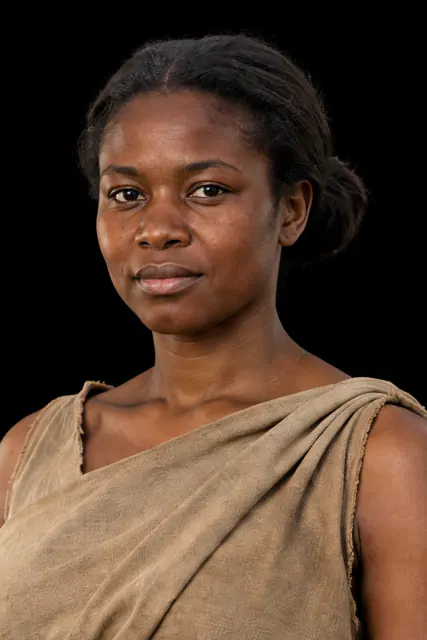
Person of Djenné-jeno
A life in the Middle Niger, many centuries before the Mali Empire.
Read the recordLOOK CLOSER
Objects and places to start with
A selection from the destination museum. Open each record to explore its documentation and images.
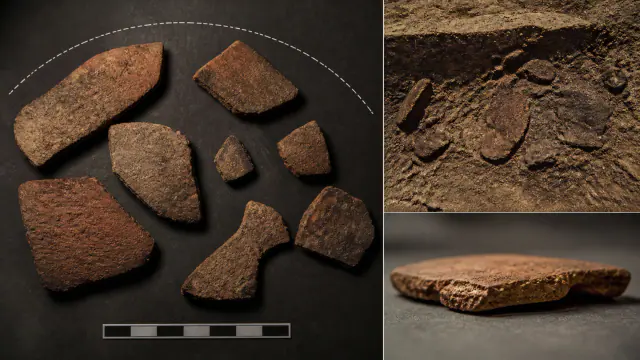
Early pottery
These fragments are one of the early pieces of evidence for pottery making in Africa.
Read the record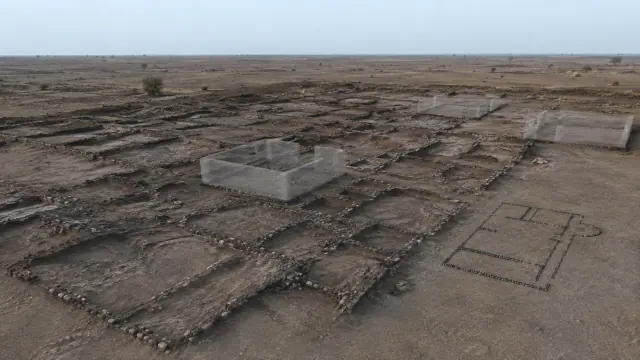
Kumbi Saleh
The city was important in the western Sahel and is a possible capital of Ghana, although that identification remains open.
Read the record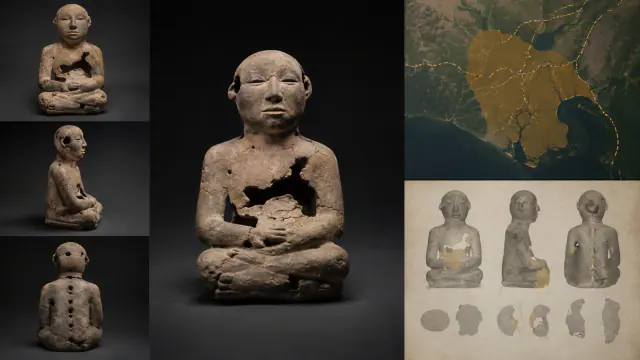
Seated figure
The figure’s posture admits different interpretations; we do not know with certainty who it represents or what it intended to express.
Read the record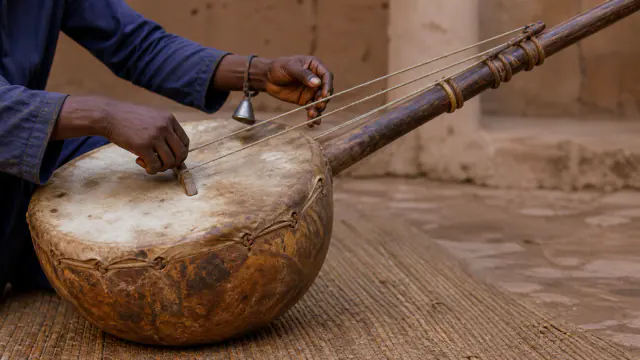
Living m’bolon
This instrument accompanies praise, heroic tales, agricultural work and other occasions, with uses that vary by place.
Read the recordWHAT REMAINS
Its legacy and ongoing research
Mande languages, musical practices, oral archives, manuscripts, associations and memories of the empire remain active. The Sunjata epic has living versions and authorities: it is not a literal transcription from the thirteenth century.
CHOOSE YOUR NEXT STOP
Inside this museum
Sources for this introduction
Each theme links to its documentation. The full bibliography also brings together sources for the chronology, the people and the connection between the museums.
View all sources and references →Evidence and interpretation
This window distinguishes the documented core from its historical reach: Upper Niger, the Manden region and corridors between the savannah, Sahel and forests of West Africa. The label “Mande worlds” summarises a changing trajectory, not an immobile population or a universal stage of progress.
Catalogue facts
- Narrative date
- 1st millennium BCE–present · cities, empires and oral memory
- Location
- Upper Niger, Manden region, and corridors between savanna, Sahel and forests of West Africa.
- Type of entity
- Language family · cultural and political networks
- Scope
- Networks of language, trade, kinship, specialists and power connected with Ghana/Wagadu, Mali and later formations; their boundaries and affiliations varied by period.
- Key innovation
- Early urbanism and specialised production in the Inner Niger Delta
- Legacy
- Mande languages, musical practices, oral archives, manuscripts, associations and memories of the empire remain active. The Sunjata epic has living versions and authorities: it is not a literal transcription from the thirteenth century.
A closer look
About 1 min to read · 1 section. Further reading and sources · free access. Editorial review recorded: .
A seated figure opens an urban history
A thirteenth-century terracotta from the Inner Niger Delta shows a hunched body, with the head resting on the knee and reliefs on the back. The Metropolitan Museum places it in a tradition that also produced vessels, worked iron and brass items. The gesture appears intimate, but we do not know with certainty its original meaning. This comparison invites entering Mande worlds through artistic production and urban life, not just kings and gold. The regional provenance also does not authorise assigning a precise linguistic identity to an anonymous sculptor.
Location and territory
REGIONAL AREA
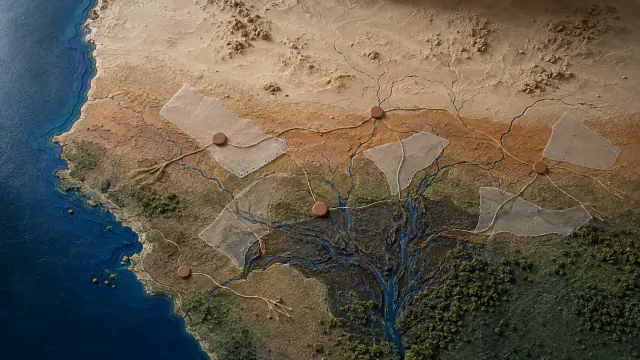
Upper Niger, Manden region, and corridors between savanna, Sahel and forests of West Africa.Linguistic, commercial and political spheres of West Africa; does not equate to a continuous imperial border. The marker indicates the indicative centre of the sphere, not a border or an exact point.Cultural connections
Sources and references
- Oxford Research Encyclopedia / UCL Discovery — The Empire of Mali
- UNESCO World Heritage Centre — Old Towns of Djenné
- UNESCO Intangible Cultural Heritage — Cultural space of Sosso-Bala
- The Met — Seated Figure, Inland Niger Delta
- Université de Genève, Archive ouverte — First emergence of ceramic production in Africa: Ounjougou
- UCL · Tracing history in Dia
- UNESCO — Urban Heritage Atlas: Djenné
- Oxford University Press — Empire of Ghana
- Boston University African Studies Center — Kingdom of Ghana: al-Bakri, eleventh century
- UNESCO · Archaeological site of Kumbi Saleh
- British Academy · Searching for Sunjata
- UNESCO · Historic and Cultural Sites of Manden
- Boston University African Studies Center — Kingdom of Mali: al-Umari on Mansa Musa
- BnF Essentiels — L’Atlas catalan
- UNESCO · Tomb of Askia
- UNESCO · Timbuktu
- Glottolog · Mande language family
- Oxford Research Encyclopedia · Mande Languages
- UNESCO Intangible Cultural Heritage — Kankurang, Manding initiatory rite
- UCL Discovery — The Empire of Mali — accepted manuscript
- The Met — Hunter’s Shirt, Mande peoples
- Antiquity / Cambridge University Press — New light on the early Islamic West African gold trade: coin moulds from Tadmekka, Mali
- UNESCO Intangible Cultural Heritage — Manden Charter, proclaimed in Kurukan Fuga
- UNESCO Intangible Cultural Heritage — Septennial re-roofing ceremony of the Kamablon, sacred house of Kangaba
- The Block Museum of Art · Northwestern University — Caravans of Gold, Fragments in Time: Art, Culture, and Exchange across Medieval Saharan Africa
- UNESCO Intangible Cultural Heritage — Cultural practices and expressions linked to the m’bolon
- The Met — Kora, Mandinka peoples
- Smithsonian Folkways Recordings — Badenya: Manden Jaliya in New York City
- UNESCO Intangible Cultural Heritage — Coming forth of the masks and puppets in Markala
- McIntosh (ed., 1995), Excavations at Jenné-Jeno, Hambarketolo, and Kaniana, pp. 52–54, 60–61, 67–68 and 356–357; F49, LX-S; text of the primary report
- Yale eHRAF, monograph and phase chronology record
- Smithsonian Libraries, excavation monograph record
YOUR NEXT VISIT
Explore Mande Worlds
The same collection, two ways to explore. Choose the experience that suits you.
Did you enjoy this exhibit?
Your opinion helps us improve the museum. You can change it whenever you like.
Loading your rating…