
 English
 Español
 Français
 Italiano
 Deutsch
 Русский
 Português
 Polski
 Română
 Svenska
 Norsk bokmål
 Suomi
 Türkçe
 العربية
 简体中文
 한국어
 हिन्दी
 Ελληνικά
SCULPTURE · CONTESTANIA
Lady of Elche
The Face That Changed Meaning
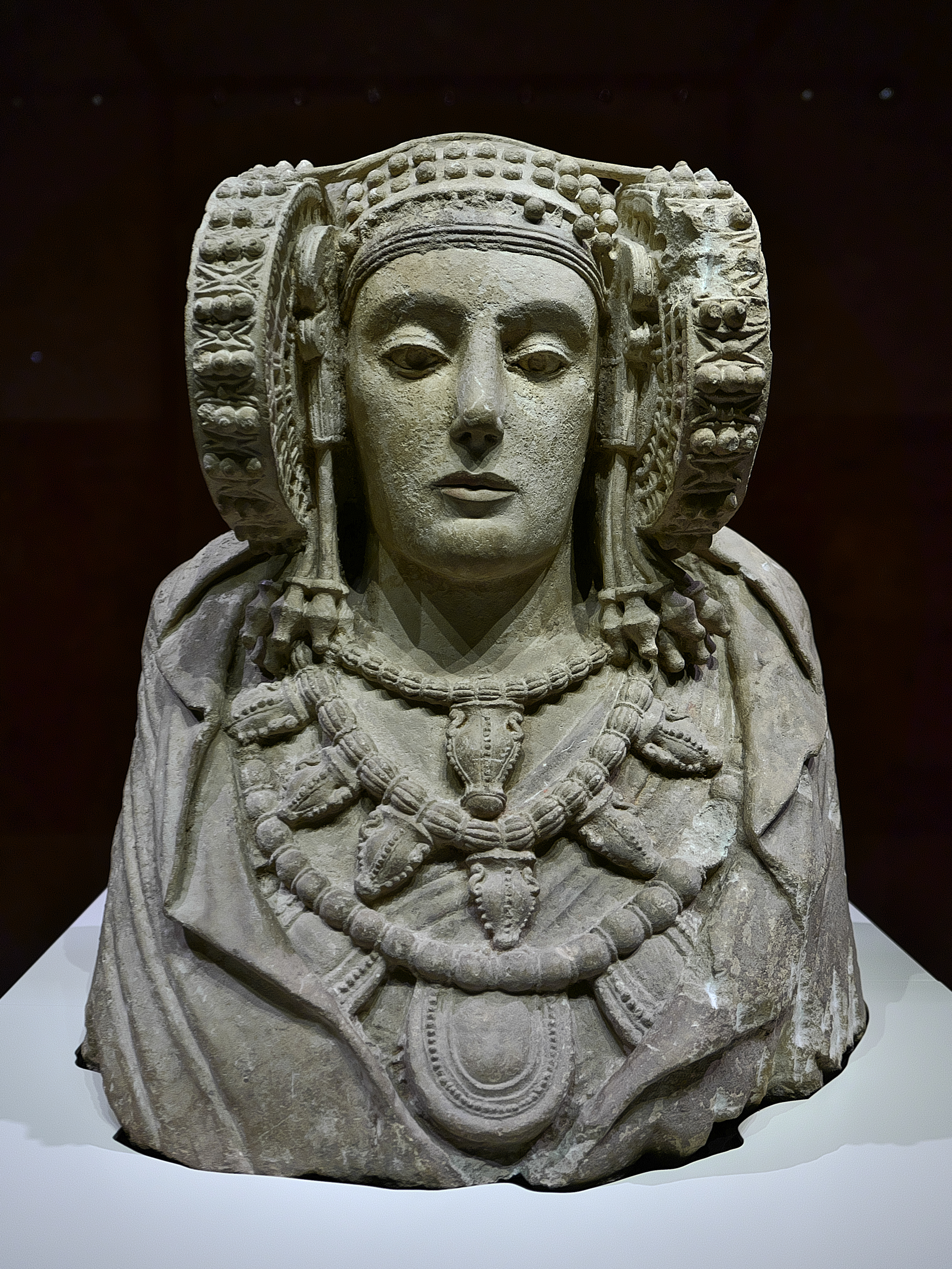
Her headdress, her jewellery and the hollow at the back help investigate why this sculpture was made.
Museum documentation · free public access, no account required.
Documentary original · Exact correspondence
Documentary photograph of the original or the exact site.
José Luis Filpo Cabana · Own work · Inventory: Dama de Elche, La Alcudia (Ilici) · CC BY 3.0
History and context
The Lady retains traces of polychromy and a rear cavity. Her elaborate headdress, jewellery and mantle construct a presence of exceptional rank; we do not see everyday fashion, but a carefully coded image for a context that the 1897 excavation documented incompletely.
For over a century she has been called priestess, aristocrat or goddess. The cavity may have received cremated remains, as demonstrably occurs in the Lady of Baza, but its concrete use continues to be debated. Her modern celebrity also forms part of her biography.
Evidence and interpretation
Documented fact: limestone, residual polychromy, approximate chronology, rear cavity and modern history of the piece are studied. Interpretation and caution: the identity of the represented figure, her original function and the exact funerary reading are not settled.
Catalogue facts
- Narrative date
- Late 5th–4th centuries BCE
- Location
- La Alcudia, Elche (Alicante)
- Material
- Polychrome limestone
- Context
- Findspot without complete modern archaeological context
- Classification
- Iberian collection or explicit interpretive resource
- Visual reference
- National Archaeological Museum · Lady of Elche · visual and provenance reference
A closer look
About 1 min to read · 1 section. Further reading and sources · free access. Editorial review recorded: .
Preserving the surface is preserving historical information
The technical report published by Cultura in 2023 identifies salts, loss of polychromy and areas where the surface separates from the stone support. The risk is not limited to visible breakage: an environmental change can activate dissolution and crystallisation cycles that detach material. For this reason monitoring uses fixed analysis points and not only general photographs. Keeping the sculpture stable protects pigments and associated remains that new techniques may study. The solid appearance of the stone must not be confused with simple conservation nor with the possibility of moving it without consequences.
Reference images and provenance
You can enlarge the documentary photograph of the piece related to this figure. It is not listed as an input of a generated portrait. The identification of the figure, when discussed, is explained in the file.
 View full-size reference ⛶
Documentary photograph of the reference object
This photograph is the registered source of the documentary image currently displayed; it is not presented as an input photograph for another generated portrait.
This photograph is the registered source of the documentary image currently displayed; it is not presented as an input photograph for another generated portrait.
Documentary original · Contextual correspondence
José Luis Filpo Cabana

Additional visual documentation
A cited publication does not establish which image was used to create the character.
Location and territory
LOCATED SITE
La Alcudia of Elche · AlicanteMarker of the Ilici site.Where it is held
Museo Arqueológico Nacional (Madrid)
Item or group in the record · Permanent exhibition
Room 13 · display case 13.1.
The holding institution is documented; public display may change. Check its official record before visiting.
Sources and references
Did you enjoy this exhibit?
Your opinion helps us improve the museum. You can change it whenever you like.
Loading your rating…