
 English
 Español
 Français
 Italiano
 Deutsch
 Русский
 Português
 Polski
 Română
 Svenska
 Norsk bokmål
 Suomi
 Türkçe
 العربية
 简体中文
 한국어
 हिन्दी
 Ελληνικά
NECROPOLIS · CABEZO LUCERO
Lady of Guardamar
A destroyed image within a funerary landscape
This sculpture appeared fragmented in an Iberian necropolis.
Museum documentation · free public access, no account required.
Documentary original · Exact correspondence
Documentary photograph of the original or the exact site.
José Luis Filpo Cabana · Own work · Inventory: La Dama de Cabezo Lucero (Yacimiento arqueológico de Cabezo Lucero) · CC BY-SA 4.0
History and context
The necropolis allows reconstructing a death sequence: transfer, pyre, bone collection and selection, urn, grave goods and monuments with protective animals. Not all steps were repeated identically in all tombs, but the archaeological landscape makes visible the collective work of the funeral.
The Lady appeared in numerous fragments excavated in 1987. She had been destroyed in Iberian times and some broken sculptures from the site were reused as urn supports, a material biography that speaks of changes in memory and authority.
Modern restoration joins compatible fragment groups, although the incomplete rear part prevents confirming that it had a funerary cavity.
Evidence and interpretation
Documented fact: provenance, dating, ancient fragmentation and restoration of the sculpture. Interpretation and caution: identity, divine or aristocratic condition and exact funerary function are not settled.
Catalogue facts
- Narrative date
- Late 5th–early 4th centuries BCE
- Location
- Necropolis of Cabezo Lucero, Guardamar del Segura (Alicante)
- Material
- Sandstone
- Context
- Destroyed and reconstructed funerary sculpture
- Classification
- Iberian collection or explicit interpretive resource
- Visual reference
- Frontal photograph and original fragments in the MARQ catalogue
A closer look
About 1 min to read · 1 section. Further reading and sources · free access. Editorial review recorded: .
Two groups of fragments support a reconstruction
The MARQ explains that the head and the necklace set do not touch in the reconstruction. Their association is supported by the similarity of stone, carving and place of discovery. It is a good example of how a restitution is argued without concealing the losses. The sculpture distinguishes tongue-shaped pendants and beads of various forms, interpreted as metal and glass paste models. We do not see those original materials, but their translation into sandstone. The reconstruction allows reading the adornment, but does not automatically recover the entire body posture.
- Museum · MARQ · Lady of Cabezo LuceroAccess recorded: .
Reference images and provenance
You can enlarge the documentary photograph of the piece related to this figure. It is not listed as an input of a generated portrait. The identification of the figure, when discussed, is explained in the file.
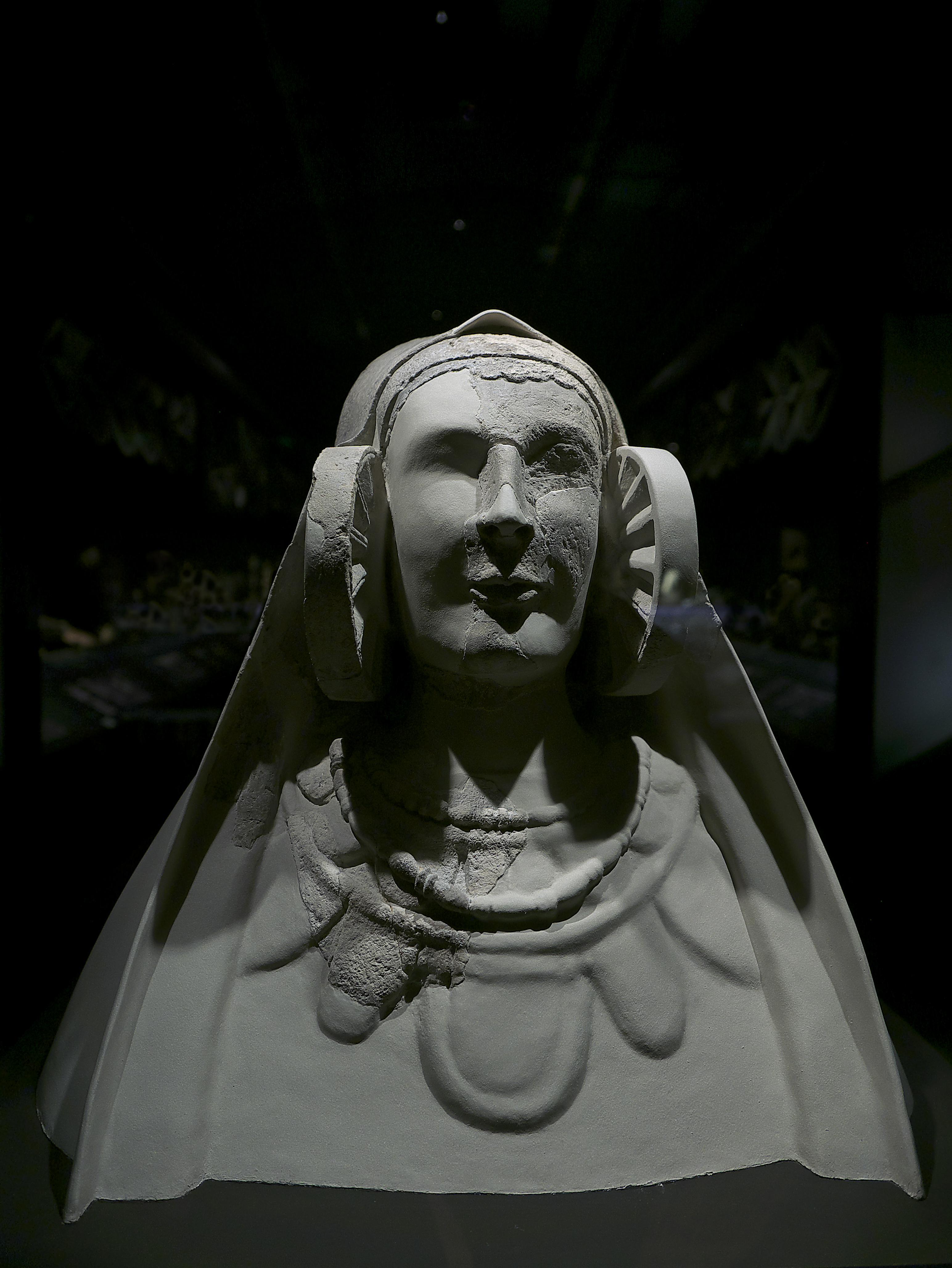 View full-size reference ⛶
Documentary photograph of the reference object
This photograph is the registered source of the documentary image currently displayed; it is not presented as an input photograph for another generated portrait.
This photograph is the registered source of the documentary image currently displayed; it is not presented as an input photograph for another generated portrait.
Documentary original · Contextual correspondence
José Luis Filpo Cabana

Additional visual documentation
A cited publication does not establish which image was used to create the character.
Where it is held
MARQ · Archaeological Museum of Alicante
Item or group in the record · Permanent exhibition
Central piece of the permanent Iberians room.
The holding institution is documented; public display may change. Check its official record before visiting.
Sources and references
Did you enjoy this exhibit?
Your opinion helps us improve the museum. You can change it whenever you like.
Loading your rating…