
 English
 Español
 Français
 Italiano
 Deutsch
 Русский
 Português
 Polski
 Română
 Svenska
 Norsk bokmål
 Suomi
 Türkçe
 العربية
 简体中文
 한국어
 हिन्दी
 Ελληνικά
CONNECTION, NOT IBERIAN PIECE · OPPIDUM AND IBERO-ROMAN CITY
Cástulo
An indigenous city that Rome did not find empty
Cástulo was an important city before Rome and continued to change under its rule.
Museum documentation · free public access, no account required.
Reconstruction · Declared visual hypothesis
AI-generated visual hypothesis of a stretch of Iberian defence at Cástulo before the republican remodelling, based on the masonry and adobe documented by the excavation of the north wall in 2013. The absolute date, geometry of the salient, heights and finishes are not established: this image does not represent an exact plan of the city nor restitute the walls without the phase of the reference photograph. Ground and materials reference: Ángel M. Felicísimo, CC BY 2.0.
OpenAI ImageGen; accredited photographic references separately · CC BY 2.0
History and context
Cástulo controlled a territory of the Upper Guadalquivir connected to Sierra Morena, its minerals and corridors towards the Meseta. The occupation sequence is very long and the Iberian funerary world shows practices that continue until the 1st century CE.
Rome took advantage of a prior centrality, but introduced taxation, institutions, architecture and new hierarchies. The category ‘ibero-roman’ allows studying the overlap without presenting the Roman city as a simple copy of the oppidum.
Comparing Cástulo with Ullastret or Edeta avoids a universal law: some cities were transformed over indigenous centralities; others were abandoned, relocated or lost control of the territory.
Evidence and interpretation
Documented fact: archaeological sequence, territorial position, necropolis and ibero-roman city protected as BIC. Interpretation and caution: continuity of the place does not equal continuity without conflict of population, institutions or identity.
Catalogue facts
- Narrative date
- Iberian horizon–Roman period, with long preceding and subsequent sequence
- Location
- Cástulo, Linares (Jaén)
- Material
- Urban landscape, walls, necropolis and materials
- Context
- Transformation of Oretan capital into Roman city
- Classification
- Comparative connection · must not be presented as an Iberian piece
- Visual reference
- Aerial view, wall and republican gate of the Cástulo Archaeological Ensemble
A closer look
About 1 min to read · 1 section. Further reading and sources · free access. Editorial review recorded: .
The city continued beyond the walled enclosure
The patrimonial delimitation of Cástulo of 2012 incorporated research that expanded the view from the urban core towards an extensive suburban zone. Prospections documented places with different functions and dates, especially linked to the river and the city. This change of scale allows studying a political centre as part of an inhabited territory, not as an isolated monument. It also obliges separating chronologies: the long sequence of the area does not mean that all its settlements, roads and necropolises functioned simultaneously during the Iberian stage.
Reference images and provenance
 View full-size photograph ⛶
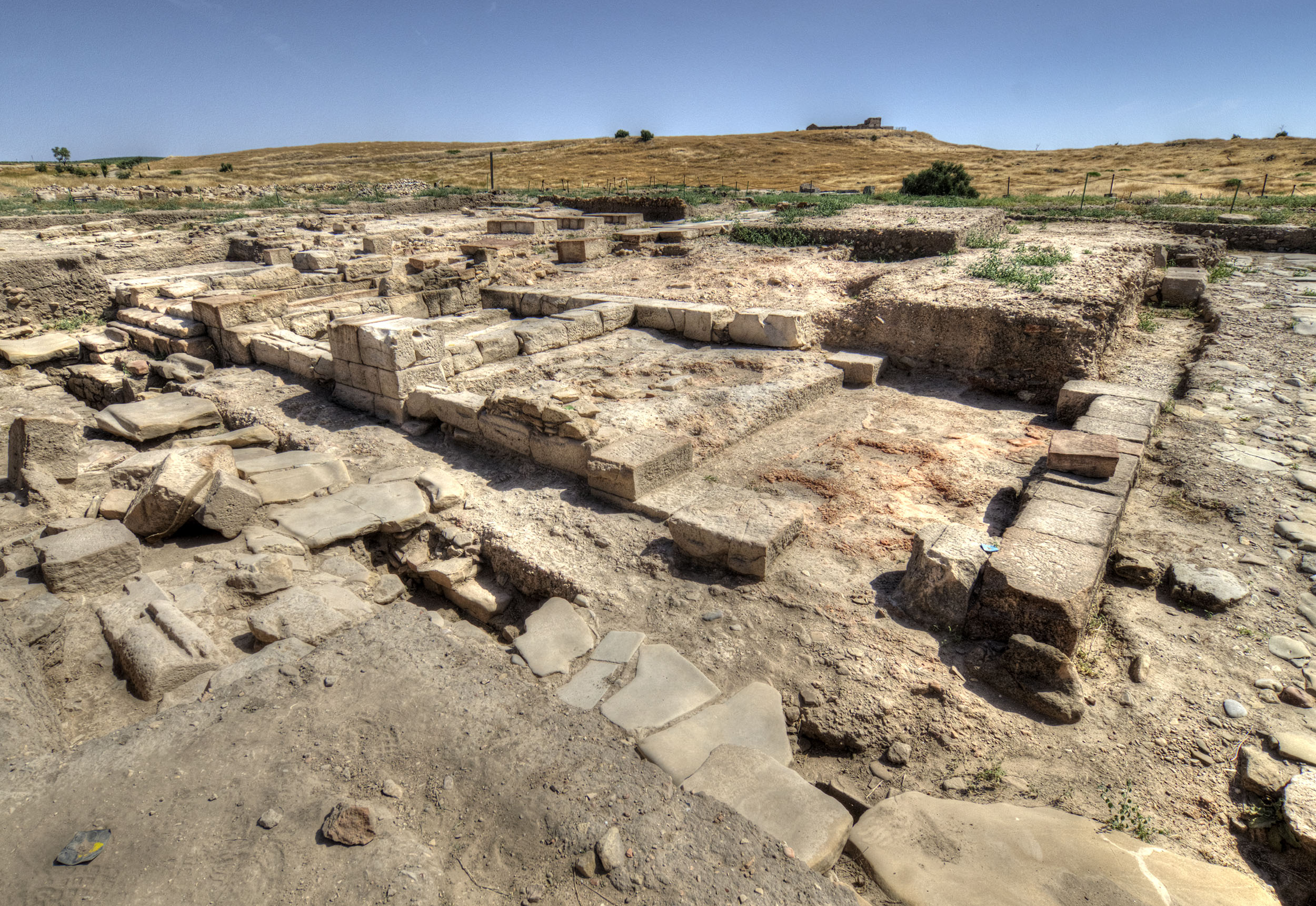
Photograph by Ángel M. Felicísimo of an excavated area of Cástulo, taken on 2 August 2018. The author does not identify the phase of each wall; the ensemble is not presented as exclusively Iberian architecture nor as a reconstruction of the city before Rome. Only format conversion and web reduction; no reconstruction by AI.
Documentary original · Exact correspondence
Ángel M. Felicísimo

Location and territory
LOCATED SITE
Cástulo · JaénMarker of the oppidum and historic city.Sources and references
Did you enjoy this exhibit?
Your opinion helps us improve the museum. You can change it whenever you like.
Loading your rating…